
HP HPE0-J68 Practice Exams
Last updated on Oct 23,2026- Exam Code: HPE0-J68
- Exam Name: HPE Storage Solutions
- Certification Provider: HP
- Latest update: Oct 23,2026
What is the benefits of HPE synergy (Select 2)
- A . It can present block storage services from HPE 3par as part of the resource pool
- B . It support up to 3 HPE store Virtual VSA nodes for storage RAID
- C . It can use HPE 3PAR file persona for objet storage
- D . It can compose and reclaim DAS storage
- E . It support HPE blade system C-Class Flex Fabrics Interconnect module (need to check)
A,D
Explanation:
HPE Synergy is a composable infrastructure solution that provides flexibility and scalability for data centers.
The benefits include:
Block Storage Services from HPE 3PAR: HPE Synergy can integrate with HPE 3PAR storage to present block storage services as part of its resource pool. This allows for a more unified and efficient management of storage resources across the infrastructure.
Composing and Reclaiming DAS Storage: HPE Synergy allows administrators to compose and reclaim direct-attached storage (DAS) as needed, optimizing the use of available storage resources and improving overall efficiency.
These features make HPE Synergy a powerful solution for modern data centers that require flexible, scalable, and efficient infrastructure management.
Reference: HPE Synergy Overview
HPE 3PAR and Synergy Integration
You are installing an HPE 3PAR StoreServ solution and need to integrate the array with the 3rd party monitoring application customer is using.
Which technology can be configured at 3PAR to support forwarding events from the array to the customer’s monitoring application?
- A . IPMI
- B . NTP
- C . SNMPv3
- D . DMI
C
Explanation:
To integrate an HPE 3PAR StoreServ array with a third-party monitoring application, SNMPv3 (Simple Network Management Protocol version 3) can be configured. SNMPv3 is a protocol that supports the forwarding of events from the array to external monitoring tools. It is a secure and standardized method for managing and monitoring network devices, including storage arrays like HPE 3PAR StoreServ.
Reference: HPE 3PAR StoreServ Management
HPE 3PAR SNMP Configuration
Recommend a software stack for changing a backup platform that includes pay-per-use, supports backup of virtualized workloads provided by HPE GreenLake, offers low RPO in minutes, supports HPE AUetra 9000, and integrates with DSCC.
- A . Veeam Backup and Recovery
- B . Recovery Manager Central
- C . Zerto
- D . HPE GreenLake Backup and Recovery
D
Explanation:
HPE GreenLake Backup and Recovery is the recommended software stack for a backup platform that includes a pay-per-use model, supports virtualized workloads, and integrates with the HPE Data Services Cloud Console (DSCC). This solution offers low Recovery Point Objectives (RPOs) in minutes, supports HPE Alletra 9000, and provides the flexibility and scalability needed for modern backup environments. It is part of the HPE GreenLake ecosystem, which provides cloud-like agility and economics with on-premises control.
Reference: HPE GreenLake Backup and Recovery
HPE Alletra 9000 Integration
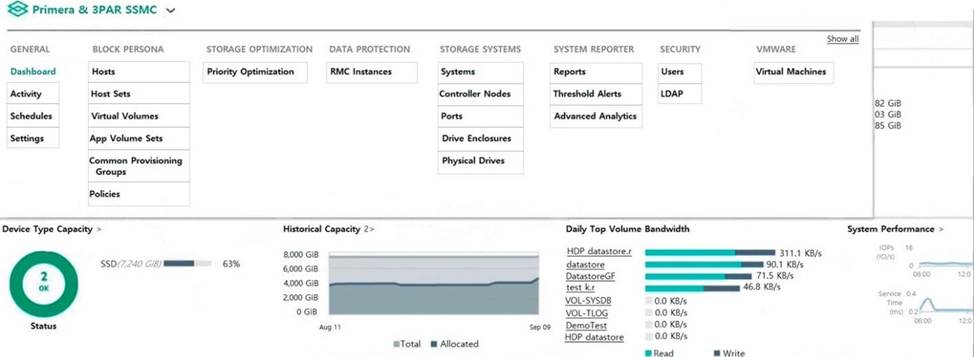
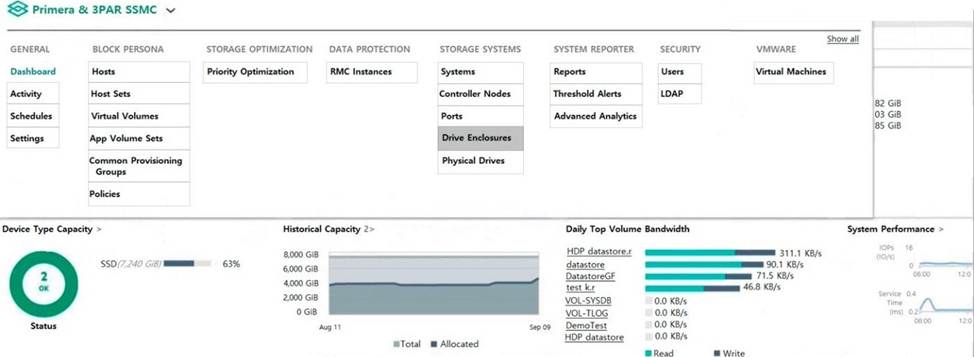
HOTSPOT
You are configuring a new HPE 3PAR solution and need to create a new disk group with a defined RAID level.
Click the appropriate option where the RAID can be selected.
A large organization is experiencing exponential data growth of object storage due to recent mergers and acquisition. They need an on-premise solution to optimize cost at petabyte scale.
Which components should you recommend for a software-defined solution? (select two)
- A . HPE Appolo 4510 server
- B . HPE Complete CScalability RING
- C . HPE Synergy 660 Gen10 compute modules
- D . HPE complete CCTERA
- E . HPE 3PAR Storeserv 9450c
A,B
Explanation:
For a large organization experiencing exponential data growth in object storage, particularly at a petabyte scale, a software-defined solution is recommended. The components to consider are: HPE Apollo 4510 Server: The Apollo 4510 is designed for massive storage capacities, making it ideal for handling large-scale data storage needs in an efficient manner.
HPE Complete C Scalability RING: The Scalability RING is a software-defined storage solution that provides scalable object storage capabilities. It is well-suited for environments that require on-premise solutions to optimize costs at petabyte scales.
These components provide the necessary infrastructure to manage large volumes of object storage
efficiently and cost-effectively.
Reference: HPE Apollo 4000 Systems
HPE Complete C Scalability RING
Which tool or feature should you use for setting up health issue alerts for B-Series SAN Switches?
- A . NetEdit NAE
- B . Web Tools
- C . Nexus Dashboard Fabric Controller
- D . SANnav MAPS
Which low-latency protocol should you recommend for a local flash-based drive connected directly to PCIe. eliminating the performance penalty of an array controller?
- A . SATA
- B . SAS
- C . FATA
- D . NVMe
D
Explanation:
NVMe (Non-Volatile Memory Express) is the protocol you should recommend for local flash-based drives connected directly to PCIe. NVMe is designed specifically for high-performance SSDs and offers low-latency access by eliminating the overhead associated with traditional storage protocols like SATA and SAS. By bypassing the array controller and connecting directly to the PCIe bus, NVMe significantly reduces latency, providing much faster data access and improving overall system performance.
Reference: HPE NVMe Solutions
HPE High-Performance Storage
What performance benefit is provided by using the HPE StoreVirtual DSM for Microsoft MPIO instead of the standard MPIO?
- A . The HPE DSM increases availability and reduces latency and throughput.
- B . The storage system, which holds a copy of the requested data, services the read I/Os.
- C . The iSCSI connections are blocked to non-critical nodes in the cluster by default.
- D . The storage system, which receives a copy of the data, does not service the write I/O.
B
Explanation:
HPE StoreVirtual DSM for Microsoft MPIO (Multi-Path Input Output) enhances performance by ensuring that the storage system holding a copy of the requested data services the read I/Os. This capability allows the DSM to optimize I/O paths by directing read requests to the most appropriate node, reducing latency and improving throughput, as it ensures that the data is accessed from the nearest or least busy copy.
HPE Storage
Reference: HPE StoreVirtual Storage Solutions
HPE DSM for Microsoft MPIO Overview
Your customer is interested in the HPE GreenLake for Block Storage Mission-critical service.
Which storage array hardware does this service use?
- A . HPE AUetra 9000
- B . HPE AUetra dHCI
- C . HPEXP8
- D . HPE AUetra 6000
A
Explanation:
The HPE GreenLake for Block Storage Mission-critical service utilizes the HPE Alletra 9000 storage array hardware. The Alletra 9000 is designed for mission-critical applications that require ultra-low latency, high availability, and robust performance. It is ideal for environments where any downtime or data loss could have severe consequences.
For further details, refer to:
HPE Alletra 9000 Overview
Which of the following actions should be performed if your customer cannot deploy vVols on their HPE GreenLake for Block Storage?
- A . Acquire a VMware Suite LTU
- B . Run the "setsys vVol 1" command on the array CLl
- C . Update the OS to release 3 (10.3) or higher
- D . Order a RAM upgrade pack
C
Explanation:
To create a configuration including the sizing and performance values for a customer solution for Alletra MP, the recommended HPE tool is Ninja STARS. This tool is specifically designed for storage sizing and configuration, providing detailed insights into the performance requirements and helping to tailor the solution to meet the specific needs of the customer. Ninja STARS helps in accurately sizing the storage solution to ensure it meets both current and future demands.
For further details, refer to:
HPE Ninja STARS Tool