
HP HPE0-J68 Practice Exams
Last updated on Oct 23,2026- Exam Code: HPE0-J68
- Exam Name: HPE Storage Solutions
- Certification Provider: HP
- Latest update: Oct 23,2026
A customer is looking for a centralized file-sharing solution that can provide print services in addition to 15TB of storage.
Which solution component should you recommend?
- A . FC switch
- B . NAS
- C . FC-based array
- D . Disk enclosure with integrated SAS switch
B
Explanation:
For a customer seeking a centralized file-sharing solution that also provides print services and 15TB of storage, the ideal recommendation is NAS (Network Attached Storage).
NAS systems are specifically designed for file sharing and often come with integrated print server capabilities. They provide centralized storage that can be accessed by multiple clients over a network, making them suitable for environments requiring both file sharing and print services. NAS devices are scalable, making it easy to add additional storage capacity as needed, and they support a variety of file-sharing protocols, ensuring compatibility with different client operating systems.
Reference: HPE NAS Solutions
HPE Storage Overview
Which product can you recommend as a SAN component for refreshing an iSCSI-based SAN that supports wire speed Ethernet, comes in a 1U fabric form with two independent switches, and supports 100GbE.
- A . HPE B-series SN6700B
- B . HPE B-series SN6500B
- C . HPE M-series SN3700cM
- D . HPEM-seriesSN2010M
C
Explanation:
The HPE M-series SN3700cM is a suitable SAN component for refreshing an iSCSI-based SAN. It supports wire-speed Ethernet, is available in a 1U form factor, and includes two independent switches. Additionally, it supports 100GbE, making it a robust choice for high-performance, scalable SAN environments that require efficient connectivity and high throughput.
Reference: HPE M-series Switches
HPE SAN Solutions
What allows volume level data to be copied between an HPE 3PAR and an HPE store Virtual VSA?
- A . Store virtual Peer motion
- B . HPE 3PAR Remote Copy
- C . Recovery Manager central
- D . StoreServ Peer Motion
A
Explanation:
StoreVirtual Peer Motion allows for seamless data migration and load balancing at the volume level between different storage systems, such as an HPE 3PAR and an HPE StoreVirtual VSA. This feature is critical for environments where maintaining continuous data availability and optimizing storage performance are key priorities. StoreVirtual Peer Motion operates by enabling the non-disruptive movement of data between storage systems, allowing organizations to balance workloads, improve resource utilization, and manage data across hybrid cloud environments.
HPE StoreVirtual Peer Motion supports federated storage, allowing customers to migrate data between HPE storage systems without impacting applications. This process is particularly useful in environments leveraging both HPE 3PAR and StoreVirtual VSA systems, providing flexibility and scalability across heterogeneous storage platforms.
Reference: HPE Data Storage Products
HPE Storage Solutions
DRAG DROP
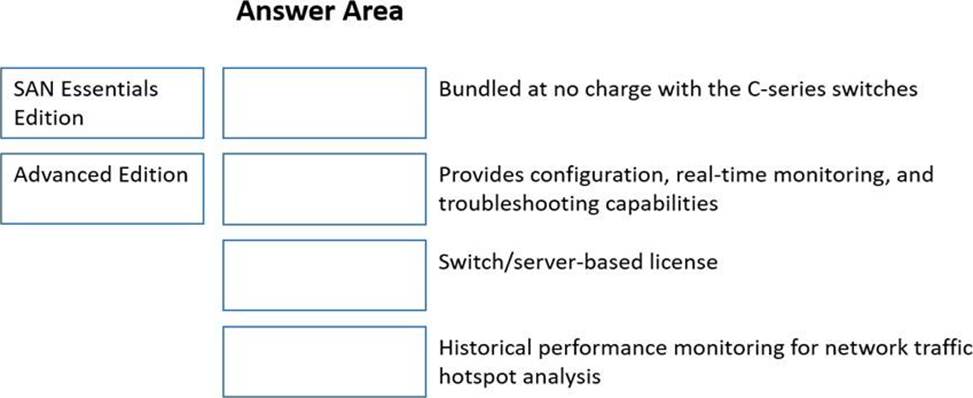
Match the feature to the appropriate C-Series DCNM license type.
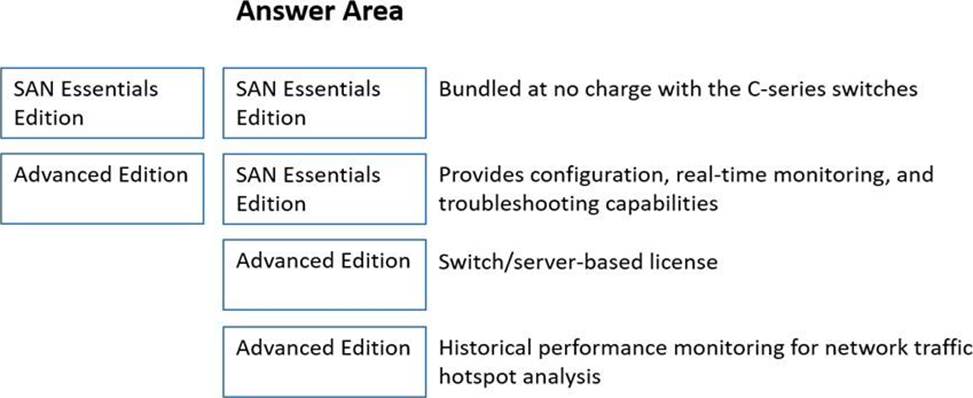
Explanation:
Graphical user interface, application Description automatically generated
Which storage feature is supported by both the HPE StoreVirtual and the HPE 3PAR StoreServ storage, and is a key differentiator of HPE storage solutions in the industry?
- A . Network RAID
- B . Peer Motion
- C . virtual Copy
- D . Dynamic Optimization
B
Explanation:
Peer Motion is a storage feature supported by both HPE StoreVirtual and HPE 3PAR StoreServ storage systems. It is a key differentiator of HPE storage solutions because it allows for non-disruptive, federated data mobility across storage systems. Peer Motion enables customers to move volumes between storage arrays seamlessly without downtime, making it ideal for data migration, load balancing, and tiering across heterogeneous environments.
This feature enhances flexibility and simplifies storage management, allowing organizations to optimize their storage resources dynamically and reduce the complexity of managing multiple storage systems.
Reference: HPE Peer Motion Overview
HPE 3PAR StoreServ and StoreVirtual
Which type of host identification is used in an iSCSI -based SAN?
- A . WWNN
- B . WWPN
- C . IQN
- D . DCB
C
Explanation:
In an iSCSI-based SAN, the IQN (iSCSI Qualified Name) is used for host identification. IQNs uniquely identify iSCSI initiators and targets within a network, enabling proper connection and communication in an iSCSI storage environment. This identification is crucial for establishing and managing iSCSI sessions between hosts and storage arrays.
For more information, refer to:
HPE Storage Networking Solutions
What is the maximum number of ISLs that can be combined to enhance the performance and availability of switch connections in a B-Series trunk group?
- A . 8
- B . 12
- C . 4
- D . 6
A
Explanation:
In a B-Series trunk group, the maximum number of Inter-Switch Links (ISLs) that can be combined to enhance the performance and availability of switch connections is 8. By aggregating up to 8 ISLs into a single trunk group, the system increases bandwidth and provides redundancy, ensuring that the loss of a single ISL does not impact the overall connectivity or performance.
Reference: HPE B-Series Switches Overview
HPE Networking Solutions
A customer is implementing a new high performance database environment.
What type of storage should you recommend?
- A . scale-out storage
- B . object store
- C . system-defined storage
- D . network-attached storage
A
Explanation:
For a high-performance database environment, scale-out storage (Option A) is the recommended solution. Scale-out storage architectures allow for the expansion of storage capacity and performance by adding more nodes to the storage cluster. This approach provides linear scalability, enabling the environment to grow as the database’s demands increase. It is particularly effective for high-performance workloads because it balances the load across multiple nodes, reducing bottlenecks and ensuring consistent performance.
Scale-out storage also supports high availability and resilience, which are critical for maintaining uptime and reliability in database environments that require rapid data access and processing.
Reference: HPE Scale-Out Storage Solutions
HPE Storage Overview
Which technology allows for non-intrusive gathering of 10 statistics from any device port, applies these statistics to an intuitive, policy-based monitoring system, and includes an alerting suite to configure thresholds and alarms?
- A . Fabric Vision
- B . Nexus Dashboard Fabric Controller
- C . MDSCU
- D . Web Tools
Which StoreOnce Gen4 features are included with the system software without additional licenses? (Choose two.)
- A . Encryption
- B . Cloud Bank
- C . Catalyst
- D . VTL/NAS replication
- E . Flexible I/O HBAs
C,D
Explanation:
In StoreOnce Gen4 systems, certain features are included with the system software without requiring additional licenses:
Catalyst: HPE StoreOnce Catalyst is included and provides advanced data reduction and deduplication capabilities, as well as integration with backup software.
VTL/NAS replication: This feature allows replication of Virtual Tape Libraries (VTL) and NAS shares between StoreOnce systems, ensuring data protection and disaster recovery, and it comes standard with the system software.
These features enhance the StoreOnce system’s functionality, providing value without additional costs.
Reference: HPE StoreOnce Features
StoreOnce Gen4 Technical Specifications