
Google Professional Machine Learning Engineer Practice Exams
Last updated on Oct 11,2026- Exam Code: Professional Machine Learning Engineer
- Exam Name: Google Professional Machine Learning Engineer
- Certification Provider: Google
- Latest update: Oct 11,2026
You are designing an architecture with a serverless ML system to enrich customer support tickets with informative metadata before they are routed to a support agent. You need a set of models to predict ticket priority, predict ticket resolution time, and perform sentiment analysis to help agents make strategic decisions when they process support requests. Tickets are not expected to have any domain-specific terms or jargon.
The proposed architecture has the following flow:
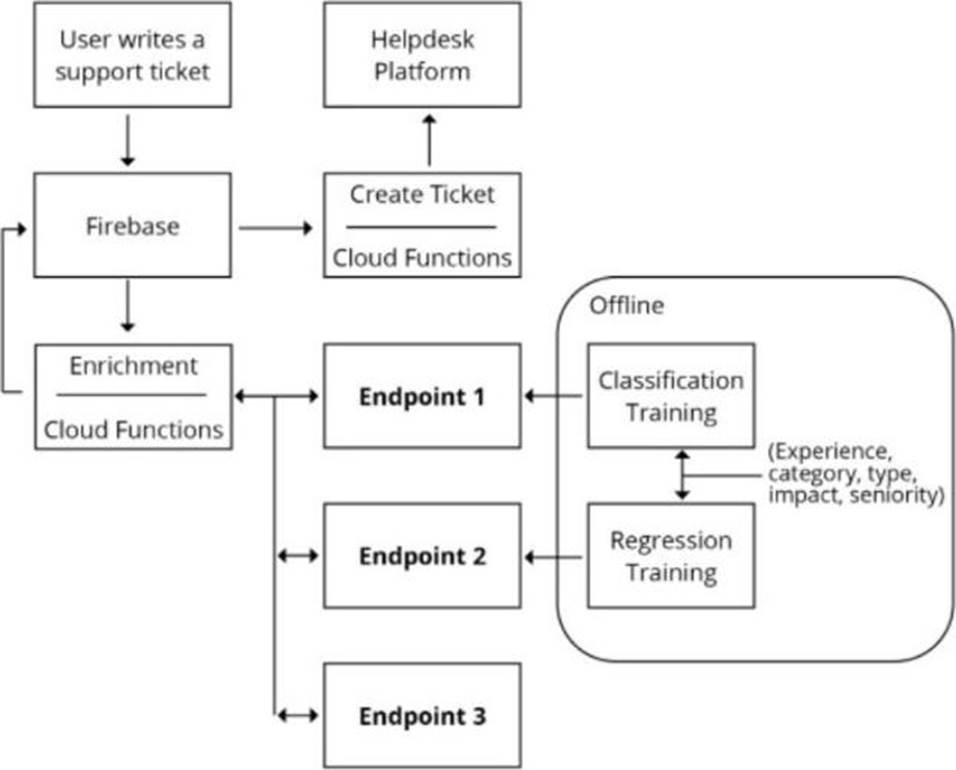
Which endpoints should the Enrichment Cloud Functions call?
- A . 1 Vertex Al. 2 Vertex Al. 3 AutoML Natural Language
- B . 1 Vertex Al. 2 Vertex Al. 3 Cloud Natural Language API
- C . 1 Vertex Al. 2 Vertex Al. 3 AutoML Vision
- D . 1 Cloud Natural Language API. 2 Vertex Al, 3 Cloud Vision API
B
Explanation:
Vertex AI is a unified platform for building and deploying ML models on Google Cloud. It supports both custom and AutoML models, and provides various tools and services for ML development, such as Vertex Pipelines, Vertex Vizier, Vertex Explainable AI, and Vertex Feature Store. Vertex AI can be used to create models for predicting ticket priority and resolution time, as these are domain-specific tasks that require custom training data and evaluation metrics. Cloud Natural Language API is a pre-trained service that provides natural language understanding capabilities, such as sentiment analysis, entity analysis, syntax analysis, and content classification. Cloud Natural Language API can be used to perform sentiment analysis on the support tickets, as this is a general task that does not require domain-specific knowledge or jargon. The other options are not suitable for the given architecture. AutoML Natural Language and AutoML Vision are services that allow users to create custom natural language and vision models using their own data and labels. They are not needed for sentiment analysis, as Cloud Natural Language API already provides this functionality. Cloud Vision API is a pre-trained service that provides image analysis capabilities, such as object detection, face detection, text detection, and image labeling. It is not relevant for the support tickets, as they are not expected to have any images.
Reference: Vertex AI documentation
Cloud Natural Language API documentation
You recently trained an XGBoost model on tabular data You plan to expose the model for internal use as an HTTP microservice After deployment you expect a small number of incoming requests. You want to productionize the model with the least amount of effort and latency.
What should you do?
- A . Deploy the model to BigQuery ML by using CREATE model with the BOOSTED-THREE-REGRESSOR statement and invoke the BigQuery API from the microservice.
- B . Build a Flask-based app Package the app in a custom container on Vertex Al and deploy it to Vertex Al Endpoints.
- C . Build a Flask-based app Package the app in a Docker image and deploy it to Google Kubernetes Engine in Autopilot mode.
- D . Use a prebuilt XGBoost Vertex container to create a model and deploy it to Vertex Al Endpoints.
D
Explanation:
XGBoost is a popular open-source library that provides a scalable and efficient implementation of gradient boosted trees. You can use XGBoost to train a classification or regression model on tabular data. You can also use Vertex AI to productionize the model and expose it for internal use as an HTTP microservice. Vertex AI is a service that allows you to create and train ML models using Google Cloud technologies. You can use a prebuilt XGBoost Vertex container to create a model and deploy it to Vertex AI Endpoints. A prebuilt Vertex container is a container image that contains the dependencies and libraries needed to run a specific ML framework, such as XGBoost. You can use a prebuilt Vertex container to simplify the model creation and deployment process, without having to build your own custom container. Vertex AI Endpoints is a service that allows you to serve your ML models online and scale them automatically. You can use Vertex AI Endpoints to deploy the model from the prebuilt Vertex container and expose it as an HTTP microservice. You can also configure the endpoint to handle a small number of incoming requests, and optimize the latency and cost of serving the model. By using a prebuilt XGBoost Vertex container and Vertex AI Endpoints, you can productionize the model with the least amount of effort and latency.
Reference: XGBoost documentation
Vertex AI documentation
Prebuilt Vertex container documentation
Vertex AI Endpoints documentation
Preparing for Google Cloud Certification: Machine Learning Engineer Professional Certificate