
Google Professional Cloud Developer Practice Exams
Last updated on Oct 22,2026- Exam Code: Professional Cloud Developer
- Exam Name: Professional Cloud Developer
- Certification Provider: Google
- Latest update: Oct 22,2026
You migrated some of your applications to Google Cloud. You are using a legacy monitoring platform deployed on-premises for both on-premises and cloud-deployed applications. You discover that your notification system is responding slowly to time-critical problems in the cloud applications.
What should you do?
- A . Replace your monitoring platform with Cloud Monitoring.
- B . Install the Cloud Monitoring agent on your Compute Engine instances.
- C . Migrate some traffic back to your old platform. Perform A/B testing on the two platforms concurrently.
- D . Use Cloud Logging and Cloud Monitoring to capture logs, monitor, and send alerts. Send them to your existing platform.
Your development team has built several Cloud Functions using Java along with corresponding integration and service tests. You are building and deploying the functions and launching the tests using Cloud Build. Your Cloud Build job is reporting deployment failures immediately after successfully validating the code.
What should you do?
- A . Check the maximum number of Cloud Function instances.
- B . Verify that your Cloud Build trigger has the correct build parameters.
- C . Retry the tests using the truncated exponential backoff polling strategy.
- D . Verify that the Cloud Build service account is assigned the Cloud Functions Developer role.
D
Explanation:
https://cloud.google.com/build/docs/securing-builds/configure-access-for-cloud-build-service-account
You are working on a social media application. You plan to add a feature that allows users to upload images. These images will be 2 MB C 1 GB in size. You want to minimize their infrastructure operations overhead for this feature.
What should you do?
- A . Change the application to accept images directly and store them in the database that stores other user information.
- B . Change the application to create signed URLs for Cloud Storage. Transfer these signed URLs to the client application to upload images to Cloud Storage.
- C . Set up a web server on GCP to accept user images and create a file store to keep uploaded files. Change the application to retrieve images from the file store.
- D . Create a separate bucket for each user in Cloud Storage. Assign a separate service account to allow write access on each bucket. Transfer service account credentials to the client application based on user information. The application uses this service account to upload images to Cloud Storage.
B
Explanation:
Reference: https://cloud.google.com/blog/products/storage-data-transfer/uploading-images-directly-to-cloud-storage-by-using-signed-url
Deploy the new container on Cloud Run as a pipeline step.
Explanation:
Reference: https://cloud.google.com/docs/ci-cd
Your data is stored in Cloud Storage buckets. Fellow developers have reported that data downloaded from Cloud Storage is resulting in slow API performance. You want to research the issue to provide details to the GCP support team.
Which command should you run?
- A . gsutil test Co output.json gs://my-bucket
- B . gsutil perfdiag Co output.json gs://my-bucket
- C . gcloud compute scp example-instance:~/test-data Co output.json gs://my-bucket
- D . gcloud services test Co output.json gs://my-bucket
B
Explanation:
Reference: https://groups.google.com/forum/#!topic/gce-discussion/xBl9Jq5HDsY
You are designing an application that will subscribe to and receive messages from a single Pub/Sub topic and insert corresponding rows into a database. Your application runs on Linux and leverages preemptible virtual machines to reduce costs. You need to create a shutdown script that will initiate a graceful shutdown.
What should you do?
- A . Write a shutdown script that uses inter-process signals to notify the application process to disconnect from the database.
- B . Write a shutdown script that broadcasts a message to all signed-in users that the Compute Engine instance is going down and instructs them to save current work and sign out.
- C . Write a shutdown script that writes a file in a location that is being polled by the application once every five minutes. After the file is read, the application disconnects from the database.
- D . Write a shutdown script that publishes a message to the Pub/Sub topic announcing that a shutdown is in progress. After the application reads the message, it disconnects from the database.
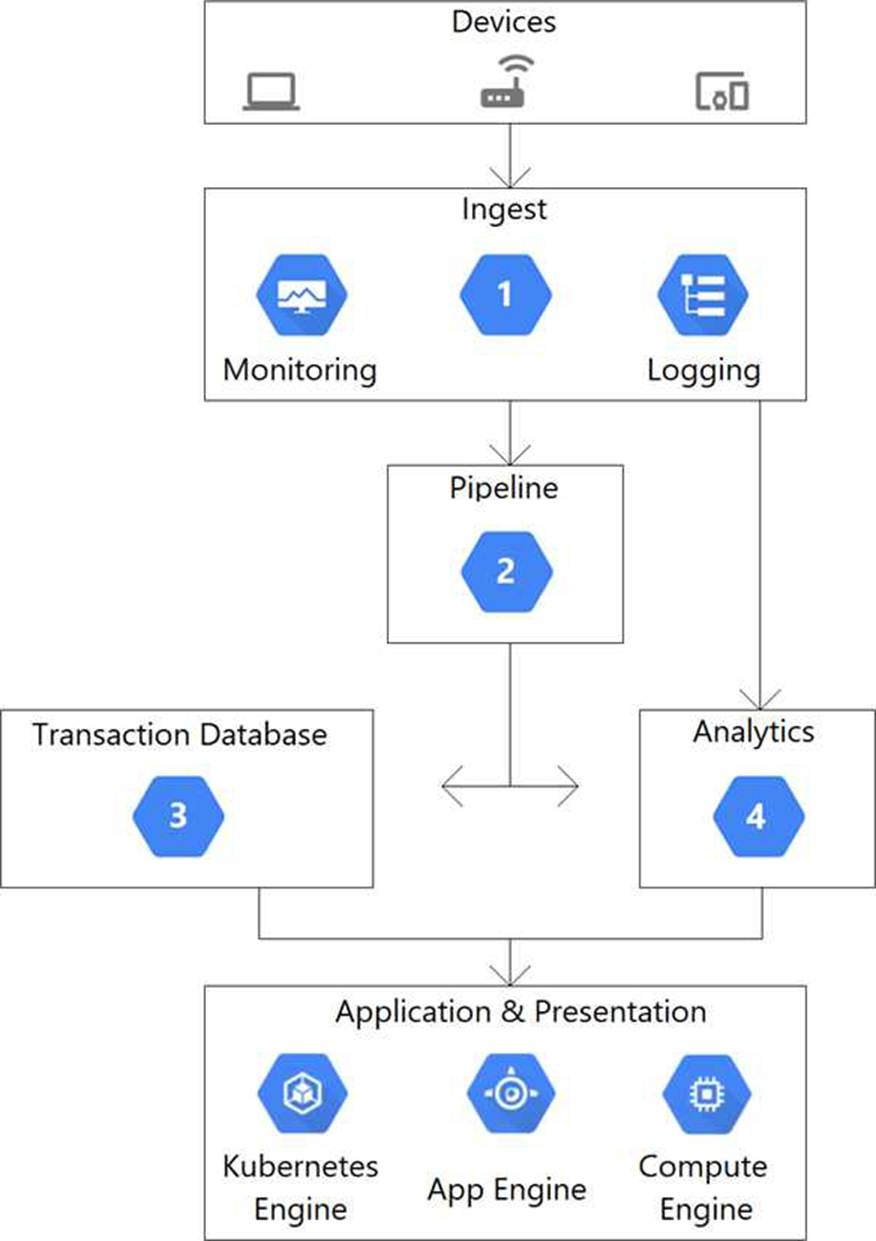
This architectural diagram depicts a system that streams data from thousands of devices. You want to ingest data into a pipeline, store the data, and analyze the data using SQL statements.
Which Google Cloud services should you use for steps 1, 2, 3, and 4?
- A . 1) App Engine
2) Pub/Sub
3) BigQuery
4) Firestore - B . 1) Dataflow
2) Pub/Sub
3) Firestore
4) BigQuery - C . 1) Pub/Sub
2) Dataflow
3) BigQuery
4) Firestore - D . 1) Pub/Sub
2) Dataflow
3) Firestore
4) BigQuery
You are developing an application that will allow users to read and post comments on news articles. You want to configure your application to store and display user-submitted comments using Firestore.
How should you design the schema to support an unknown number of comments and articles?
- A . Store each comment in a subcollection of the article.
- B . Add each comment to an array property on the article.
- C . Store each comment in a document, and add the comment’s key to an array property on the article.
- D . Store each comment in a document, and add the comment’s key to an array property on the user profile.
Your service adds text to images that it reads from Cloud Storage. During busy times of the year, requests to Cloud Storage fail with an HTTP 429 "Too Many Requests" status code.
How should you handle this error?
- A . Add a cache-control header to the objects.
- B . Request a quota increase from the GCP Console.
- C . Retry the request with a truncated exponential backoff strategy.
- D . Change the storage class of the Cloud Storage bucket to Multi-regional.
C
Explanation:
Reference: https://developers.google.com/gmail/api/v1/reference/quota
You are a lead developer working on a new retail system that runs on Cloud Run and Firestore. A web UI requirement is for the user to be able to browse through alt products. A few months after go-live, you notice that Cloud Run instances are terminated with HTTP 500: Container instances are exceeding memory limits errors during busy times
This error coincides with spikes in the number of Firestore queries
You need to prevent Cloud Run from crashing and decrease the number of Firestore queries. You want to use a solution that optimizes system performance.
What should you do?
- A . Create a custom jndex over the products
- B . Modify the query that returns the product list using cursors with limits
- C . Modify the Cloud Run configuration to increase the memory limits
- D . Modify the query that returns the product list using integer offsets