
Google Professional Cloud Developer Practice Exams
Last updated on Oct 22,2026- Exam Code: Professional Cloud Developer
- Exam Name: Professional Cloud Developer
- Certification Provider: Google
- Latest update: Oct 22,2026
You have an on-premises application that authenticates to the Cloud Storage API using a user-managed service account with a user-managed key. The application connects to Cloud Storage using Private Google Access over a Dedicated Interconnect link. You discover that requests from the application to access objects in the Cloud Storage bucket are failing with a 403 Permission Denied error code.
What is the likely cause of this issue?
- A . The folder structure inside the bucket and object paths have changed.
- B . The permissions of the service account’s predefined role have changed.
- C . The service account key has been rotated but not updated on the application server.
- D . The Interconnect link from the on-premises data center to Google Cloud is experiencing a temporary outage.
You have an application deployed in Google Kubernetes Engine (GKE) that reads and processes Pub/Sub messages. Each Pod handles a fixed number of messages per minute. The rate at which messages are published to the Pub/Sub topic varies considerably throughout the day and week, including occasional large batches of messages published at a single moment.
You want to scale your GKE Deployment to be able to process messages in a timely manner.
What GKE feature should you use to automatically adapt your workload?
- A . Vertical Pod Autoscaler in Auto mode
- B . Vertical Pod Autoscaler in Recommendation mode
- C . Horizontal Pod Autoscaler based on an external metric
- D . Horizontal Pod Autoscaler based on resources utilization
C
Explanation:
https://kubernetes.io/docs/tasks/run-application/horizontal-pod-autoscale/
Your team is writing a backend application to implement the business logic for an interactive voice response (IVR) system that will support a payroll application.
The IVR system has the following technical characteristics:
• Each customer phone call is associated with a unique IVR session.
• The IVR system creates a separate persistent gRPC connection to the backend for each session.
• If the connection is interrupted, the IVR system establishes a new connection, causing a slight latency for that call.
You need to determine which compute environment should be used to deploy the backend application.
Using current call data, you determine that:
• Call duration ranges from 1 to 30 minutes.
• Calls are typically made during business hours.
• There are significant spikes of calls around certain known dates (e.g., pay days), or when large payroll changes occur.
You want to minimize cost, effort, and operational overhead.
Where should you deploy the backend application?
- A . Compute Engine
- B . Google Kubernetes Engine cluster in Standard mode
- C . Cloud Functions
- D . Cloud Run
D
Explanation:
This page shows Cloud Run-specific details for developers who want to use gRPC to connect a Cloud Run service with other services, for example, to provide simple, high performance communication between internal microservices. You can use all gRPC types, streaming or unary, with Cloud Run.
Possible use cases include:
Communication between internal microservices.
High loads of data (gRPC uses protocol buffers, which are up to seven times faster than REST calls).
Only a simple service definition is needed, you don’t want to write a full client library. Use streaming gRPCs in your gRPC server to build more responsive applications and APIs. https://cloud.google.com/run/docs/tutorials/secure-services#:~:text=The%20backend%20service%20is%20private,Google%20Cloud%20except%20where %20necessary.
You recently migrated an on-premises monolithic application to a microservices application on Google Kubernetes Engine (GKE). The application has dependencies on backend services on-premises, including a CRM system and a MySQL database that contains personally identifiable information (PII). The backend services must remain on-premises to meet regulatory requirements.
You established a Cloud VPN connection between your on-premises data center and Google Cloud. You notice that some requests from your microservices application on GKE to the backend services are failing due to latency issues caused by fluctuating bandwidth, which is causing the application to crash.
How should you address the latency issues?
- A . Use Memorystore to cache frequently accessed PII data from the on-premises MySQL database
- B . Use Istio to create a service mesh that includes the microservices on GKE and the on-premises services
- C . Increase the number of Cloud VPN tunnels for the connection between Google Cloud and the on-premises services
- D . Decrease the network layer packet size by decreasing the Maximum Transmission Unit (MTU) value from its default value on Cloud VPN
C
Explanation:
https://cloud.google.com/network-connectivity/docs/vpn/concepts/choosing-networks-routing#route-alignment
You made a typo in a low-level Linux configuration file that prevents your Compute Engine instance from booting to a normal run level. You just created the Compute Engine instance today and have
done no other maintenance on it, other than tweaking files.
How should you correct this error?
- A . Download the file using scp, change the file, and then upload the modified version
- B . Configure and log in to the Compute Engine instance through SSH, and change the file
- C . Configure and log in to the Compute Engine instance through the serial port, and change the file
- D . Configure and log in to the Compute Engine instance using a remote desktop client, and change the file
C
Explanation:
https://cloud.google.com/compute/docs/troubleshooting/troubleshooting-using-serial-console
You are a developer at a large corporation You manage three Google Kubernetes Engine clusters. Your team’s developers need to switch from one cluster to another regularly without losing access to their preferred development tools. You want to configure access to these clusters using the fewest number of steps while following Google-recommended best practices.
What should you do?
- A . Ask the developers to use Cloud Shell and run gcloud container clusters get-credentials to switch to another cluster.
- B . Ask the developers to open three terminals on their workstation and use kubecrt1 config to configure access to each cluster.
- C . Ask the developers to install the gcloud CLI on their workstation and run gcloud container clusters get-credentials to switch to another cluster
- D . In a configuration file, define the clusters users, and contexts Email the file to the developers and ask them to use kubect1 config to add cluster, user and context details.
D
Explanation:
https://kubernetes.io/docs/tasks/access-application-cluster/configure-access-multiple-clusters/
You are building a mobile application that will store hierarchical data structures in a database. The application will enable users working offline to sync changes when they are back online. A backend
service will enrich the data in the database using a service account. The application is expected to be very popular and needs to scale seamlessly and securely.
Which database and IAM role should you use?
- A . Use Cloud SQL, and assign the roles/cloudsql.editor role to the service account.
- B . Use Bigtable, and assign the roles/bigtable.viewer role to the service account.
- C . Use Firestore in Native mode and assign the roles/datastore.user role to the service account.
- D . Use Firestore in Datastore mode and assign the roles/datastore.viewer role to the service account.
C
Explanation:
https://firebase.google.com/docs/firestore/manage-data/enable-offline
Cloud Firestore supports offline data persistence. This feature caches a copy of the Cloud Firestore data that your app is actively using, so your app can access the data when the device is offline. You can write, read, listen to, and query the cached data. When the device comes back online, Cloud Firestore synchronizes any local changes made by your app to the Cloud Firestore backend.
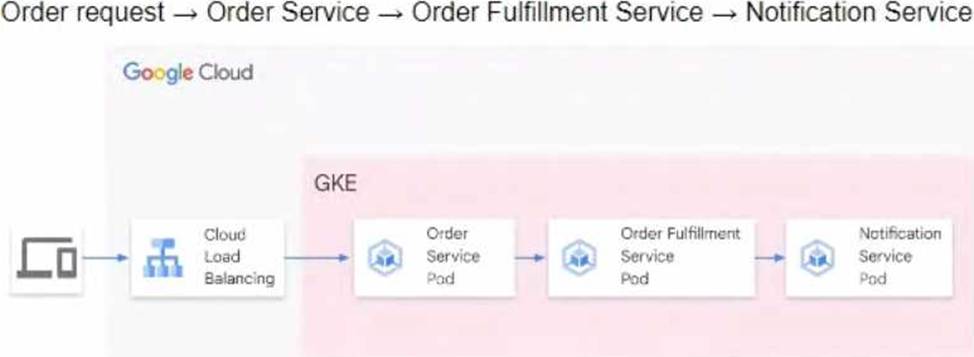
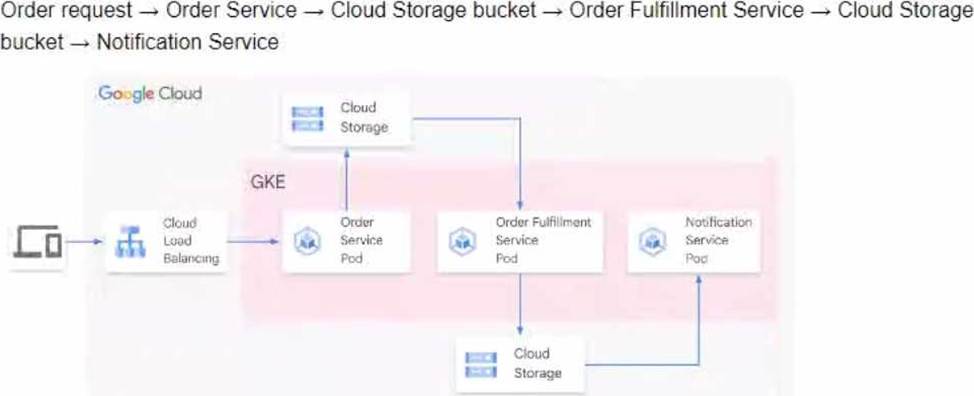
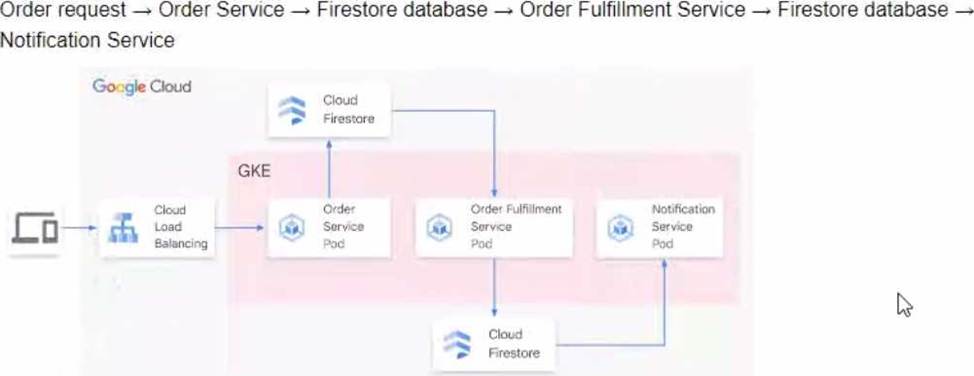
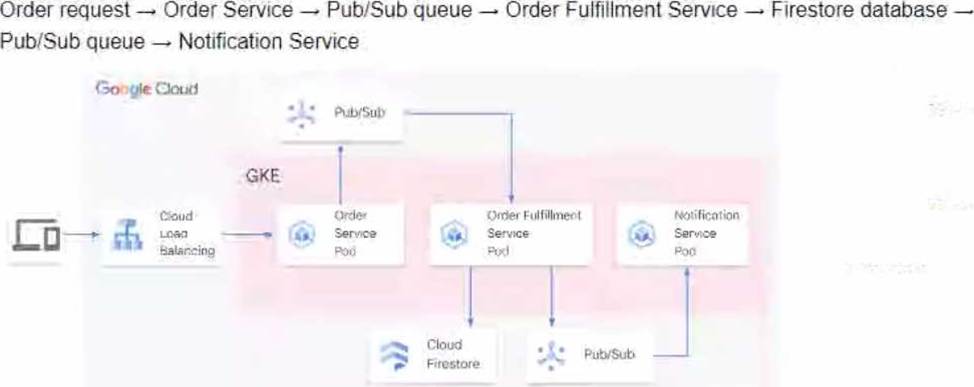
You are developing a flower ordering application Currently you have three microservices.
• Order Service (receives the orders).
• Order Fulfillment Service (processes the orders).
• Notification Service (notifies the customer when the order is filled).
You need to determine how the services will communicate with each other. You want incoming orders to be processed quickly and you need to collect order information for fulfillment. You also want to make sure orders are not lost between your services and are able to communicate asynchronously.
How should the requests be processed?
A)
B)
C)
D)
- A . Option A
- B . Option B
- C . Option C
- D . Option D
You are developing an application that reads credit card data from a Pub/Sub subscription. You have written code and completed unit testing. You need to test the Pub/Sub integration before deploying to Google Cloud.
What should you do?
- A . Create a service to publish messages, and deploy the Pub/Sub emulator. Generate random content in the publishing service, and publish to the emulator.
- B . Create a service to publish messages to your application. Collect the messages from Pub/Sub in production, and replay them through the publishing service.
- C . Create a service to publish messages, and deploy the Pub/Sub emulator. Collect the messages from Pub/Sub in production, and publish them to the emulator.
- D . Create a service to publish messages, and deploy the Pub/Sub emulator. Publish a standard set of testing messages from the publishing service to the emulator.
You are creating and running containers across different projects in Google Cloud. The application you are developing needs to access Google Cloud services from within Google Kubernetes Engine (GKE).
What should you do?
- A . Assign a Google service account to the GKE nodes.
- B . Use a Google service account to run the Pod with Workload Identity.
- C . Store the Google service account credentials as a Kubernetes Secret.
- D . Use a Google service account with GKE role-based access control (RBAC).
B
Explanation:
https://cloud.google.com/kubernetes-engine/docs/concepts/workload-identity