Google Professional Cloud Architect Practice Exams
Last updated on Oct 22,2026- Exam Code: Professional Cloud Architect
- Exam Name: Google Certified Professional – Cloud Architect (GCP)
- Certification Provider: Google
- Latest update: Oct 22,2026
You are running a cluster on Kubernetes Engine to serve a web application. Users are reporting that a specific part of the application is not responding anymore. You notice that all pods of your deployment keep restarting after 2 seconds. The application writes logs to standard output. You want to inspect the logs to find the cause of the issue .
Which approach can you take?
- A . Review the Stackdriver logs for each Compute Engine instance that is serving as a node in the cluster.
- B . Review the Stackdriver logs for the specific Kubernetes Engine container that is serving the unresponsive part of the application.
- C . Connect to the cluster using gcloud credentials and connect to a container in one of the pods to read the logs.
- D . Review the Serial Port logs for each Compute Engine instance that is serving as a node in the cluster.
You want to optimize the performance of an accurate, real-time, weather-charting application. The data comes from 50,000 sensors sending 10 readings a second, in the format of a timestamp and sensor reading. Where should you store the data?
- A . Google BigQuery
- B . Google Cloud SQL
- C . Google Cloud Bigtable
- D . Google Cloud Storage
Topic 3, JencoMart Case Study
Company Overview
JencoMart is a global retailer with over 10,000 stores in 16 countries. The stores carry a range of goods, such as groceries, tires, and jewelry. One of the company’s core values is excellent customer service. In addition, they recently introduced an environmental policy to reduce their carbon output by 50% over the next 5 years.
Company Background
JencoMart started as a general store in 1931, and has grown into one of the world’s leading brands, known for great value and customer service. Over time, the company transitioned from only physical stores to a stores and online hybrid model, with 25% of sales online. Currently, JencoMart has little presence in Asia, but considers that market key for future growth.
Solution Concept
JencoMart wants to migrate several critical applications to the cloud but has not completed a technical review to determine their suitability for the cloud and the engineering required for migration. They currently host all of these applications on infrastructure that is at its end of life and is no longer supported.
Existing Technical Environment
JencoMart hosts all of its applications in 4 data centers: 3 in North American and 1 in Europe; most applications are dual-homed.
JencoMart understands the dependencies and resource usage metrics of their on-premises architecture.
Application: Customer loyalty portal
LAMP (Linux, Apache, MySQL and PHP) application served from the two JencoMart-owned U.S. data centers.
Database
– Oracle Database stores user profiles
– 20 TB
– Complex table structure
– Well maintained, clean data
– Strong backup strategy
– PostgreSQL database stores user credentials
– Single-homed in US West
– No redundancy
– Backed up every 12 hours
– 100% uptime service level agreement (SLA)
– Authenticates all users
Compute
– 30 machines in US West Coast, each machine has:
– Twin, dual core CPUs
– 32 GB of RAM
– Twin 250 GB HDD (RAID 1)
– 20 machines in US East Coast, each machine has:
– Single, dual-core CPU
– 24 GB of RAM
– Twin 250 GB HDD (RAID 1)
Storage
– Access to shared 100 TB SAN in each location
– Tape backup every week
Business Requirements
– Optimize for capacity during peak periods and value during off-peak periods
– Guarantee service availability and support
– Reduce on-premises footprint and associated financial and environmental impact
– Move to outsourcing model to avoid large upfront costs associated with infrastructure purchase
– Expand services into Asia
Technical Requirements
– Assess key application for cloud suitability
– Modify applications for the cloud
– Move applications to a new infrastructure
– Leverage managed services wherever feasible
– Sunset 20% of capacity in existing data centers
– Decrease latency in Asia
CEO Statement
JencoMart will continue to develop personal relationships with our customers as more people access the web. The future of our retail business is in the global market and the connection between online and in-store experiences. As a large, global company, we also have a responsibility to the environment through “green” initiatives and policies.
CTO Statement
The challenges of operating data centers prevent focus on key technologies critical to our long-term success. Migrating our data services to a public cloud infrastructure will allow us to focus on big data and machine learning to improve our service to customers.
CFO Statement
Since its founding, JencoMart has invested heavily in our data services infrastructure. However, because of changing market trends, we need to outsource our infrastructure to ensure our long-term success. This model will allow us to respond to increasing customer demand during peak periods and reduce costs.
For this question, refer to the JencoMart case study.
JencoMart has built a version of their application on Google Cloud Platform that serves traffic to Asia. You want to measure success against their business and technical goals .
Which metrics should you track?
- A . Error rates for requests from Asia
- B . Latency difference between US and Asia
- C . Total visits, error rates, and latency from Asia
- D . Total visits and average latency for users in Asia
- E . The number of character sets present in the database
For this question, refer to the Dress4Win case study.
At Dress4Win, an operations engineer wants to create a tow-cost solution to remotely archive copies of database backup files. The database files are compressed tar files stored in their current data center .
How should he proceed?
- A . Create a cron script using gsutil to copy the files to a Coldline Storage bucket.
- B . Create a cron script using gsutil to copy the files to a Regional Storage bucket.
- C . Create a Cloud Storage Transfer Service Job to copy the files to a Coldline Storage bucket.
- D . Create a Cloud Storage Transfer Service job to copy the files to a Regional Storage bucket.
Your customer is receiving reports that their recently updated Google App Engine application is taking approximately 30 seconds to load for some of their users. This behavior was not reported before the update .
What strategy should you take?
- A . Work with your ISP to diagnose the problem.
- B . Open a support ticket to ask for network capture and flow data to diagnose the problem, then roll back your application.
- C . Roll back to an earlier known good release initially, then use Stackdriver Trace and logging to diagnose the problem in a development/test/staging environment.
- D . Roll back to an earlier known good release, then push the release again at a quieter period to investigate. Then use Stackdriver Trace and logging to diagnose the problem.
You are managing an application deployed on Cloud Run for Anthos, and you need to define a strategy for deploying new versions of the application. You want to evaluate the new code with a subset of production traffic to decide whether to proceed with the rollout .
What should you do?
- A . Deploy a new revision to Cloud Run with the new version. Configure traffic percentage between revisions.
- B . Deploy a new service to Cloud Run with the new version. Add a Cloud Load Balancing instance in front of both services.
- C . In the Google Cloud Console page for Cloud Run, set up continuous deployment using Cloud Build for the development branch. As part of the Cloud Build trigger, configure the substitution variable TRAFFIC_PERCENTAGE with the percentage of traffic you want directed to a new version.
- D . In the Google Cloud Console, configure Traffic Director with a new Service that points to the new version of the application on Cloud Run. Configure Traffic Director to send a small percentage of traffic to the new version of the application.
You write a Python script to connect to Google BigQuery from a Google Compute Engine virtual machine. The script is printing errors that it cannot connect to BigQuery .
What should you do to fix the script?
- A . Install the latest BigQuery API client library for Python
- B . Run your script on a new virtual machine with the BigQuery access scope enabled
- C . Create a new service account with BigQuery access and execute your script with that user
- D . Install the bq component for gccloud with the command gcloud components install bq.
You need to develop procedures to verify resilience of disaster recovery for remote recovery using GCP. Your production environment is hosted on-premises. You need to establish a secure, redundant connection between your on premises network and the GCP network.
What should you do?
- A . Verify that Dedicated Interconnect can replicate files to GCP. Verify that direct peering can establish a
secure connection between your networks if Dedicated Interconnect fails. - B . Verify that Dedicated Interconnect can replicate files to GCP. Verify that Cloud VPN can establish a secure connection between your networks if Dedicated Interconnect fails.
- C . Verify that the Transfer Appliance can replicate files to GCP. Verify that direct peering can establish a
secure connection between your networks if the Transfer Appliance fails. - D . Verify that the Transfer Appliance can replicate files to GCP. Verify that Cloud VPN can establish a secure connection between your networks if the Transfer Appliance fails.
Your development team has installed a new Linux kernel module on the batch servers in Google Compute Engine (GCE) virtual machines (VMs) to speed up the nightly batch process. Two days after the installation, 50% of web application deployed in the same
nightly batch run. You want to collect details on the failure to pass back to the development team .
Which three actions should you take? Choose 3 answers
- A . Use Stackdriver Logging to search for the module log entries.
- B . Read the debug GCE Activity log using the API or Cloud Console.
- C . Use gcloud or Cloud Console to connect to the serial console and observe the logs.
- D . Identify whether a live migration event of the failed server occurred, using in the activity log.
- E . Adjust the Google Stackdriver timeline to match the failure time, and observe the batch server metrics.
- F . Export a debug VM into an image, and run the image on a local server where kernel log messages will be displayed on the native screen.
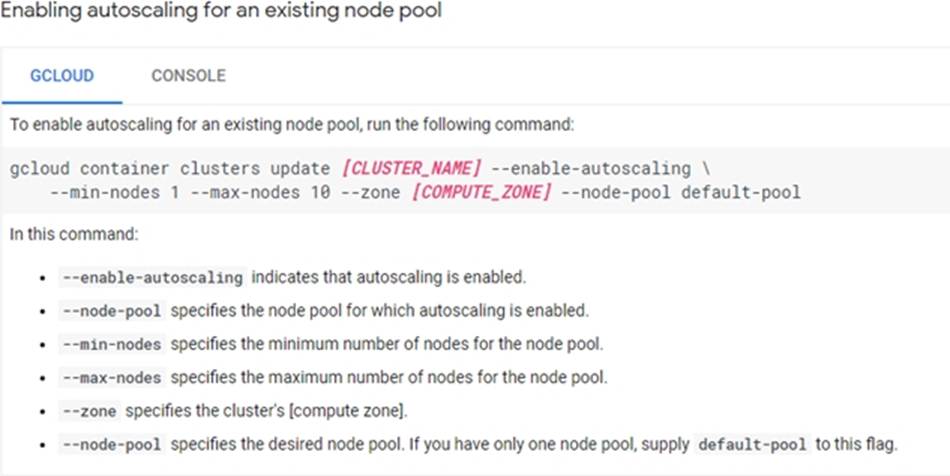
You want to enable your running Google Kubernetes Engine cluster to scale as demand for your application changes.
What should you do?
- A . Add additional nodes to your Kubernetes Engine cluster using the following command:
gcloud container clusters resize
CLUSTER_Name C -size 10 - B . Add a tag to the instances in the cluster with the following command:
gcloud compute instances add-tags
INSTANCE – -tags enable-
autoscaling max-nodes-10 - C . Update the existing Kubernetes Engine cluster with the following command:
gcloud alpha container clusters
update mycluster – -enable
autoscaling – -min-nodes=1 – -max-nodes=10 - D . Create a new Kubernetes Engine cluster with the following command:
gcloud alpha container clusters
create mycluster – -enable-
autoscaling – -min-nodes=1 – -max-nodes=10
and redeploy your application