
Google Professional Cloud Architect Practice Exams
Last updated on Oct 21,2026- Exam Code: Professional Cloud Architect
- Exam Name: Google Certified Professional – Cloud Architect (GCP)
- Certification Provider: Google
- Latest update: Oct 21,2026
You need to upload files from your on-premises environment to Cloud Storage. You want the files to be
encrypted on Cloud Storage using customer-supplied encryption keys .
What should you do?
- A . Supply the encryption key in a .boto configuration file. Use gsutil to upload the files.
- B . Supply the encryption key using gcloud config. Use gsutil to upload the files to that bucket.
- C . Use gsutil to upload the files, and use the flag –encryption-key to supply the encryption key.
- D . Use gsutil to create a bucket, and use the flag –encryption-key to supply the encryption key. Use gsutil to upload the files to that bucket.
You need to evaluate your team readiness for a new GCP project. You must perform the evaluation and create a skills gap plan incorporates the business goal of cost optimization. Your team has deployed two GCP projects successfully to date .
What should you do?
- A . Allocate budget for team training. Set a deadline for the new GCP project.
- B . Allocate budget for team training. Create a roadmap for your team to achieve Google Cloud certification based on job role.
- C . Allocate budget to hire skilled external consultants. Set a deadline for the new GCP project.
- D . Allocate budget to hire skilled external consultants. Create a roadmap for your team to achieve Google Cloud certification based on job role.
The database administration team has asked you to help them improve the performance of their new database server running on Google Compute Engine. The database is for importing and normalizing their performance statistics and is built with MySQL running on Debian Linux. They have an n1-standard-8 virtual machine with 80 GB of SSD persistent disk .
What should they change to get better performance from this system?
- A . Increase the virtual machine’s memory to 64 GB.
- B . Create a new virtual machine running PostgreSQL.
- C . Dynamically resize the SSD persistent disk to 500 GB.
- D . Migrate their performance metrics warehouse to BigQuery.
- E . Modify all of their batch jobs to use bulk inserts into the database.
You have developed a non-critical update to your application that is running in a managed instance group, and have created a new instance template with the update that you want to release. To prevent any possible impact to the application, you don’t want to update any running instances. You want any new instances that are created by the managed instance group to contain the new update .
What should you do?
- A . Start a new rolling restart operation.
- B . Start a new rolling replace operation.
- C . Start a new rolling update. Select the Proactive update mode.
- D . Start a new rolling update. Select the Opportunistic update mode.
Your architecture calls for the centralized collection of all admin activity and VM system logs within your project.
How should you collect these logs from both VMs and services?
- A . All admin and VM system logs are automatically collected by Stackdriver.
- B . Stackdriver automatically collects admin activity logs for most services. The Stackdriver Logging agent must be installed on each instance to collect system logs.
- C . Launch a custom syslogd compute instance and configure your GCP project and VMs to forward all logs to it.
- D . Install the Stackdriver Logging agent on a single compute instance and let it collect all audit and access logs for your environment.
You team needs to create a Google Kubernetes Engine (GKE) cluster to host a newly built application that requires access to third-party services on the internet. Your company does not allow any Compute Engine instance to have a public IP address on Google Cloud. You need to create a deployment strategy that adheres to these guidelines .
What should you do?
- A . Create a Compute Engine instance, and install a NAT Proxy on the instance. Configure all workloads on GKE to pass through this proxy to access third-party services on the Internet
- B . Configure the GKE cluster as a private cluster, and configure Cloud NAT Gateway for the cluster subnet
- C . Configure the GKE cluster as a route-based cluster. Configure Private Google Access on the Virtual Private Cloud (VPC)
- D . Configure the GKE cluster as a private cluster. Configure Private Google Access on the Virtual Private Cloud (VPC)
You are developing an application using different microservices that should remain internal to the cluster. You want to be able to configure each microservice with a specific number of replicas. You also want to be able to address a specific microservice from any other microservice in a uniform way, regardless of the number of replicas the microservice scales to. You need to implement this solution on Google Kubernetes Engine .
What should you do?
- A . Deploy each microservice as a Deployment. Expose the Deployment in the cluster using a Service, and use the Service DNS name to address it from other microservices within the cluster.
- B . Deploy each microservice as a Deployment. Expose the Deployment in the cluster using an Ingress, and use the Ingress IP address to address the Deployment from other microservices within the cluster.
- C . Deploy each microservice as a Pod. Expose the Pod in the cluster using a Service, and use the Service DNS name to address the microservice from other microservices within the cluster.
- D . Deploy each microservice as a Pod. Expose the Pod in the cluster using an Ingress, and use the Ingress IP address name to address the Pod from other microservices within the cluster.
You deploy your custom java application to google app engine.
It fails to deploy and gives you the following stack trace:
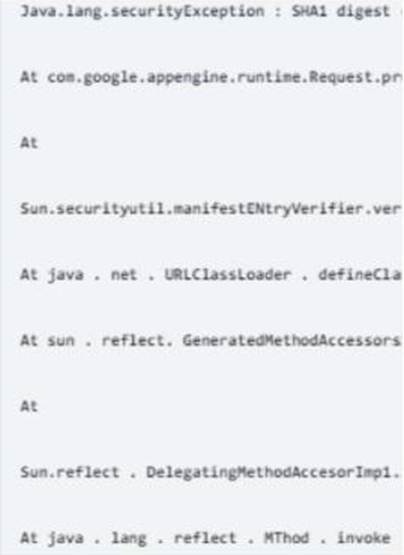
- A . Recompile the CLoakedServlet class using and MD5 hash instead of SHA1
- B . Digitally sign all of your JAR files and redeploy your application.
- C . Upload missing JAR files and redeploy your application
For this question, refer to the TerramEarth case study.
The TerramEarth development team wants to create an API to meet the company’s business requirements. You want the development team to focus their development effort on business value versus creating a custom framework .
Which method should they use?
- A . Use Google App Engine with Google Cloud Endpoints. Focus on an API for dealers and partners.
- B . Use Google App Engine with a JAX-RS Jersey Java-based framework. Focus on an API for the public.
- C . Use Google App Engine with the Swagger (open API Specification) framework. Focus on an API for the public.
- D . Use Google Container Engine with a Django Python container. Focus on an API for the public.
- E . Use Google Container Engine with a Tomcat container with the Swagger (Open API Specification) framework. Focus on an API for dealers and partners.
For this question, refer to the Dress4Win case study.
As part of their new application experience, Dress4Wm allows customers to upload images of themselves. The customer has exclusive control over who may view these images. Customers should be able to upload images with minimal latency and also be shown their images quickly on the main application page when they log in .
Which configuration should Dress4Win use?
- A . Store image files in a Google Cloud Storage bucket. Use Google Cloud Datastore to maintain metadata that maps each customer’s ID and their image files.
- B . Store image files in a Google Cloud Storage bucket. Add custom metadata to the uploaded images in Cloud Storage that contains the customer’s unique ID.
- C . Use a distributed file system to store customers’ images. As storage needs increase, add more persistent disks and/or nodes. Assign each customer a unique ID, which sets each file’s owner attribute, ensuring privacy of images.
- D . Use a distributed file system to store customers’ images. As storage needs increase, add more persistent disks and/or nodes. Use a Google Cloud SQL database to maintain metadata that maps each customer’s ID to their image files.