
Google Professional Cloud Architect Practice Exams
Last updated on Oct 22,2026- Exam Code: Professional Cloud Architect
- Exam Name: Google Certified Professional – Cloud Architect (GCP)
- Certification Provider: Google
- Latest update: Oct 22,2026
You created a pipeline that can deploy your source code changes to your infrastructure in instance
groups for self healing.
One of the changes negatively affects your key performance indicator.
You are not sure how to fix it and investigation could take up to a week.
What should you do
- A . Log in to a server, and iterate a fix locally
- B . Change the instance group template to the previous one, and delete all instances.
- C . Revert the source code change and rerun the deployment pipeline
- D . Log into the servers with the bad code change, and swap in the previous code
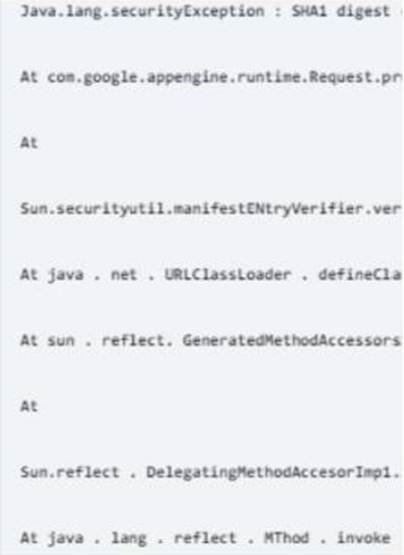
You deploy your custom java application to google app engine.
It fails to deploy and gives you the following stack trace:
- A . Recompile the CLoakedServlet class using and MD5 hash instead of SHA1
- B . Digitally sign all of your JAR files and redeploy your application.
- C . Upload missing JAR files and redeploy your application
You deploy your custom java application to google app engine.
It fails to deploy and gives you the following stack trace:
- A . Recompile the CLoakedServlet class using and MD5 hash instead of SHA1
- B . Digitally sign all of your JAR files and redeploy your application.
- C . Upload missing JAR files and redeploy your application
For this question refer to the TerramEarth case study.
Which of TerramEarth’s legacy enterprise processes will experience significant change as a result of increased Google Cloud Platform adoption.
- A . Opex/capex allocation, LAN changes, capacity planning
- B . Capacity planning, TCO calculations, opex/capex allocation
- C . Capacity planning, utilization measurement, data center expansion
- D . Data Center expansion, TCO calculations, utilization measurement
B
Explanation:
Capacity planning, TCO calculations, opex/capex allocation From the case study, it can conclude that Management (CXO) all concern rapid provision of resources (infrastructure) for growing as well as cost management, such as Cost optimization in Infrastructure, trade up front capital expenditures (Capex) for ongoing operating expenditures (Opex), and Total cost of ownership (TCO)
Topic 4, Dress4Win case study
Company Overview
Dress4win is a web-based company that helps their users organize and manage their personal wardrobe using a website and mobile application. The company also cultivates an active social network that connects their users with designers and retailers. They monetize their services through advertising, e-commerce, referrals, and a premium app model.
Company Background
Dress4win’s application has grown from a few servers in the founder’s garage to several hundred servers and appliances in a collocated data center. However, the capacity of their infrastructure is now insufficient for the application’s rapid growth. Because of this growth and the company’s desire to innovate faster, Dress4win is committing to a full migration to a public cloud.
Solution Concept
For the first phase of their migration to the cloud, Dress4win is considering moving their development and test environments. They are also considering building a disaster recovery site, because their current infrastructure is at a single location. They are not sure which components of their architecture they can migrate as is and which components they need to change before migrating them.
Existing Technical Environment
The Dress4win application is served out of a single data center location.
– Databases:
– MySQL – user data, inventory, static data
– Redis – metadata, social graph, caching
– Application servers:
– Tomcat – Java micro-services
– Nginx – static content
– Apache Beam – Batch processing
– Storage appliances:
– iSCSI for VM hosts
– Fiber channel SAN – MySQL databases
– NAS – image storage, logs, backups
– Apache Hadoop/Spark servers:
– Data analysis
– Real-time trending calculations
– MQ servers:
– Messaging
– Social notifications
– Events
– Miscellaneous servers:
– Jenkins, monitoring, bastion hosts, security scanners
Business Requirements
– Build a reliable and reproducible environment with scaled parity of production.
– Improve security by defining and adhering to a set of security and Identity and Access Management (IAM) best practices for cloud.
– Improve business agility and speed of innovation through rapid provisioning of new resources.
– Analyze and optimize architecture for performance in the cloud.
– Migrate fully to the cloud if all other requirements are met.
Technical Requirements
– Evaluate and choose an automation framework for provisioning resources in cloud.
– Support failover of the production environment to cloud during an emergency.
– Identify production services that can migrate to cloud to save capacity.
– Use managed services whenever possible.
– Encrypt data on the wire and at rest.
– Support multiple VPN connections between the production data center and cloud environment.
CEO Statement
Our investors are concerned about our ability to scale and contain costs with our current infrastructure. They are also concerned that a new competitor could use a public cloud platform to offset their up-front investment and freeing them to focus on developing better features.
CTO Statement
We have invested heavily in the current infrastructure, but much of the equipment is approaching the end of its useful life. We are consistently waiting weeks for new gear to be racked before we can start new projects. Our traffic patterns are highest in the mornings and weekend evenings; during other times, 80% of our capacity is sitting idle.
CFO Statement
Our capital expenditure is now exceeding our quarterly projections. Migrating to the cloud will likely cause an initial increase in spending, but we expect to fully transition before our next hardware refresh cycle. Our total cost of ownership (TCO) analysis over the next 5 years puts a cloud strategy between 30 to 50% lower than our current model.
For this question, refer to the Dress4Win case study.
At Dress4Win, an operations engineer wants to create a tow-cost solution to remotely archive copies of database backup files. The database files are compressed tar files stored in their current data center.
How should he proceed?
- A . Create a cron script using gsutil to copy the files to a Coldline Storage bucket.
- B . Create a cron script using gsutil to copy the files to a Regional Storage bucket.
- C . Create a Cloud Storage Transfer Service Job to copy the files to a Coldline Storage bucket.
- D . Create a Cloud Storage Transfer Service job to copy the files to a Regional Storage bucket.
A
Explanation:
Follow these rules of thumb when deciding whether to use gsutil or Storage Transfer Service:
When transferring data from an on-premises location, use gsutil.
When transferring data from another cloud storage provider, use Storage Transfer Service.
Otherwise, evaluate both tools with respect to your specific scenario.
Use this guidance as a starting point. The specific details of your transfer scenario will also help you
determine which tool is more appropriate
https://cloud.google.com/storage-transfer/docs/overview
You are implementing Firestore for Mountkirk Games. Mountkirk Games wants to give a new game programmatic access to a legacy game’s Firestore database. Access should be as restricted as possible.
What should you do?
- A . Create a service account (SA) in the legacy game’s Google Cloud project, add this SA in the new game’s IAM page, and then give it the Firebase Admin role in both projects
- B . Create a service account (SA) in the legacy game’s Google Cloud project, add a second SA in the new game’s IAM page, and then give the Organization Admin role to both SAs
- C . Create a service account (SA) in the legacy game’s Google Cloud project, give it the Firebase Admin role, and then migrate the new game to the legacy game’s project.
- D . Create a service account (SA) in the lgacy game’s Google Cloud project, give the SA the Organization Admin rule and then give it the Firebase Admin role in both projects
Topic 10, EHR Health Care
Company overview
EHR Healthcare is a leading provider of electronic health record software to the medical industry. EHR Healthcare provides their software as a service to multi-national medical offices, hospitals, and insurance providers.
Solution concept
Due to rapid changes in the healthcare and insurance industry, EHR Healthcare’s business has been growing exponentially year over year. They need to be able to scale their environment, adapt their disaster recovery plan, and roll out new continuous deployment capabilities to update their software at a fast pace. Google Cloud has been chosen to replace their current colocation facilities.
Existing technical environment
EHR’s software is currently hosted in multiple colocation facilities. The lease on one of the data centers is about to expire.
Customer-facing applications are web-based, and many have recently been containerized to run on a group of Kubernetes clusters. Data is stored in a mixture of relational and NoSQL databases (MySQL,
MS SQL Server, Redis, and MongoDB).
EHR is hosting several legacy file- and API-based integrations with insurance providers on-premises. These systems are scheduled to be replaced over the next several years. There is no plan to upgrade or move these systems at the current time.
Users are managed via Microsoft Active Directory. Monitoring is currently being done via various open source tools. Alerts are sent via email and are often ignored.
Business requirements
• On-board new insurance providers as quickly as possible.
• Provide a minimum 99.9% availability for all customer-facing systems.
• Provide centralized visibility and proactive action on system performance and usage.
• Increase ability to provide insights into healthcare trends.
• Reduce latency to all customers.
• Maintain regulatory compliance.
• Decrease infrastructure administration costs.
• Make predictions and generate reports on industry trends based on provider data.
Technical requirements
• Maintain legacy interfaces to insurance providers with connectivity to both on-premises systems and cloud providers.
• Provide a consistent way to manage customer-facing applications that are container-based.
• Provide a secure and high-performance connection between on-premises systems and Google Cloud.
• Provide consistent logging, log retention, monitoring, and alerting capabilities.
• Maintain and manage multiple container-based environments.
• Dynamically scale and provision new environments.
• Create interfaces to ingest and process data from new providers.
Executive statement
Our on-premises strategy has worked for years but has required a major investment of time and money in training our team on distinctly different systems, managing similar but separate environments, and responding to outages. Many of these outages have been a result of misconfigured systems, inadequate capacity to manage spikes in traffic, and inconsistent monitoring practices. We want to use Google Cloud to leverage a scalable, resilient platform that can span multiple environments seamlessly and provide a consistent and stable user experience that positions us for future growth.
For this question, refer to the EHR Healthcare case study. You are responsible for ensuring that EHR’s use of Google Cloud will pass an upcoming privacy compliance audit.
What should you do? (Choose two.)
- A . Verify EHR’s product usage against the list of compliant products on the Google Cloud compliance page.
- B . Advise EHR to execute a Business Associate Agreement (BAA) with Google Cloud.
- C . Use Firebase Authentication for EHR’s user facing applications.
- D . Implement Prometheus to detect and prevent security breaches on EHR’s web-based applications.
- E . Use GKE private clusters for all Kubernetes workloads.
AB
Explanation:
https://cloud.google.com/security/compliance/hipaa