
Google Cloud-Digital-Leader Practice Exams
Last updated on Oct 09,2026- Exam Code: Cloud-Digital-Leader
- Exam Name: Google Cloud Digital Leader exam
- Certification Provider: Google
- Latest update: Oct 09,2026
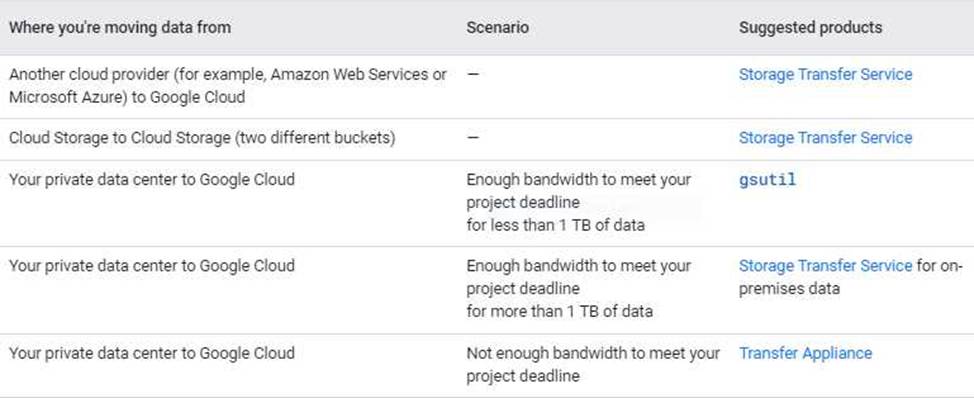
Your organization is migrating to Google Cloud. As part of that effort, it needs to move terabytes of data from on-premises file servers to Cloud Storage. Your organization wants the migration process to be automated and to be managed by Google. Your organization has an existing Dedicated Interconnect connection that it wants to use.
Which Google Cloud product or feature should your organization use?
- A . Storage Transfer Service
- B . Migrate for Anthos
- C . BigQuery Data Transfer Service
- D . Transfer Appliance
Your customer’s IT team is in the process of modernizing their customer-facing applications. They’ve witnessed others getting good results from employing microservices, and they’re keen to adopt it themselves. The first application that they are modernizing has about 5 different sub-parts, which they have identified will be the services. They also identify that each of them has different scale requirements – some services like user login are less frequently used while others like transactions are heavily used.
What technical strategy would you recommend for them?
- A . Containerize the services and orchestrate them with Google Kubernetes Engine.
- B . Retain the original application in Compute Engine and scale it as needed using Managed Instance Groups.
- C . Retain the original application as a backup and also for separately scaling the ser-vices, create new application binaries.
- D . Retain the original application in Compute Engine and scale it as needed using Unmanaged Instance Groups.
An organization wants a centralized view of their cloud infrastructure in a fully managed system that includes uptime checks.
Which Google Cloud service should they use?
- A . Cloud Trace
- B . Cloud Monitoring
- C . Cloud Logging
- D . Cloud Profiler
You are running a data warehouse on BigQuery. A partner company is offering a recommendation engine based on the data in your data warehouse. The partner company is also running their applica-tion on Google Cloud. They manage the resources in their own project, but they need access to the BigQuery dataset in your project. You want to provide the partner company with access to the dataset.
What should you do?
- A . Ask the partner to create a Service Account in their project, and have them give the Service Account access to BigQuery in their project.
- B . Create a Service Account in your own project, and grant this Service Account access to BigQuery in your project.
- C . Create a Service Account in your own project, and ask the partner to grant this Service Account access to BigQuery in their project.
- D . Ask the partner to create a Service Account in their project, and grant their Service Account access to the BigQuery dataset in your project.
Your manager wants to restrict communication of all virtual machines with internet access; with resources in another network; or with a resource outside Compute Engine. It is expected that different teams will create new folders and projects in the near future.
How would you restrict all virtual machines from having an external IP address?
- A . Define an organization policy at the root organization node to restrict virtual machine instances from having an external IP address
- B . Define an organization policy on all existing folders to define a constraint to restrict virtual machine instances from having an external IP address
- C . Define an organization policy on all existing projects to restrict virtual machine instances from having an external IP address
- D . Communicate with the different teams and agree that each time a virtual machine is created, it must be configured without an external IP address
Your manager wants to restrict communication of all virtual machines with internet access; with resources in another network; or with a resource outside Compute Engine. It is expected that different teams will create new folders and projects in the near future.
How would you restrict all virtual machines from having an external IP address?
- A . Define an organization policy at the root organization node to restrict virtual machine instances from having an external IP address
- B . Define an organization policy on all existing folders to define a constraint to restrict virtual machine instances from having an external IP address
- C . Define an organization policy on all existing projects to restrict virtual machine instances from having an external IP address
- D . Communicate with the different teams and agree that each time a virtual machine is created, it must be configured without an external IP address
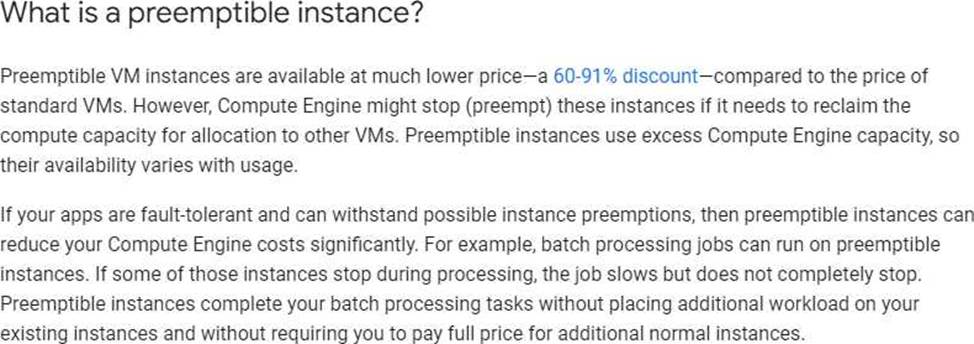
You are a program manager within a Software as a Service (SaaS) company that offers rendering software for animation studios. Your team needs the ability to allow scenes to be scheduled at will and to be interrupted at any time to restart later. Any individual scene rendering takes less than 12 hours to complete, and there is no service-level agreement (SLA) for the completion time for all scenes. Results will be stored in a global Cloud Storage bucket. The compute resources are not bound to any single geographical location. This software needs to run on Google Cloud in a cost-optimized way.
What should you do?
- A . Deploy the application on Compute Engine using preemptible instances
- B . Develop the application so it can run in an unmanaged instance group
- C . Create a reservation for the minimum number of Compute Engine instances you will use
- D . Start more instances with fewer virtual centralized processing units (vCPUs) instead of fewer instances with more vCPUs
Your organization recently migrated its compute workloads to Google Cloud. You want these
workloads in Google Cloud to privately and securely access your large volume of on-premises data,
and you also want to minimize latency.
What should your organization do?
- A . Use Storage Transfer Service to securely make your data available to Google Cloud
- B . Create a VPC between your on-premises data center and your Google resources
- C . Peer your on-premises data center to Google’s Edge Network
- D . Use Transfer Appliance to securely make your data available to Google Cloud
An organization wants to adopt the advanced machine learning capabilities of the Google Cloud.
However, regulations require data to be stored in an on-premises data center.
Which approach should the organization use?
- A . A private-cloud approach
- B . A multi-cloud approach
- C . A hybrid-cloud approach
- D . A public-cloud approach
You have deployed a new public web application that allows users to register and login with email ids, phone numbers, or user ids. You are seeing some unusual activity with user registrations and logins from a few IPs. A large number of accounts were created very quickly. Logins are also hap-pening quickly thereafter from these new accounts. Different parts of the application are being ex-plored, all of which are putting a heavy load on the application.
What could be a problem and how can you solve it?
- A . A hacker group has hired a bunch of people to create accounts and manually use the system. Use Cloud Asset Inventory to see if there have been changes in the inventory.
- B . Bots are creating accounts and then using them. Use Google Cloud’s Web App and API Protection (WAAP).
- C . Bots are creating accounts and then using them. Use Identity-Aware Proxy to re-strict the users to known users.
- D . Automated testing tools might still be running and creating accounts. Use Identity-Aware Proxy to restrict the users to known users.