
Fortinet NSE6_FSR-7.3 Practice Exams
Last updated on Oct 22,2026- Exam Code: NSE6_FSR-7.3
- Exam Name: Fortinet NSE 6 - FortiSOAR 7.3 Administrator
- Certification Provider: Fortinet
- Latest update: Oct 22,2026
What configurations are important for enhancing the performance of a recommendation engine?
- A . Increasing the font size of recommendations
- B . Filtering and preprocessing of input data
- C . Selection of relevant features for the model
- D . Regular model retraining with new data
Role-Based Access Control (RBAC) limits system access to authorized users.
What does RBAC primarily manage?
- A . The physical access to buildings
- B . Permissions based on user roles
- C . Internet bandwidth per user
- D . The number of logins per user
How can administrators export FortiSOAR system configuration?
- A . Through command line interface only
- B . Via the System Configuration section under Administration
- C . By manually copying configuration files
- D . System configuration cannot be exported
Which three roles are defined as SAML roles? (Choose three.)
- A . Service provider
- B . Role
- C . Identity provider
- D . Attribute map
- E . Principal
An administrator is issuing the following command on a node trying to join a FortiSOAR duster as a standby: csadm ha join-cluster –status active ―role secondary –primary-node 10.0. 1. 160 The node fails to join the cluster.
What is the issue?
- A . The role value should be worker.
- B . The primary node needs to be resolvable via FQDN.
- C . The IP address should be for secondary-node Instead of primary-node.
- D . The status value should be passive.
D
Explanation:
When joining a FortiSOAR cluster as a standby node, the correct status value should be passive. Using active would imply that the node is trying to join as an active node, which could cause conflicts in the cluster setup. In FortiSOAR, standby nodes must be set as passive to ensure they are recognized correctly and to avoid conflicts with the primary node or other active nodes within the cluster. Therefore, setting the status to passive will resolve the issue and allow the node to join the cluster as intended.
Select two statements that are true about FortiSOAR themes. (Choose two.)
- A . There are three theme options available: Dark, Light, and Sky.
- B . Non-administrator users can change the theme by editing their user profile
- C . FortiSOAR theme can be configured to apply to all users on the system.
- D . Selecting Revert Theme allows the user to revert the user profile theme.
What are the prerequisites for configuring applications within FortiSOAR? (Choose two)
- A . Valid license for each application
- B . Network connectivity to external application servers
- C . Specialized hardware modules
- D . Direct database modifications
For monitoring FortiSOAR’s web application server, which of the following metrics are most relevant?
- A . Network latency
- B . HTTP response times
- C . Number of active sessions
- D . Disk write speed
Which of the following are true regarding audit logs in FortiSOAR? (Choose two)
- A . They can be exported for external analysis.
- B . They are only accessible by system administrators.
- C . They include information about system errors.
- D . They are deleted after 30 days for performance reasons.
Refer to the exhibit.
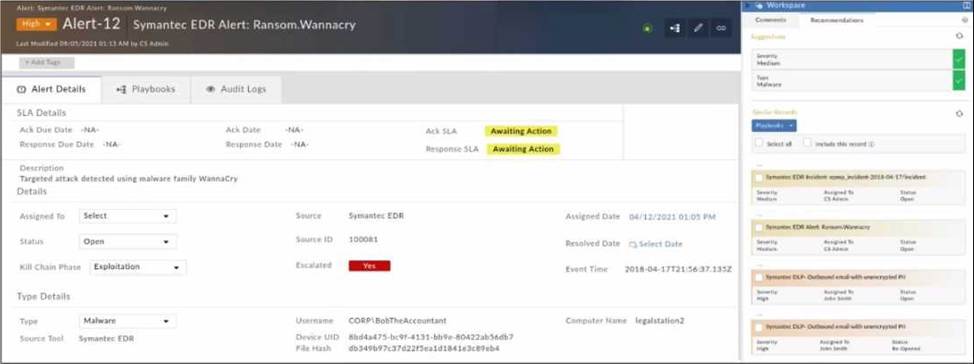
Which two statements about the recommendation engine are true? (Choose two.)
- A . There are no playbooks that can be run on the recommended alerts using the recommendation panel
- B . The dataset is trained to predict the Severity and Type fields.
- C . The recommendation engine is set to automatically accept suggestions.
- D . The alert severity is High, but the recommendation is for it to be set to Medium
B, D
Explanation:
The Recommendation Engine in FortiSOAR is designed to assist in alert triage by suggesting values for certain fields based on historical data and machine learning models. In this case, the engine is trained to predict both the Severity and Type fields, suggesting values that align with past incidents and threat intelligence. Although the current alert severity is High, the recommendation engine has suggested adjusting it to Medium based on the pattern of similar past alerts, indicating a less critical threat level than initially perceived. This functionality helps analysts by providing data-driven insights, which can optimize alert handling and resource allocation.