
Fortinet NSE6_FSR-7.3 Practice Exams
Last updated on Oct 21,2026- Exam Code: NSE6_FSR-7.3
- Exam Name: Fortinet NSE 6 - FortiSOAR 7.3 Administrator
- Certification Provider: Fortinet
- Latest update: Oct 21,2026
Differentiating between appliance authentication and user authentication is crucial.
Which of the following best describes appliance authentication?
- A . Authentication of a user’s personal device
- B . Authentication involving the verification of network devices and servers
- C . Verification of user identity through passwords or biometrics
- D . Authentication of software applications
Which statement is true regarding FortiSOAR upgrades?
- A . Upgrades should be performed during peak system usage
- B . It is not necessary to inform users about planned downtime
- C . A trial run in a test environment is recommended before upgrading production
- D . Backup is optional if the previous version was stable
Troubleshooting security management issues often involves reviewing ________ to identify recent changes or updates that could have introduced problems.
- A . user complaints
- B . network cable connections
- C . employee schedules
- D . audit logs
Which of the following can be exported from FortiSOAR for system configuration purposes?
- A . User accounts only
- B . Network settings only
- C . Incident records only
- D . All of the above
When externalizing Elasticsearch data for better management, which practices are beneficial?
- A . Using a single large disk for all data
- B . Implementing data tiering strategies
- C . Ensuring high availability through clustering
- D . Regularly updating the Elasticsearch version
Several users have informed you that the FortiSOAR GUI Is not reachable. When troubleshooting, which step should you take first?
- A . Enter the csadm license –show-details command to check if there is a duplicate license.
- B . Enter the csadm services –restart ngiax command to restart only the Nginx process.
- C . Enter the systemct1 status nginx command to gather more information.
- D . Review the connecters.log file to see what is happening to the HTTPS connections.
C
Explanation:
When troubleshooting the issue of the FortiSOAR GUI not being reachable, the first step should be to check the status of the nginx service, which is responsible for managing web requests. Using the command systemctl status nginx will provide information on whether the service is running and any potential issues or errors related to it. This approach is more efficient as it directly addresses the service responsible for the web interface, making it possible to diagnose and resolve common issues such as service failure, configuration errors, or connectivity problems.
Which two statements about appliance users are true? (Choose two.)
- A . Appliance users do not have a login ID and do not add to the license count.
- B . Appliance users represent non-human users.
- C . Appliance users use two-factor authentication for messages sent to the API.
- D . Appliance users use time-expiring tokens for primary authentication.
A, B
Explanation:
In FortiSOAR, appliance users are accounts that represent non-human entities, such as system processes or integrations. These users do not require login IDs and therefore do not contribute to the licensing user count. Appliance users are configured for backend tasks or to interact with external systems, enabling automated processes without consuming standard user licenses. This approach optimizes system resources and keeps licensing costs manageable.
Which playbook collection includes system-level playbooks that FortiSOAR uses to auto-populate date fields when the status of incident or alert records changes to Resolved or Closed?
- A . SLA Management Playbooks
- B . Utilities Playbooks
- C . Schedule Management Playbooks
- D . Approval/Manual Task Playbooks
A
Explanation:
The SLA Management Playbooks collection in FortiSOAR includes system-level playbooks designed to auto-populate date fields when the status of incident or alert records changes to Resolved or Closed. This functionality ensures that relevant date fields, such as resolution date or closure date, are accurately filled based on SLA criteria. By using SLA Management Playbooks, FortiSOAR automatically maintains date-related data integrity, which is essential for tracking and reporting purposes.
Refer to the exhibit.
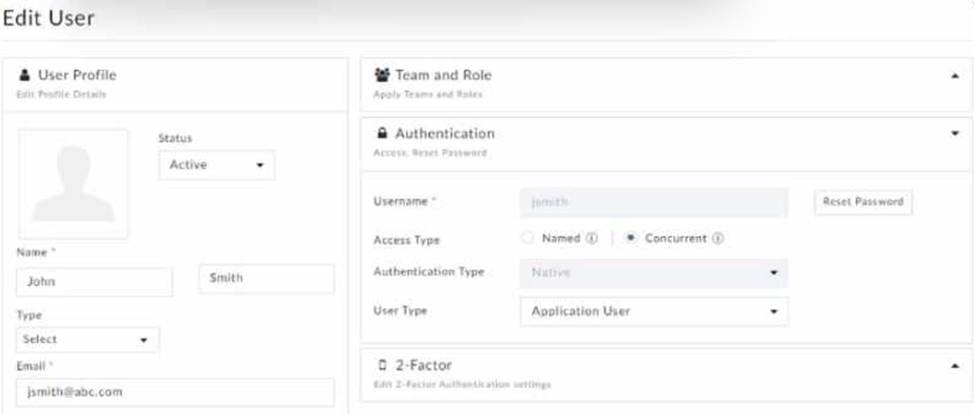
Which statement correctly describes the user’s login behavior?
- A . The user is sent to a waiting queue if there are named users logged in.
- B . The user can log in only if there are enough seats available.
- C . The user will always be able to draw from the concurrent pool and log in.
- D . The user has an active concurrent session that does not time out.
B
Explanation:
In FortiSOAR, when a user is configured with "Concurrent" access type, their ability to log in depends on the availability of concurrent user seats. This means the user can only log in if there are available seats in the concurrent pool. If all seats are occupied, the user must wait until a seat becomes free.
This configuration allows multiple users to share a pool of licenses, making it suitable for environments where not all users need constant access.
Refer to the exhibit.
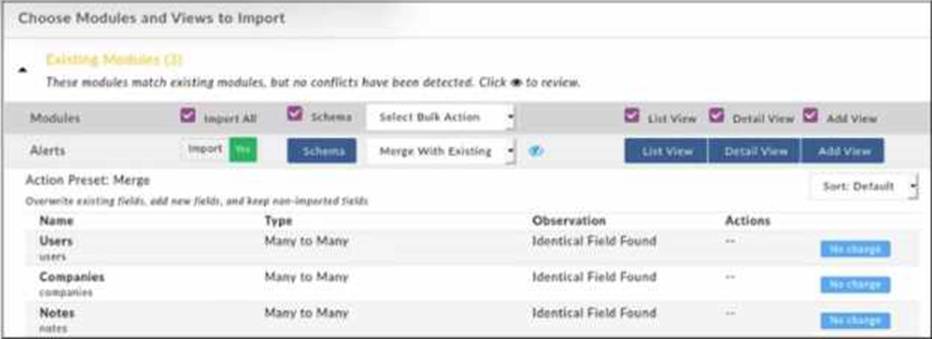
When importing modules to FortiSOAR using the configuration wizard, what actions are applied to fields it you select Merge with Existing as the Bulk action?
- A . Existing fields are kept, new fields are added, and non-imported fields are deleted.
- B . Existing Holds are overwritten, now fields are added, and non-imported fields are deleted.
- C . Existing fields are kept, new fields are added, and non-imported fields are kept.
- D . Existing fields are overwritten, new fields are added, and non-Imported fields are kept.
D
Explanation:
When importing modules into FortiSOAR using the configuration wizard and selecting "Merge with Existing" as the bulk action, the behavior for field handling is as follows: any fields that already exist in the system are overwritten with the imported values. New fields from the imported module are added to the system, while fields that are not part of the imported module remain unaffected and are retained in the system. This option ensures that existing data structures are updated with new information without losing existing, but non-imported, fields.