
Fortinet FCSS_SASE_AD-24 Practice Exams
Last updated on Oct 21,2026- Exam Code: FCSS_SASE_AD-24
- Exam Name: FCSS - FortiSASE 24 Administrator
- Certification Provider: Fortinet
- Latest update: Oct 21,2026
In FortiSASE, what role does the Secure Private Access (SPA) component play?
- A . Provides secure access to private cloud applications
- B . Monitors public internet traffic
- C . Manages user credentials
- D . Provides load balancing across multiple sites
Which FortiOS command is used to verify the connectivity between FortiSASE components and remote users?
- A . execute internet-lookup
- B . get system status
- C . diagnose debug application forticloud
- D . ping
Refer to the exhibits.
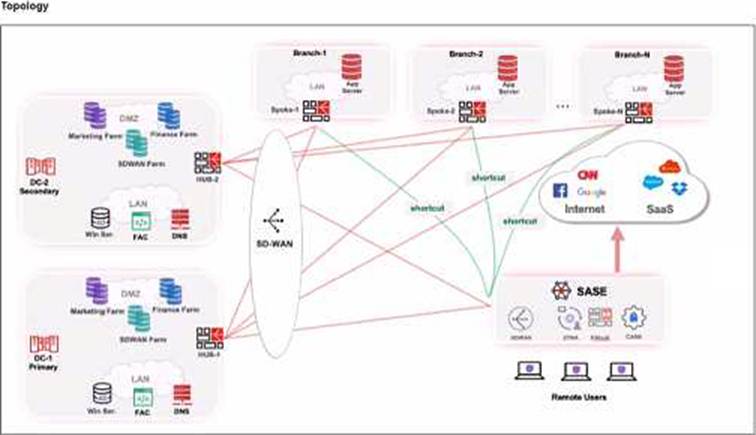
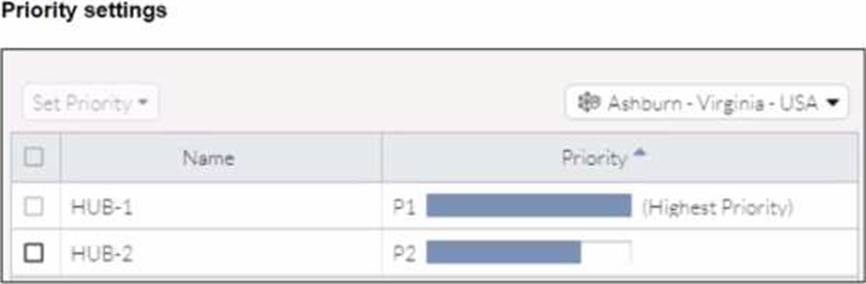
When remote users connected to FortiSASE require access to internal resources on Branch-2. how will traffic be routed?
- A . FortiSASE will use the SD-WAN capability and determine that traffic will be directed to HUB-2. which will then route traffic to Branch-2.
- B . FortiSASE will use the AD VPN protocol and determine that traffic will be directed to Branch-2 directly, using a static route
- C . FortiSASE will use the SD-WAN capability and determine that traffic will be directed to HUB-1, which will then route traffic to Branch-2.
- D . FortiSASE will use the AD VPN protocol and determine that traffic will be directed to Branch-2 directly, using a dynamic route
You are designing a new network for Company X and one of the new cybersecurity policy requirements is that all remote user endpoints must always be connected and protected.
Which FortiSASE component facilitates this always-on security measure?
- A . site-based deployment
- B . thin-branch SASE extension
- C . unified FortiClient
- D . inline-CASB
C
Explanation:
The unified FortiClient component of FortiSASE facilitates the always-on security measure required
for ensuring that all remote user endpoints are always connected and protected.
Unified FortiClient:
FortiClient is a comprehensive endpoint security solution that integrates with FortiSASE to provide continuous protection for remote user endpoints.
It ensures that endpoints are always connected to the FortiSASE infrastructure, even when users are
off the corporate network.
Always-On Security:
The unified FortiClient maintains a persistent connection to FortiSASE, enforcing security policies and protecting endpoints against threats at all times.
This ensures compliance with the cybersecurity policy requiring constant connectivity and protection
for remote users.
Reference: FortiOS 7.2 Administration Guide: Provides information on configuring and managing FortiClient for endpoint security.
FortiSASE 23.2 Documentation: Explains how FortiClient integrates with FortiSASE to deliver always-on security for remote endpoints.
Which setting is crucial when configuring logging to identify security threats effectively in FortiSASE?
- A . Log rotation frequency based on storage capacity
- B . The color theme of log entries
- C . The font size of log texts
- D . Privacy settings that obscure sensitive information
What benefits does real-time log analysis provide in FortiSASE? (Select all that apply)
- A . Immediate threat detection
- B . Improved network efficiency
- C . Real-time monitoring of user activities
- D . Enhanced compliance with security policies
Which security measures are integral to Secure Private Access (SPA) in FortiSASE? (Select all that apply)
- A . Application-level encryption
- B . Role-based access control
- C . Device posture checks
- D . Content filtering
What are two advantages of using zero-trust tags? (Choose two.)
- A . Zero-trust tags can be used to allow or deny access to network resources
- B . Zero-trust tags can determine the security posture of an endpoint.
- C . Zero-trust tags can be used to create multiple endpoint profiles which can be applied to different endpoints
- D . Zero-trust tags can be used to allow secure web gateway (SWG) access
AB
Explanation:
Zero-trust tags are critical in implementing zero-trust network access (ZTNA) policies. Here are the
two key advantages of using zero-trust tags:
Access Control (Allow or Deny):
Zero-trust tags can be used to define policies that either allow or deny access to specific network resources based on the tag associated with the user or device.
This granular control ensures that only authorized users or devices with the appropriate tags can
access sensitive resources, thereby enhancing security.
Determining Security Posture:
Zero-trust tags can be utilized to assess and determine the security posture of an endpoint.
Based on the assigned tags, FortiSASE can evaluate the device’s compliance with security policies,
such as antivirus status, patch levels, and configuration settings.
Devices that do not meet the required security posture can be restricted from accessing the network
or given limited access.
Reference: FortiOS 7.2 Administration Guide: Provides detailed information on configuring and using zero-trust tags for access control and security posture assessment.
FortiSASE 23.2 Documentation: Explains how zero-trust tags are implemented and used within the FortiSASE environment for enhancing security and compliance.
When accessing the FortiSASE portal for the first time, an administrator must select data center locations for which three FortiSASE components? (Choose three.)
- A . Endpoint management
- B . Points of presence
- C . SD-WAN hub
- D . Logging
- E . Authentication
A, B, D
Explanation:
When accessing the FortiSASE portal for the first time, an administrator must select data center locations for the following FortiSASE components: Endpoint Management:
The data center location for endpoint management ensures that endpoint data and policies are managed and stored within the chosen geographical region. Points of Presence (PoPs):
Points of Presence (PoPs) are the locations where FortiSASE services are delivered to users. Selecting
PoP locations ensures optimal performance and connectivity for users based on their geographical
distribution.
Logging:
The data center location for logging determines where log data is stored and managed. This is crucial for compliance and regulatory requirements, as well as for efficient log analysis and reporting.
Reference: FortiOS 7.2 Administration Guide: Details on initial setup and configuration steps for FortiSASE. FortiSASE 23.2 Documentation: Explains the importance of selecting data center locations for various FortiSASE components.
What are the primary goals of deploying ZTNA in a modern enterprise network?
(Choose Three)
- A . To simplify user authentication
- B . To ensure secure remote access
- C . To monitor outbound communications only
- D . To minimize the attack surface