
DELL EMC D-PVM-OE-01 Practice Exams
Last updated on Nov 16,2026- Exam Code: D-PVM-OE-01
- Exam Name: Dell PowerMax Operate v2 Exam
- Certification Provider: DELL EMC
- Latest update: Nov 16,2026
A Storage Group is serving host read/write I/O. The Storage Administrator started an MDM migration and ran a symdm sync -stop command, putting the migration in a CutoverNoSync migration state
Where does the customer data in the Storage Group reside?
- A . Only the target array
- B . Only on the source array
- C . On both the source and the target array
C
Explanation:
Step by Step Comprehensive Detailed
In an MDM (Migration for Dell EMC) migration, data is moved from a source array to a target array.
When the symdm sync -stop command is issued, it puts the migration into the CutoverNoSync state.
This state signifies that:
Synchronization Stopped: Active data synchronization between the source and target arrays has been stopped.
Data on Both Arrays: However, the customer data still resides on both the source and target arrays. This is because the CutoverNoSync state is a transitional state that allows for a controlled cutover to the target array.
The next step would typically involve a cutover operation, where host access is switched to the target array, and the source array is removed from the migration configuration.
Why other options are incorrect:
Which services are active after a Unisphere for PowerMax installation on a Microsoft Windows host?
- A . SYMAPI and symrdfg
- B . SMASandGNS
- C . SMASandSTP
- D . SMAS and smasdb
D
Explanation:
Step by Step Comprehensive Detailed
When you install Unisphere for PowerMax on a Microsoft Windows host, it installs several services necessary for its operation.
The two primary services that are active after installation are:
SMAS (Storage Management Agent Service): This service is responsible for communication between the Unisphere server and the PowerMax storage array. It handles tasks like collecting data, sending commands, and receiving alerts from the array.
smasdb: This service manages the local database used by Unisphere for storing configuration information, performance data, and other relevant information.
Why other options are incorrect:
Which services are active after a Unisphere for PowerMax installation on a Microsoft Windows host?
- A . SYMAPI and symrdfg
- B . SMASandGNS
- C . SMASandSTP
- D . SMAS and smasdb
D
Explanation:
Step by Step Comprehensive Detailed
When you install Unisphere for PowerMax on a Microsoft Windows host, it installs several services necessary for its operation.
The two primary services that are active after installation are:
SMAS (Storage Management Agent Service): This service is responsible for communication between the Unisphere server and the PowerMax storage array. It handles tasks like collecting data, sending commands, and receiving alerts from the array.
smasdb: This service manages the local database used by Unisphere for storing configuration information, performance data, and other relevant information.
Why other options are incorrect:
What is a feature unique to the PowerMax 8500 compared to the PowerMax 2500?
- A . Persistent Memory
- B . Mainframe Connectivity
- C . Storage Class Memory
- D . InfiniBand Switches
D
Explanation:
Step by Step Comprehensive Detailed
Both the PowerMax 2500 and 8500 utilize NVMe over Fabrics (NVMe-oF) for high-speed data transfer.
However, they differ in their internal fabric architecture:
PowerMax 2500: Uses a direct NVMe/PCIe connection between the compute nodes and the Dynamic Media Enclosures (DMEs).
PowerMax 8500: Employs a fully switched InfiniBand (IB) fabric for all NVMe-oF traffic. This means that the compute nodes and DMEs are interconnected through InfiniBand switches, providing a high-performance, low-latency, and scalable fabric for data transfer.
Therefore, the use of InfiniBand switches is a feature unique to the PowerMax 8500 compared to the PowerMax 2500.
Why other options are incorrect:
What does the symcf g discover command do when upgrading Solutions Enabler on a Linux host1?
- A . Identifies the running SE version
- B . Verifies that the SE daemons have been stopped
- C . Builds the SYMAPI database
- D . Creates backups of the configuration directories
A
Explanation:
Step by Step Comprehensive Detailed
When upgrading Solutions Enabler (SE) on a Linux host, the symcfg discover command plays a crucial role in preparing for the upgrade. Its primary function in this context is to:
Identify the running SE version: Before proceeding with the upgrade, it’s essential to know the current version of Solutions Enabler installed on the host. The symcfg discover command gathers information about the existing SE environment, including the version number. This information is used to determine the appropriate upgrade path and ensure compatibility.
Why other options are incorrect:
B. Verifies that the SE daemons have been stopped: While stopping SE daemons is a necessary step before the upgrade, it’s not the function of the symcfg discover command.
C. Builds the SYMAPI database: The SYMAPI database is typically built during the initial installation or after a fresh discovery.
D. Creates backups of the configuration directories: Backups are important, but they are usually handled separately as part of the upgrade process, not by the symcfg discover command itself.
Reference and documents of Dell’s public documentation for PowerMax Operate v.2:
Dell Solutions Enabler 10.0.0 Installation Guide: This guide provides detailed instructions for upgrading Solutions Enabler on different operating systems, including Linux. It explains the steps involved and the role of the symcfg discover command in the upgrade process. You can find this document on the Dell Support website by searching for "Solutions Enabler Installation Guide."
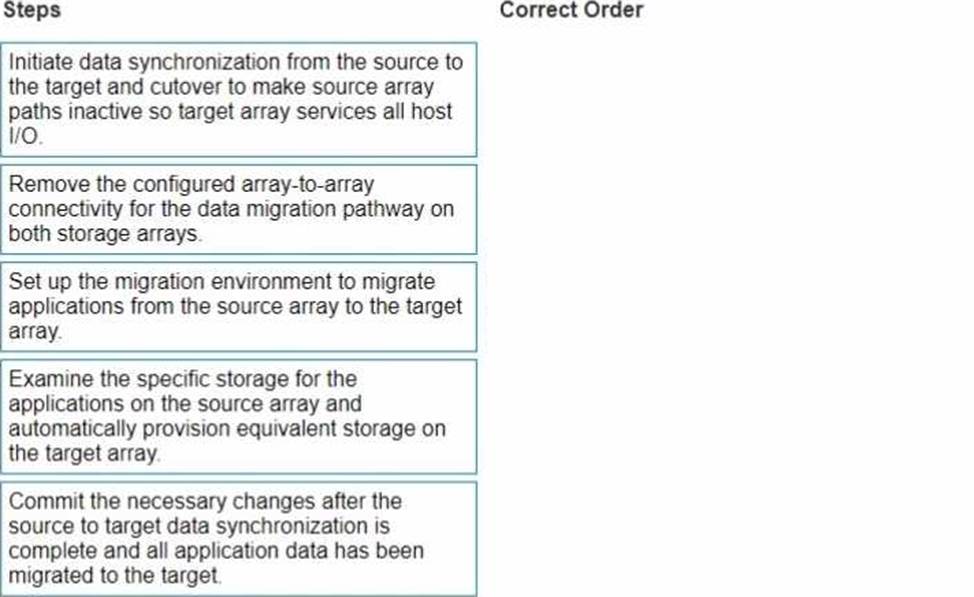
DRAG DROP
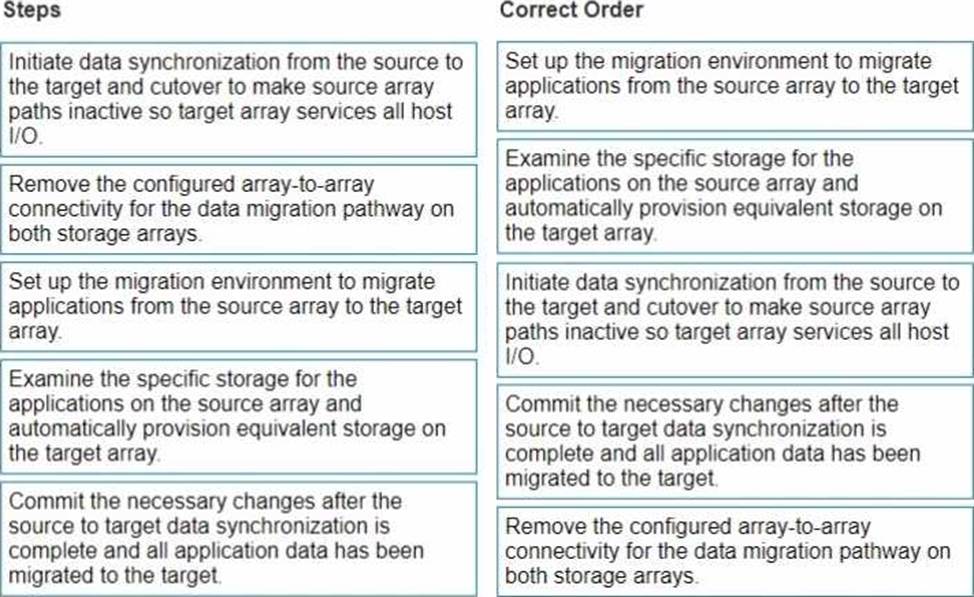
Place the steps in the correct order for performing a Non-Disruptive Migration
Explanation:
Set up the migration environment to migrate applications from the source array to the target array.
Examine the specific storage for the applications on the source array and automatically provision equivalent storage on the target array.
Initiate data synchronization from the source to the target and cutover to make source array paths inactive so target array services all host I/O.
Commit the necessary changes after the source to target data synchronization is complete and all application data has been migrated to the target.
Remove the configured array-to-array connectivity for the data migration pathway on both storage arrays.
Correct Order:
Set up the migration environment to migrate applications from the source array to the target array.
Why: This is the initial setup phase, where you configure the necessary settings on both the source and target arrays to enable the migration.
This involves actions like:
Verifying compatibility between the source and target arrays.
Ensuring that the required licenses are in place (e.g., NDM license).
Configuring network connectivity (FC or iSCSI) for data transfer between the arrays.
Examine the specific storage for the applications on the source array and automatically provision equivalent storage on the target array.
Why: Before migrating data, you need to ensure that the target array has the appropriate storage capacity and configuration to host the applications.
How: NDM can often automatically provision equivalent storage on the target based on the source configuration. This includes creating storage groups, volumes, and masking views that mirror the source.
Initiate data synchronization from the source to the target and cutover to make source array paths inactive so target array services all host I/O.
Why: This is the core of the migration process. Data is copied from the source to the target while the application continues to run. Cutover is the final step where I/O is redirected to the target array.
How:
Synchronization: Data is copied in the background.
Cutover: Once synchronization is complete, a brief cutover is performed. In a well-planned NDM, this cutover is designed to be within the I/O timeout limits of most applications.
Commit the necessary changes after the source to target data synchronization is complete and all application data has been migrated to the target.
Why: This step finalizes the migration and makes it permanent.
What it involves: The migration session is acknowledged and the configuration is finalized on the target array.
Remove the configured array-to-array connectivity for the data migration pathway on both storage arrays.
Why: After the migration is complete, the temporary connections used for data transfer between the arrays should be removed to free up resources and maintain a clean configuration.
What it involves: This typically means removing the FC zones or iSCSI settings that were configured specifically for the NDM process.
What function does the storsrvd daemon support?
- A . Manages Composite Groups and Device Groups
- B . Provides centralized gatekeeper device management
- C . Provides replication consistency protection
- D . Listens for SYMAPI sessions and management requests
D
Explanation:
The storsrvd daemon is a critical component of the Solutions Enabler (SYMCLI) software suite used to manage Dell PowerMax and VMAX storage arrays. Its primary function is to:
Listen for SYMAPI Sessions: It acts as a communication endpoint, listening for incoming SYMAPI sessions from clients or management tools like Unisphere.
Handle Management Requests: When a client connects, storsrvd receives and processes SYMAPI commands and requests, forwarding them to the appropriate components within Solutions Enabler
for execution.
Essentially, storsrvd acts as an intermediary between SYMCLI clients and the storage array, facilitating communication and management operations.
Why other options are incorrect:
What can be managed from the Configure Storage section using the Dell VSI vSphere plug-in?
- A . Remote replication
- B . Port flags
- C . Access control
- D . Snapshots
D
Explanation:
Step by Step Comprehensive Detailed
The Dell VSI (Virtual Storage Integrator) vSphere plug-in is a tool that integrates Dell storage management capabilities into the VMware vSphere environment. It allows administrators to manage storage directly from the vSphere client. Within the "Configure Storage" section of the VSI plug-in, you can manage:
Snapshots: The plug-in allows you to create, delete, and restore snapshots of virtual machines’ storage volumes. This provides a convenient way to protect data and revert to previous states if needed.
Why other options are incorrect:
What can be managed from the Configure Storage section using the Dell VSI vSphere plug-in?
- A . Remote replication
- B . Port flags
- C . Access control
- D . Snapshots
D
Explanation:
Step by Step Comprehensive Detailed
The Dell VSI (Virtual Storage Integrator) vSphere plug-in is a tool that integrates Dell storage management capabilities into the VMware vSphere environment. It allows administrators to manage storage directly from the vSphere client. Within the "Configure Storage" section of the VSI plug-in, you can manage:
Snapshots: The plug-in allows you to create, delete, and restore snapshots of virtual machines’ storage volumes. This provides a convenient way to protect data and revert to previous states if needed.
Why other options are incorrect:
What can be managed from the Configure Storage section using the Dell VSI vSphere plug-in?
- A . Remote replication
- B . Port flags
- C . Access control
- D . Snapshots
D
Explanation:
Step by Step Comprehensive Detailed
The Dell VSI (Virtual Storage Integrator) vSphere plug-in is a tool that integrates Dell storage management capabilities into the VMware vSphere environment. It allows administrators to manage storage directly from the vSphere client. Within the "Configure Storage" section of the VSI plug-in, you can manage:
Snapshots: The plug-in allows you to create, delete, and restore snapshots of virtual machines’ storage volumes. This provides a convenient way to protect data and revert to previous states if needed.
Why other options are incorrect: