
DELL EMC D-ISM-FN-01 Practice Exams
Last updated on Oct 23,2026- Exam Code: D-ISM-FN-01
- Exam Name: Dell Information Storage and Management Foundations Exam
- Certification Provider: DELL EMC
- Latest update: Oct 23,2026
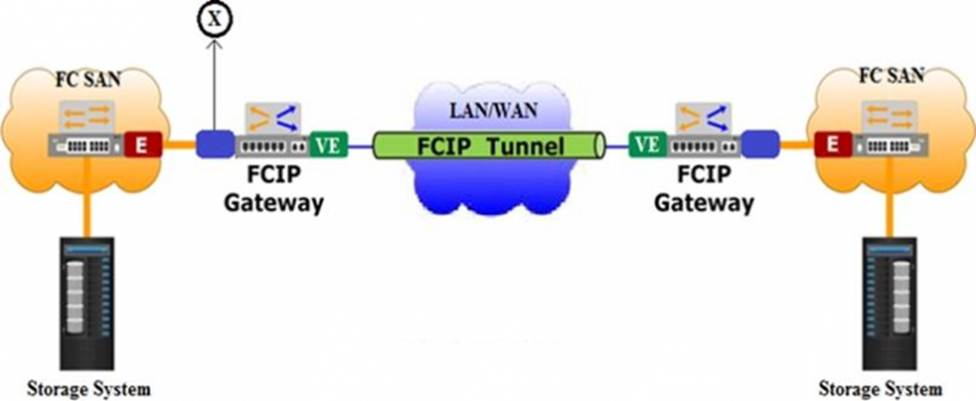
Based on the exhibit, what does the "X" represent in the FCIP tunnel configuration?
- A . E_port
- B . EX_port
- C . F_port
- D . VE_port
In a data center environment, what is an advantage of using parity-based RAID protection over mirroring?
- A . Eliminates the write penalty for improving the performance
- B . Improves the efficiency of logical disk drives in the RAID set
- C . Increases the performance of small write I/O operation
- D . Reduces the storage capacity required to protect the data
D
Explanation:
Parity-based RAID protection uses fewer physical drives than mirroring to provide the same level of data protection. It does this by using error correction codes to detect and correct errors in the data. This allows for a much more efficient use of storage capacity, as it only requires the same amount of storage capacity as the actual data, rather than requiring twice the storage capacity as with mirroring. Additionally, parity RAID systems have the advantage of being able to recover from drive failures without having to wait for the data to be rewritten to the remaining drives, as is the case with mirroring.
A RAID set is created from eight disks, and a RAID level 5 is implemented on the RAID set.
If the strip size is 32 KB, what is the stripe size?
- A . 128
- B . 160
- C . 224
- D . 256
Refer to the exhibit.
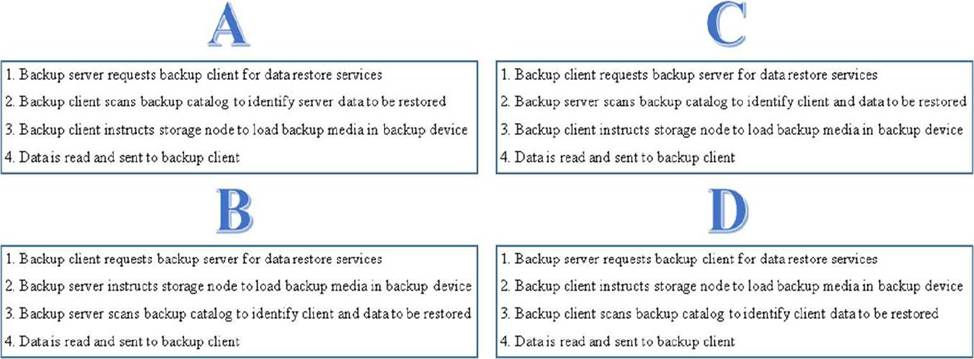
Which option shows the correct sequence of steps to perform a data recovery operation?
- A . Option A
- B . Option B
- C . Option C
- D . Option D
Which set of factors govern the overall performance of a hard disk drive?
- A . Seek time Rotational latency RAID level
- B . Seek time Rotational latency I/O operations per second
- C . Seek time Rotational latency Bandwidth
- D . Seek time Rotational latency Data transfer rate
How should vulnerabilities be managed in a data center environment? (Verify the Correct answer from Associate – Information Storage and Management Study Manual from dellemc.com)
- A . Minimize the attack surfaces and maximize the work factors
- B . Minimize the attack surfaces and minimize the work factors
- C . Maximize the attack surfaces and minimize the attack vector
- D . Maximize the attack surfaces and maximize the attack vector
A
Explanation:
According to 1, vulnerabilities are weaknesses that can be exploited by attackers to compromise the confidentiality, integrity, or availability of data or systems. Vulnerabilities can exist at various levels of a data center environment, such as applications, operating systems, networks, devices, and physical infrastructure.
One of the ways to manage vulnerabilities in a data center environment is to minimize the attack surfaces and maximize the work factors1. This means that you should reduce the number of entry points and exposure areas that an attacker can exploit (attack surfaces) and increase the amount of effort and resources that an attacker needs to overcome your defenses (work factors). This can be achieved by applying various security measures such as patching, hardening, encryption, authentication, authorization, monitoring, auditing, and testing.
Which technique protects the data in cache from power failures?
- A . Vaulting
- B . Mirroring
- C . Cache tiering
- D . Idle flushing
What is a benefit when a node is added to a scale-out NAS cluster?
- A . Increased cluster performance
- B . Reduced capital expenditure
- C . Simplified cluster management
- D . Decreased data duplication
What is a benefit of using an existing IP-based network infrastructure for storage connectivity?
- A . Provide a dedicated network for storage
- B . Provide the ability to extend the network over long distances
- C . Ensure lossless transmission of FC traffic over Ethernet
- D . Ensure security by allowing only localized data movement
If an attacker installs malware on an end-user’s computer, which type of attack does this represent?
- A . Man-in-the-middle
- B . Phishing
- C . Denial-of-Service
- D . Keystroke logging