
DELL EMC D-ISM-FN-01 Practice Exams
Last updated on Oct 21,2026- Exam Code: D-ISM-FN-01
- Exam Name: Dell Information Storage and Management Foundations Exam
- Certification Provider: DELL EMC
- Latest update: Oct 21,2026
What is the lowest to highest order of I/O performance among these storage devices?
- A . SCM–> SSD –> DRAM–> SATA
- B . SATA–> SSD–> SCM –> DRAM
- C . SSD –> SCM–> SATA–> DRAM
- D . DRAM–> SCM–> SSD-> SATA
B
Explanation:
According to the web search results, I/O performance is a measure of how fast data can be transferred between a storage device and a host system1. It depends on various factors such as the type of storage device, the interface, the workload, and the response time12.
The four storage devices you mentioned are:
SCM: Storage Class Memory, a type of persistent memory that can retain data even when power is lost. It can support both byte-level and block-level data access and has speeds nearly as fast as DRAM3.
SSD: Solid State Drive, a type of flash-based storage device that uses NAND chips to store data. It has no moving parts and offers faster read/write speeds than HDDs. It can use different interfaces such
as SATA or NVMe45.
DRAM: Dynamic Random Access Memory, a type of volatile memory that loses data when power is lost. It is used as main memory in computers and offers very fast access speeds but consumes more power than SCM3.
SATA: Serial ATA, an interface standard for connecting storage devices such as HDDs or SSDs to a host system. It offers lower bandwidth and performance than NVMe but is more widely compatible4. the correct order of I/O performance from lowest to highest among these storage devices is B. SATAC> SSDC> SCM –> DRAM. This is because SATA has lower bandwidth than NVMe which most SSDs use; SSDs have lower latency than HDDs but higher latency than SCM; SCM has lower latency than SSDs but higher latency than DRAM; and DRAM has the lowest latency and highest bandwidth among them all.
Which component initiates scheduled backups during backup operations?
- A . Backup server
- B . Backup client
- C . Backup storage node
- D . Backup device
What is an advantage of implementing an image-based backup solution in a virtualized environment?
- A . Backup process is offloaded from the production virtual machine
- B . Eliminates the need for a proxy server
- C . Eliminates the need for deduplication
- D . Backup performance is improved through agents running on virtual machines
An organization plans to deploy a new application in their environment. The new application requires 4 TB of storage space. During peak workloads, the application is expected to generate 4900 IOPS with a typical I/O size of 8 KB.
The capacity of each available disk drive is 500 GB. The maximum number of IOPS a drive can perform at with a 70 percent utilization is 110 IOPS.
What is the minimum number of disk drives needed to meet the application’s capacity and performance requirements given a RAID 0 configuration?
- A . 8
- B . 20
- C . 30
- D . 45
What accurately describes an Incident in a storage infrastructure?
- A . Unknown root cause of one or more disruptions to service.
- B . Any event that may lead to the disruption of a service.
- C . Support request to help access an IT resource.
- D . Any event that may create a change in correcting a known error.
Edge computing is crucial for IoT because:
- A . It allows for longer battery life
- B . It enables real-time data processing near the source
- C . It increases the need for bandwidth
- D . It centralizes data processing
Why do organizations need a malware protection software?
- A . Secure critical applications by using strong credentials
- B . Prevent authorized modification of OS-sensitive areas
- C . Protect applications and the OS against trojan horse programs
- D . Prevent eavesdropping and tampering of application data
What method does FCIP use to transport Fibre Channel SAN data?
- A . FCIP encapsulates and tunnels FC SAN data over Ethernet networks.
- B . FCIP encapsulates and tunnels FC SAN data over IP networks.
- C . FCIP splits LAN and FC SAN data and tunnels FC SAN data over Ethernet networks.
- D . FCIP separates LAN and FC SAN data and tunnels FC SAN data over IP networks.
Refer to the Exhibit:
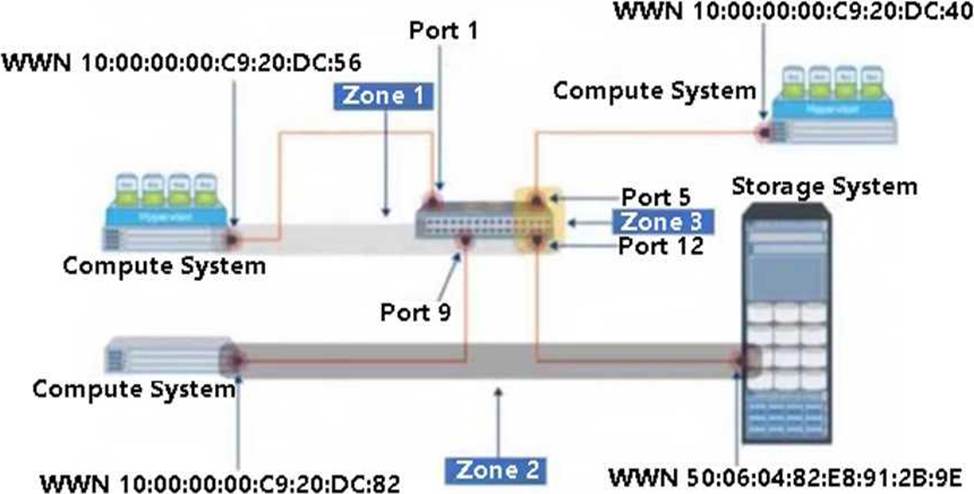
Select the option that represents the three Zone Types for each of the labeled zones.
- A . Zone1: Port
Zone2: WWW
Zone3: Fabric - B . Zone1: Mixed
Zone2: WWW
Zone3: Port - C . Zone1: Fabric
Zone2: WWW
Zone3: Mixed - D . Zone1: WWW
Zone2: Mixed
Zone3: Port
In a data archiving environment, which component scans primary storage to find the files that are required to archive?
- A . Archive stub file
- B . Archive agent
- C . Archive storage
- D . Archive database server