
Databricks Databricks Machine Learning Professional Practice Exams
Last updated on Oct 21,2026- Exam Code: Databricks Machine Learning Professional
- Exam Name: Databricks Certified Machine Learning Professional
- Certification Provider: Databricks
- Latest update: Oct 21,2026
A machine learning engineer wants to view all of the active MLflow Model Registry Webhooks for a specific model.
They are using the following code block:
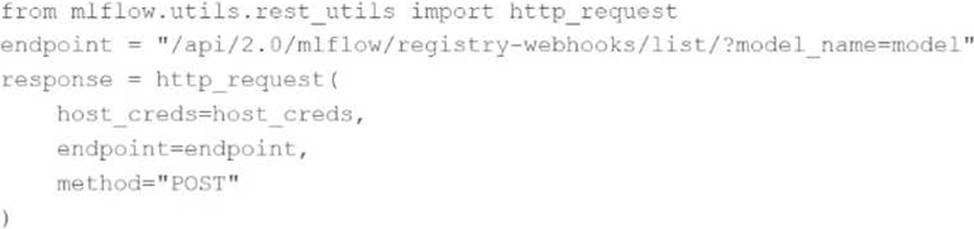
Which of the following changes does the machine learning engineer need to make to this code block so it will successfully accomplish the task?
- A . There are no necessary changes
- B . Replace list with view in the endpoint URL
- C . Replace POST with GET in the call to http request
- D . Replace list with webhooks in the endpoint URL
- E . Replace POST with PUT in the call to http request
A machine learning engineer wants to view all of the active MLflow Model Registry Webhooks for a specific model.
They are using the following code block:
Which of the following changes does the machine learning engineer need to make to this code block so it will successfully accomplish the task?
- A . There are no necessary changes
- B . Replace list with view in the endpoint URL
- C . Replace POST with GET in the call to http request
- D . Replace list with webhooks in the endpoint URL
- E . Replace POST with PUT in the call to http request
A machine learning engineer wants to log and deploy a model as an MLflow pyfunc model. They have custom preprocessing that needs to be completed on feature variables prior to fitting the model or computing predictions using that model. They decide to wrap this preprocessing in a custom model class ModelWithPreprocess, where the preprocessing is performed when calling fit and when calling predict. They then log the fitted model of the ModelWithPreprocess class as a pyfunc model.
Which of the following is a benefit of this approach when loading the logged pyfunc model for downstream deployment?
- A . The pvfunc model can be used to deploy models in a parallelizable fashion
- B . The same preprocessing logic will automatically be applied when calling fit
- C . The same preprocessing logic will automatically be applied when calling predict
- D . This approach has no impact when loading the logged Pvfunc model for downstream deployment
- E . There is no longer a need for pipeline-like machine learning objects
A data scientist has developed and logged a scikit-learn random forest model model, and then they ended their Spark session and terminated their cluster. After starting a new cluster, they want to review the feature_importances_ of the original model object.
Which of the following lines of code can be used to restore the model object so that feature_importances_ is available?
- A . mlflow.load_model(model_uri)
- B . client.list_artifacts(run_id)["feature-importances.csv"]
- C . mlflow.sklearn.load_model(model_uri)
- D . This can only be viewed in the MLflow Experiments UI
- E . client.pyfunc.load_model(model_uri)
A data scientist has created a Python function compute_features that returns a Spark DataFrame with the following schema:
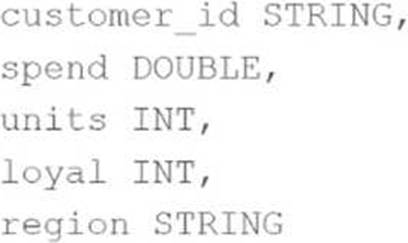
The resulting DataFrame is assigned to the features_df variable. The data scientist wants to create a Feature Store table using features_df.
Which of the following code blocks can they use to create and populate the Feature Store table using the Feature Store Client fs?
A)
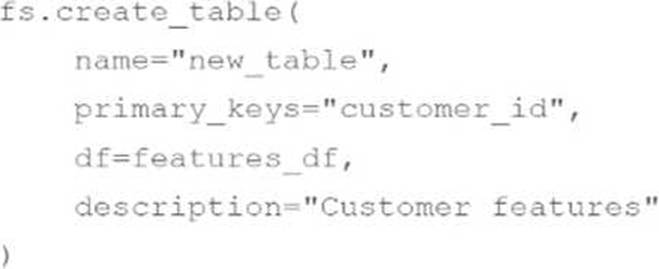
B)
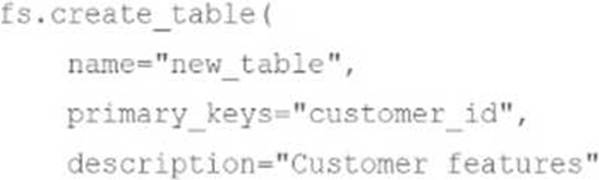
C)
features_df.write.mode("fs").path("new_table")
D)
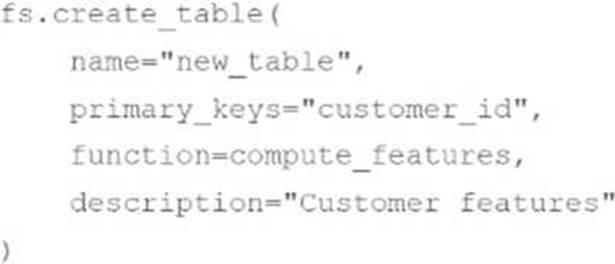
- A . Option A
- B . Option B
- C . Option C
- D . Option D
- E . features_df.write.mode("feature").path("new_table")
A data scientist set up a machine learning pipeline to automatically log a data visualization with each run. They now want to view the visualizations in Databricks.
Which of the following locations in Databricks will show these data visualizations?
- A . The MLflow Model Registry Model paqe
- B . The Artifacts section of the MLflow Experiment page
- C . Logged data visualizations cannot be viewed in Databricks
- D . The Artifacts section of the MLflow Run page
- E . The Figures section of the MLflow Run page
A data scientist is utilizing MLflow to track their machine learning experiments. After completing a series of runs for the experiment with experiment ID exp_id, the data scientist wants to programmatically work with the experiment run data in a Spark DataFrame. They have an active MLflow Client client and an active Spark session spark.
Which of the following lines of code can be used to obtain run-level results for exp_id in a Spark DataFrame?
- A . client.list_run_infos(exp_id)
- B . spark.read.format("delta").load(exp_id)
- C . There is no way to programmatically return row-level results from an MLflow Experiment.
- D . mlflow.search_runs(exp_id)
- E . spark.read.format("mlflow-experiment").load(exp_id)
A data scientist has developed a scikit-learn random forest model model, but they have not yet logged model with MLflow. They want to obtain the input schema and the output schema of the model so they can document what type of data is expected as input.
Which of the following MLflow operations can be used to perform this task?
- A . mlflow.models.schema.infer_schema
- B . mlflow.models.signature.infer_signature
- C . mlflow.models.Model.get_input_schema
- D . mlflow.models.Model.signature
- E . There is no way to obtain the input schema and the output schema of an unlogged model.
After a data scientist noticed that a column was missing from a production feature set stored as a Delta table, the machine learning engineering team has been tasked with determining when the column was dropped from the feature set.
Which of the following SQL commands can be used to accomplish this task?
- A . VERSION
- B . DESCRIBE
- C . HISTORY
- D . DESCRIBE HISTORY
- E . TIMESTAMP