
Databricks Databricks Certified Data Engineer Professional Practice Exams
Last updated on Oct 22,2026- Exam Code: Databricks Certified Data Engineer Professional
- Exam Name: Databricks Certified Data Engineer Professional Exam
- Certification Provider: Databricks
- Latest update: Oct 22,2026
A table named user_ltv is being used to create a view that will be used by data analysis on various teams. Users in the workspace are configured into groups, which are used for setting up data access using ACLs.
The user_ltv table has the following schema:
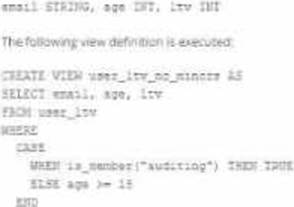
An analyze who is not a member of the auditing group executing the following query:

Which result will be returned by this query?
- A . All columns will be displayed normally for those records that have an age greater than 18; records not meeting this condition will be omitted.
- B . All columns will be displayed normally for those records that have an age greater than 17; records not meeting this condition will be omitted.
- C . All age values less than 18 will be returned as null values all other columns will be returned with the values in user_ltv.
- D . All records from all columns will be displayed with the values in user_ltv.
A DLT pipeline includes the following streaming tables:
Raw_lot ingest raw device measurement data from a heart rate tracking device.
Bgm_stats incrementally computes user statistics based on BPM measurements from raw_lot.
How can the data engineer configure this pipeline to be able to retain manually deleted or updated records in the raw_iot table while recomputing the downstream table when a pipeline update is run?
- A . Set the skipChangeCommits flag to true on bpm_stats
- B . Set the SkipChangeCommits flag to true raw_lot
- C . Set the pipelines, reset, allowed property to false on bpm_stats
- D . Set the pipelines, reset, allowed property to false on raw_iot
Where in the Spark UI can one diagnose a performance problem induced by not leveraging predicate push-down?
- A . In the Executor’s log file, by gripping for "predicate push-down"
- B . In the Stage’s Detail screen, in the Completed Stages table, by noting the size of data read from the Input column
- C . In the Storage Detail screen, by noting which RDDs are not stored on disk
- D . In the Delta Lake transaction log. by noting the column statistics
- E . In the Query Detail screen, by interpreting the Physical Plan
A data ingestion task requires a one-TB JSON dataset to be written out to Parquet with a target part-file size of 512 MB. Because Parquet is being used instead of Delta Lake, built-in file-sizing features such as Auto-Optimize & Auto-Compaction cannot be used.
Which strategy will yield the best performance without shuffling data?
- A . Set spark.sql.files.maxPartitionBytes to 512 MB, ingest the data, execute the narrow transformations, and then write to parquet.
- B . Set spark.sql.shuffle.partitions to 2,048 partitions (1TB*1024*1024/512), ingest the data, execute the narrow transformations, optimize the data by sorting it (which automatically repartitions the data), and then write to parquet.
- C . Set spark.sql.adaptive.advisoryPartitionSizeInBytes to 512 MB bytes, ingest the data, execute the narrow transformations, coalesce to 2,048 partitions (1TB*1024*1024/512), and then write to parquet.
- D . Ingest the data, execute the narrow transformations, repartition to 2,048 partitions (1TB* 1024*1024/512), and then write to parquet.
- E . Set spark.sql.shuffle.partitions to 512, ingest the data, execute the narrow transformations, and then write to parquet.
Assuming that the Databricks CLI has been installed and configured correctly, which Databricks CLI command can be used to upload a custom Python Wheel to object storage mounted with the DBFS for use with a production job?
- A . configure
- B . fs
- C . jobs
- D . libraries
- E . workspace
A data architect has designed a system in which two Structured Streaming jobs will concurrently write to a single bronze Delta table. Each job is subscribing to a different topic from an Apache Kafka source, but they will write data with the same schema. To keep the directory structure simple, a data engineer has decided to nest a checkpoint directory to be shared by both streams.
The proposed directory structure is displayed below:
Which statement describes whether this checkpoint directory structure is valid for the given scenario and why?
- A . No; Delta Lake manages streaming checkpoints in the transaction log.
- B . Yes; both of the streams can share a single checkpoint directory.
- C . No; only one stream can write to a Delta Lake table.
- D . Yes; Delta Lake supports infinite concurrent writers.
- E . No; each of the streams needs to have its own checkpoint directory.
Which REST API call can be used to review the notebooks configured to run as tasks in a multi-task job?
- A . /jobs/runs/list
- B . /jobs/runs/get-output
- C . /jobs/runs/get
- D . /jobs/get
- E . /jobs/list
A junior member of the data engineering team is exploring the language interoperability of Databricks notebooks. The intended outcome of the below code is to register a view of all sales that occurred in countries on the continent of Africa that appear in the geo_lookup table.
Before executing the code, running SHOW TABLES on the current database indicates the database contains only two tables: geo_lookup and sales.
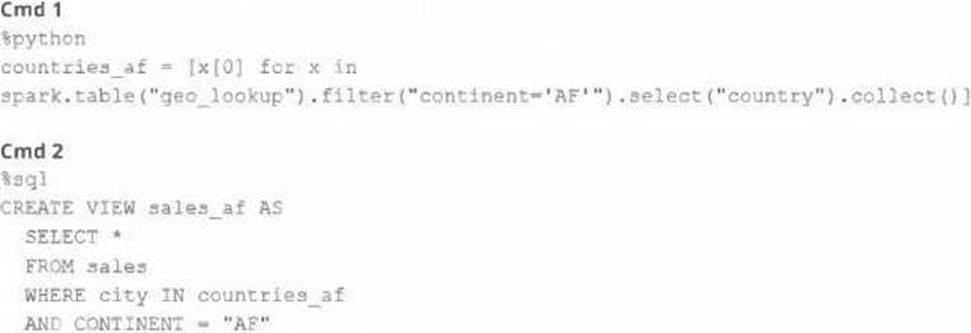
Which statement correctly describes the outcome of executing these command cells in order in an interactive notebook?
- A . Both commands will succeed. Executing show tables will show that countries at and sales at have been registered as views.
- B . Cmd 1 will succeed. Cmd 2 will search all accessible databases for a table or view named countries af: if this entity exists, Cmd 2 will succeed.
- C . Cmd 1 will succeed and Cmd 2 will fail, countries at will be a Python variable representing a PySpark DataFrame.
- D . Both commands will fail. No new variables, tables, or views will be created.
- E . Cmd 1 will succeed and Cmd 2 will fail, countries at will be a Python variable containing a list of strings.
A CHECK constraint has been successfully added to the Delta table named activity_details using the following logic:
A batch job is attempting to insert new records to the table, including a record where latitude = 45.50 and longitude = 212.67.
Which statement describes the outcome of this batch insert?
- A . The write will fail when the violating record is reached; any records previously processed will be recorded to the target table.
- B . The write will fail completely because of the constraint violation and no records will be inserted into the target table.
- C . The write will insert all records except those that violate the table constraints; the violating records will be recorded to a quarantine table.
- D . The write will include all records in the target table; any violations will be indicated in the boolean column named valid_coordinates.
- E . The write will insert all records except those that violate the table constraints; the violating records will be reported in a warning log.
The data architect has decided that once data has been ingested from external sources into the Databricks Lakehouse, table access controls will be leveraged to manage permissions for all production tables and views.
The following logic was executed to grant privileges for interactive queries on a production database to the core engineering group.
GRANT USAGE ON DATABASE prod TO eng;
GRANT SELECT ON DATABASE prod TO eng;
Assuming these are the only privileges that have been granted to the eng group and that these users are not workspace administrators, which statement describes their privileges?
- A . Group members have full permissions on the prod database and can also assign permissions to other users or groups.
- B . Group members are able to list all tables in the prod database but are not able to see the results of any queries on those tables.
- C . Group members are able to query and modify all tables and views in the prod database, but cannot create new tables or views.
- D . Group members are able to query all tables and views in the prod database, but cannot create or edit anything in the database.
- E . Group members are able to create, query, and modify all tables and views in the prod database, but cannot define custom functions.