
Databricks Databricks Certified Data Engineer Professional Practice Exams
Last updated on Oct 22,2026- Exam Code: Databricks Certified Data Engineer Professional
- Exam Name: Databricks Certified Data Engineer Professional Exam
- Certification Provider: Databricks
- Latest update: Oct 22,2026
In order to facilitate near real-time workloads, a data engineer is creating a helper function to leverage the schema detection and evolution functionality of Databricks Auto Loader. The desired function will automatically detect the schema of the source directly, incrementally process JSON files as they arrive in a source directory, and automatically evolve the schema of the table when new fields are detected.
The function is displayed below with a blank:
Which response correctly fills in the blank to meet the specified requirements?
- A . Option A
- B . Option B
- C . Option C
- D . Option D
- E . Option E
A junior data engineer on your team has implemented the following code block.
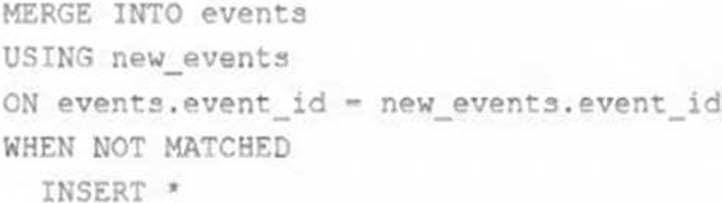
The view new_events contains a batch of records with the same schema as the events Delta table.
The event_id field serves as a unique key for this table.
When this query is executed, what will happen with new records that have the same event_id as an existing record?
- A . They are merged.
- B . They are ignored.
- C . They are updated.
- D . They are inserted.
- E . They are deleted.
The business intelligence team has a dashboard configured to track various summary metrics for retail stories. This includes total sales for the previous day alongside totals and averages for a variety of time periods.
The fields required to populate this dashboard have the following schema:
For Demand forecasting, the Lakehouse contains a validated table of all itemized sales updated ncrementally in near real-time. This table named products_per_order, includes the following fields:
Because reporting on long-term sales trends is less volatile, analysts using the new dashboard only require data to be refreshed once daily. Because the dashboard will be queried interactively by many users throughout a normal business day, it should return results quickly and reduce total compute associated with each materialization.
Which solution meets the expectations of the end users while controlling and limiting possible costs?
- A . Use the Delta Cache to persists the products_per_order table in memory to quickly the dashboard with each query.
- B . Populate the dashboard by configuring a nightly batch job to save the required to quickly update the dashboard with each query.
- C . Use Structure Streaming to configure a live dashboard against the products_per_order table within a Databricks notebook.
- D . Define a view against the products_per_order table and define the dashboard against this view.
The view updates represents an incremental batch of all newly ingested data to be inserted or updated in the customers table.
The following logic is used to process these records.
MERGE INTO customers
USING (
SELECT updates.customer_id as merge_ey, updates .*
FROM updates
UNION ALL
SELECT NULL as merge_key, updates .*
FROM updates JOIN customers
ON updates.customer_id = customers.customer_id
WHERE customers.current = true AND updates.address <> customers.address ) staged_updates
ON customers.customer_id = mergekey
WHEN MATCHED AND customers. current = true AND customers.address <> staged_updates.address
THEN
UPDATE SET current = false, end_date = staged_updates.effective_date
WHEN NOT MATCHED THEN
INSERT (customer_id, address, current, effective_date, end_date) VALUES (staged_updates.customer_id, staged_updates.address, true, staged_updates.effective_date, null)
Which statement describes this implementation?
- A . The customers table is implemented as a Type 2 table; old values are overwritten and new customers are appended.
- B . The customers table is implemented as a Type 1 table; old values are overwritten by new values and no history is maintained.
- C . The customers table is implemented as a Type 2 table; old values are maintained but marked as no longer current and new values are inserted.
- D . The customers table is implemented as a Type 0 table; all writes are append only with no changes to existing values.
A Delta Lake table was created with the below query:
Consider the following query:
DROP TABLE prod.sales_by_store –
If this statement is executed by a workspace admin, which result will occur?
- A . Nothing will occur until a COMMIT command is executed.
- B . The table will be removed from the catalog but the data will remain in storage.
- C . The table will be removed from the catalog and the data will be deleted.
- D . An error will occur because Delta Lake prevents the deletion of production data.
- E . Data will be marked as deleted but still recoverable with Time Travel.
Which statement describes the correct use of pyspark.sql.functions.broadcast?
- A . It marks a column as having low enough cardinality to properly map distinct values to available partitions, allowing a broadcast join.
- B . It marks a column as small enough to store in memory on all executors, allowing a broadcast join.
- C . It caches a copy of the indicated table on attached storage volumes for all active clusters within a Databricks workspace.
- D . It marks a DataFrame as small enough to store in memory on all executors, allowing a broadcast join.
- E . It caches a copy of the indicated table on all nodes in the cluster for use in all future queries during the cluster lifetime.
Spill occurs as a result of executing various wide transformations. However, diagnosing spill requires one to proactively look for key indicators.
Where in the Spark UI are two of the primary indicators that a partition is spilling to disk?
- A . Stage’s detail screen and Executor’s files
- B . Stage’s detail screen and Query’s detail screen
- C . Driver’s and Executor’s log files
- D . Executor’s detail screen and Executor’s log files
The data science team has created and logged a production model using MLflow. The following code correctly imports and applies the production model to output the predictions as a new DataFrame named preds with the schema "customer_id LONG, predictions DOUBLE, date DATE".
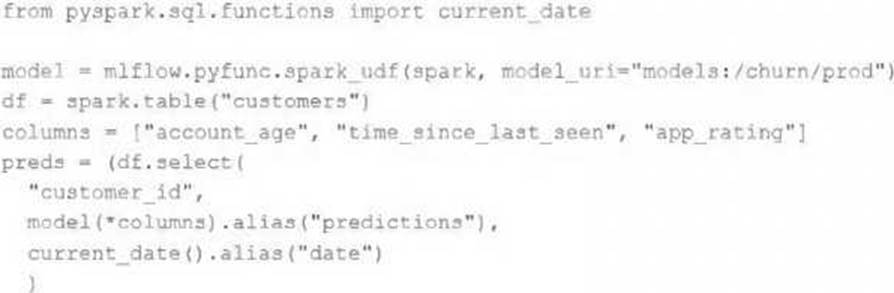
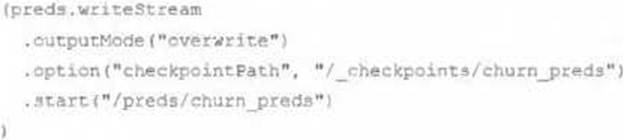
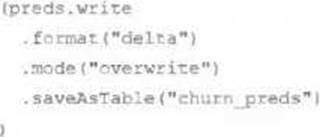
The data science team would like predictions saved to a Delta Lake table with the ability to compare all predictions across time. Churn predictions will be made at most once per day.
Which code block accomplishes this task while minimizing potential compute costs?
A) preds.write.mode("append").saveAsTable("churn_preds")
B) preds.write.format("delta").save("/preds/churn_preds")
C)
D)
E)
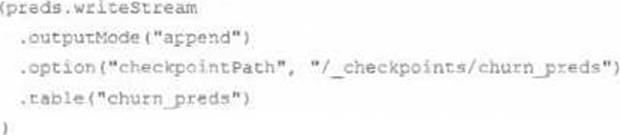
- A . Option A
- B . Option B
- C . Option C
- D . Option D
- E . Option E
Which is a key benefit of an end-to-end test?
- A . It closely simulates real world usage of your application.
- B . It pinpoint errors in the building blocks of your application.
- C . It provides testing coverage for all code paths and branches.
- D . It makes it easier to automate your test suite
When a junior developer uses an old version of logic in their notebook due to using a personal branch, which approach allows them to review the current logic?
- A . Pull changes from the remote Git repository and switch to the branch dev-2.3.9
- B . Make a pull request using the Databricks REST API to update the current branch to dev-2.3.9
- C . Checkout the dev-2.3.9 branch directly and auto-resolve conflicts
- D . Merge all changes back to the main branch in the remote Git repository and clone the repo again