
CompTIA SY0-701 Practice Exams
Last updated on Nov 16,2026- Exam Code: SY0-701
- Exam Name: CompTIA Security+
- Certification Provider: CompTIA
- Latest update: Nov 16,2026
A penetration test identifies that an SMBvl Is enabled on multiple servers across an organization. The organization wants to remediate this vulnerability in the most efficient way possible.
Which of the following should the organization use for this purpose?
- A . GPO
- B . ACL
- C . SFTP
- D . DLP
A
Explanation:
"Group Policy Objects (GPOs) are a feature of Microsoft Windows Active Directory that allow administrators to centrally manage and configure settings across multiple systems in an efficient manner. When a vulnerability such as SMBv1 (Server Message Block version 1) is identified on multiple servers, GPOs can be used to disable this outdated and insecure protocol across all affected systems simultaneously. By creating a GPO to enforce a policy that disables SMBv1, the organization can ensure consistent remediation without manually configuring each server individually, making it the most efficient solution for domain-joined environments."
Reference: CompTIA Security+ SY0-701 Study Guide, Domain 3.0: Implementation, Section: "Secure System Configuration" (GPOs are covered under centralized management tools for implementing security policies).
SMBv1 is an outdated and vulnerable protocol that should be disabled to mitigate risks, such as exploitation by attacks like WannaCry. The question emphasizes efficiency across multiple servers. Option A (GPO) allows an organization to push a policy to disable SMBv1 across all servers in an Active Directory environment with minimal effort, making it the most efficient choice. Option B (ACL) refers to Access Control Lists, which manage permissions but aren’t designed for protocol configuration. Option C (SFTP) is a secure file transfer protocol unrelated to SMBv1 remediation. Option D (DLP) focuses on data loss prevention, not protocol vulnerabilities. Thus, A is the correct and most efficient solution.
A hacker gained access to a system via a phishing attempt that was a direct result of a user clicking a suspicious link. The link laterally deployed ransomware, which laid dormant for multiple weeks, across the network.
Which of the following would have mitigated the spread?
- A . IPS
- B . IDS
- C . WAF
- D . UAT
A
Explanation:
IPS stands for intrusion prevention system, which is a network security device that monitors and blocks malicious traffic in real time. IPS is different from IDS, which only detects and alerts on malicious traffic, but does not block it. IPS would have mitigated the spread of ransomware by preventing the hacker from accessing the system via the phishing link, or by stopping the ransomware from communicating with its command and control server or encrypting the files.
A security analyst receives an alert from a corporate endpoint used by employees to issue visitor badges.
The alert contains the following details:
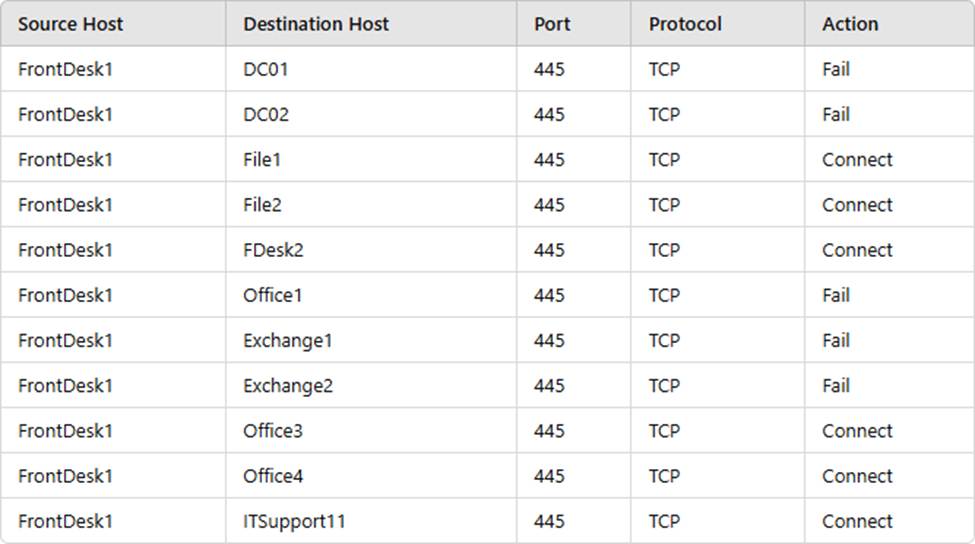
Which of the following best describes the indicator that triggered the alert?
- A . Blocked content
- B . Brute-force attack
- C . Concurrent session usage
- D . Account lockout
B
Explanation:
Detailed The activity described in the table, where multiple connection attempts are made on port 445 (used for SMB services), suggests a brute-force attack. The attacker likely used automated methods to guess credentials, causing multiple failures. Such attempts are a hallmark of brute-force attacks targeting shared resources.
Reference: CompTIA Security+ SY0-701 Study Guide, Domain 4: Security Operations, Section: "Indicators of Malicious Activity".
Which of the following tools is best for logging and monitoring in a cloud environment?
- A . IPS
- B . FIM
- C . NAC
- D . SIEM
An administrator was notified that a user logged in remotely after hours and copied large amounts of data to a personal device.
Which of the following best describes the user’s activity?
- A . Penetration testing
- B . Phishing campaign
- C . External audit
- D . Insider threat
D
Explanation:
An insider threat is a security risk that originates from within the organization, such as an employee, contractor, or business partner, who has authorized access to the organization’s data and systems. An insider threat can be malicious, such as stealing, leaking, or sabotaging sensitive data, or unintentional, such as falling victim to phishing or social engineering. An insider threat can cause significant damage to the organization’s reputation, finances, operations, and legal compliance. The user’s activity of logging in remotely after hours and copying large amounts of data to a personal device is an example of a malicious insider threat, as it violates the organization’s security policies and compromises the confidentiality and integrity of the data.
Reference = Insider Threats C CompTIA Security+ SY0-701: 3.2, video at 0:00; CompTIA Security+ SY0-701 Certification Study Guide, page 133.
While investigating a recent security breach an analyst finds that an attacker gained access by SOL infection through a company website.
Which of the following should the analyst recommend to the website developers to prevent this from reoccurring?
- A . Secure cookies
- B . Input sanitization
- C . Code signing
- D . Blocklist
B
Explanation:
Input sanitization is a critical security measure to prevent SQL injection attacks, which occur when an attacker exploits vulnerabilities in a website’s input fields to execute malicious SQL code. By properly sanitizing and validating all user inputs, developers can prevent malicious code from being executed, thereby securing the website against such attacks.
Reference = CompTIA Security+ SY0-701 study materials, particularly in the domain of web application security and common vulnerability mitigation strategies.
A recent penetration test identified that an attacker could flood the MAC address table of network switches.
Which of the following would best mitigate this type of attack?
- A . Load balancer
- B . Port security
- C . IPS
- D . NGFW
B
Explanation:
Port security is the best mitigation technique for preventing an attacker from flooding the MAC address table of network switches. Port security can limit the number of MAC addresses learned on a port, preventing an attacker from overwhelming the switch’s MAC table (a form of MAC flooding attack). When the allowed number of MAC addresses is exceeded, port security can block additional devices or trigger alerts.
Load balancer distributes network traffic but does not address MAC flooding attacks.
IPS (Intrusion Prevention System) detects and prevents attacks but isn’t specifically designed for MAC flooding mitigation.
NGFW (Next-Generation Firewall) offers advanced traffic inspection but is not directly involved in MAC table security.
Which of the following would most likely be deployed to obtain and analyze attacker activity and techniques?
- A . Firewall
- B . IDS
- C . Honeypot
- D . Layer 3 switch
A program manager wants to ensure contract employees can only use the company’s computers Monday through Friday from 9 a.m. to 5 p.m.
Which of the following would best enforce this access control?
- A . Creating a GPO for all contract employees and setting time-of-day log-in restrictions
- B . Creating a discretionary access policy and setting rule-based access for contract employees
- C . Implementing an OAuth server and then setting least privilege for contract employees
- D . Implementing SAML with federation to the contract employees’ authentication server
A
Explanation:
The most appropriate method is to use a Group Policy Object (GPO) with time-of-day restrictions (A). This is a native capability in Windows environments that allows administrators to control when users are allowed to log in to domain-joined systems.
This aligns with Domain 3.1: Given a scenario, apply identity and access management (IAM) concepts, especially under “Access controls (e.g., time-based restrictions, GPOs, least privilege).”
Reference: CompTIA Security+ SY0-701 Objectives, Domain 3.1 C “Access controls: Time-based restrictions, GPO.”
After a recent ransomware attack on a company’s system, an administrator reviewed the log files.
Which of the following control types did the administrator use?
- A . Compensating
- B . Detective
- C . Preventive
- D . Corrective
B
Explanation:
Detective controls are security measures that are designed to identify and monitor any malicious activity or anomalies on a system or network. They can help to discover the source, scope, and impact of an attack, and provide evidence for further analysis or investigation. Detective controls include log files, security audits, intrusion detection systems, network monitoring tools, and antivirus software. In this case, the administrator used log files as a detective control to review the ransomware attack on the company’s system. Log files are records of events and activities that occur on a system or network, such as user actions, system errors, network traffic, and security alerts. They can provide valuable information for troubleshooting, auditing, and forensics.
Reference: Security+ (Plus) Certification | CompTIA IT Certifications, under “About the exam”, bullet point 3: “Operate with an awareness of applicable regulations and policies, including principles of governance, risk, and compliance.”
CompTIA Security+ Certification Kit: Exam SY0-701, 7th Edition, Chapter 1, page 14: “Detective controls are designed to identify and monitor any malicious activity or anomalies on a system or network.”
Control Types C CompTIA Security+ SY0-401: 2.1 – Professor Messer IT …, under “Detective Controls”: “Detective controls are security measures that are designed to identify and monitor any malicious activity or anomalies on a system or network.”