
CompTIA SY0-701 Practice Exams
Last updated on Nov 16,2026- Exam Code: SY0-701
- Exam Name: CompTIA Security+
- Certification Provider: CompTIA
- Latest update: Nov 16,2026
A security analyst receives an alert that there was an attempt to download known malware.
Which of the following actions would allow the best chance to analyze the malware?
- A . Review the IPS logs and determine which command-and-control IPs were blocked.
- B . Analyze application logs to see how the malware attempted to maintain persistence.
- C . Run vulnerability scans to check for systems and applications that are vulnerable to the malware.
- D . Obtain and execute the malware in a sandbox environment and perform packet captures.
D
Explanation:
To analyze malware behavior in detail, the best approach is to execute the malware in a sandbox (D) and capture its network activity. This provides real-time analysis of how the malware behaves, spreads, and communicates.
This method is highlighted in Domain 2.1 under "Analyzing indicators of compromise" and using sandboxing and packet capture to study malware.
Reference: CompTIA Security+ SY0-701 Objectives, Domain 2.1 C “Indicators of malicious activity:
Perform packet captures; sandboxing for malware analysis.”
Employees located off-site must have access to company resources in order to complete their assigned tasks These employees utilize a solution that allows remote access without interception concerns.
Which of the following best describes this solution?
- A . Proxy server
- B . NGFW
- C . VPN
- D . Security zone
C
Explanation:
A Virtual Private Network (VPN) is the best solution to allow remote employees secure access to company resources without interception concerns. A VPN establishes an encrypted tunnel over the internet, ensuring that data transferred between remote employees and the company is secure from eavesdropping.
Proxy server helps with web content filtering and anonymization but does not provide encrypted access.
NGFW (Next-Generation Firewall) enhances security but is not the primary tool for enabling remote access.
Security zone is a network segmentation technique but does not provide remote access capabilities.
Several employees received a fraudulent text message from someone claiming to be the Chief Executive Officer (CEO).
The message stated:
“I’m in an airport right now with no access to email. I need you to buy gift cards for employee recognition awards. Please send the gift cards to following email address.”
Which of the following are the best responses to this situation? (Choose two).
- A . Cancel current employee recognition gift cards.
- B . Add a smishing exercise to the annual company training.
- C . Issue a general email warning to the company.
- D . Have the CEO change phone numbers.
- E . Conduct a forensic investigation on the CEO’s phone.
- F . Implement mobile device management.
B,C
Explanation:
This situation is an example of smishing, which is a type of phishing that uses text messages (SMS) to entice individuals into providing personal or sensitive information to cybercriminals. The best responses to this situation are to add a smishing exercise to the annual company training and to issue a general email warning to the company. A smishing exercise can help raise awareness and educate employees on how to recognize and avoid smishing attacks. An email warning can alert employees to the fraudulent text message and remind them to verify the identity and legitimacy of any requests for information or money.
Reference = What Is Phishing | Cybersecurity | CompTIA, Phishing C SY0-601 CompTIA Security+: 1.1 – Professor Messer IT Certification Training Courses
Which of the following is a feature of a next-generation SIEM system?
- A . Virus signatures
- B . Automated response actions
- C . Security agent deployment
- D . Vulnerability scanning
The Chief Information Security Officer of an organization needs to ensure recovery from ransomware would likely occur within the organization’s agreed-upon RPOs end RTOs.
Which of the following backup scenarios would best ensure recovery?
- A . Hourly differential backups stored on a local SAN array
- B . Dally full backups stored on premises in magnetic offline media
- C . Daly differential backups maintained by a third-party cloud provider
- D . Weekly full backups with daily incremental stored on a NAS drive
D
Explanation:
A backup strategy that combines weekly full backups with daily incremental backups stored on a NAS (Network Attached Storage) drive is likely to meet an organization’s Recovery Point Objectives (RPOs) and Recovery Time Objectives (RTOs). This approach ensures that recent data is regularly backed up and that recovery can be done efficiently, without significant data loss or lengthy downtime.
Reference =
CompTIA Security+ SY0-701 Course Content: Domain 05 Security Program Management and Oversight.
CompTIA Security+ SY0-601 Study Guide: Chapter on Disaster Recovery and Backup Strategies.
After a security awareness training session, a user called the IT help desk and reported a suspicious call. The suspicious caller stated that the Chief Financial Officer wanted credit card information in order to close an invoice.
Which of the following topics did the user recognize from the training?
- A . Insider threat
- B . Email phishing
- C . Social engineering
- D . Executive whaling
C
Explanation:
Social engineering is the practice of manipulating people into performing actions or divulging confidential information, often by impersonating someone else or creating a sense of urgency or trust. The suspicious caller in this scenario was trying to use social engineering to trick the user into giving away credit card information by pretending to be the CFO and asking for a payment. The user recognized this as a potential scam and reported it to the IT help desk. The other topics are not relevant to this situation.
Reference: CompTIA Security+ Study Guide: Exam SY0-701, 9th Edition, page 19 1
A newly appointed board member with cybersecurity knowledge wants the board of directors to receive a quarterly report detailing the number of incidents that impacted the organization. The systems administrator is creating a way to present the data to the board of directors.
Which of the following should the systems administrator use?
- A . Packet captures
- B . Vulnerability scans
- C . Metadata
- D . Dashboard
D
Explanation:
A dashboard is a graphical user interface that provides a visual representation of key performance indicators, metrics, and trends related to security events and incidents. A dashboard can help the board of directors to understand the number and impact of incidents that affected the organization in a given period, as well as the status and effectiveness of the security controls and processes. A dashboard can also allow the board of directors to drill down into specific details or filter the data by various criteria12.
A packet capture is a method of capturing and analyzing the network traffic that passes through a device or a network segment. A packet capture can provide detailed information about the source, destination, protocol, and content of each packet, but it is not a suitable way to present a summary of incidents to the board of directors13.
A vulnerability scan is a process of identifying and assessing the weaknesses and exposures in a system or a network that could be exploited by attackers. A vulnerability scan can help the organization to prioritize and remediate the risks and improve the security posture, but it is not a relevant way to report the number of incidents that occurred in a quarter14.
Metadata is data that describes other data, such as its format, origin, structure, or context. Metadata can provide useful information about the characteristics and properties of data, but it is not a meaningful way to communicate the impact and frequency of incidents to the board of directors.
Reference = 1: CompTIA Security+ SY0-701 Certification Study Guide, page 3722: SIEM Dashboards C SY0-601 CompTIA Security+: 4.3, video by Professor Messer3: CompTIA Security+ SY0-701 Certification Study Guide, page 3464: CompTIA Security+ SY0-701 Certification Study Guide, page 362.: CompTIA Security+ SY0-701 Certification Study Guide, page 97.
Which of the following security concepts is accomplished with the installation of a RADIUS server?
- A . CIA
- B . AA
- C . ACL
- D . PEM
A security analyst finds a rogue device during a monthly audit of current endpoint assets that are connected to the network. The corporate network utilizes 002.1X for access control. To be allowed on the network, a device must have a Known hardware address, and a valid user name and password must be entered in a captive portal.
The following is the audit report:
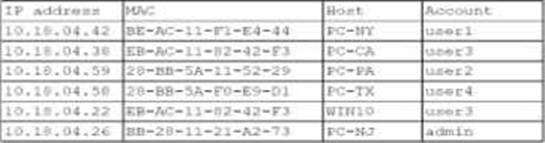
Which of the following is the most likely way a rogue device was allowed to connect?
- A . A user performed a MAC cloning attack with a personal device.
- B . A DMCP failure caused an incorrect IP address to be distributed
- C . An administrator bypassed the security controls for testing.
- D . DNS hijacking let an attacker intercept the captive portal traffic.
Users at a company are reporting they are unable to access the URL for a new retail website because it is flagged as gambling and is being blocked.
Which of the following changes would allow users to access the site?
- A . Creating a firewall rule to allow HTTPS traffic
- B . Configuring the IPS to allow shopping
- C . Tuning the DLP rule that detects credit card data
- D . Updating the categorization in the content filter
D
Explanation:
A content filter is a device or software that blocks or allows access to web content based on predefined rules or categories. In this case, the new retail website is mistakenly categorized as gambling by the content filter, which prevents users from accessing it. To resolve this issue, the content filter’s categorization needs to be updated to reflect the correct category of the website, such as shopping or retail. This will allow the content filter to allow access to the website instead of blocking it.
Reference: CompTIA Security+ Study Guide: Exam SY0-701, 9th Edition, Chapter 3: Technologies and Tools, page 1221. CompTIA Security+ Certification Kit: Exam SY0-701, 7th Edition, Chapter 3:
Technologies and Tools, page 1222.