
CompTIA SY0-701 Practice Exams
Last updated on Nov 16,2026- Exam Code: SY0-701
- Exam Name: CompTIA Security+
- Certification Provider: CompTIA
- Latest update: Nov 16,2026
Which of the following would be the best solution to deploy a low-cost standby site that includes hardware and internet access?
- A . Recovery site
- B . Cold site
- C . Hot site
- D . Warm site
HOTSPOT
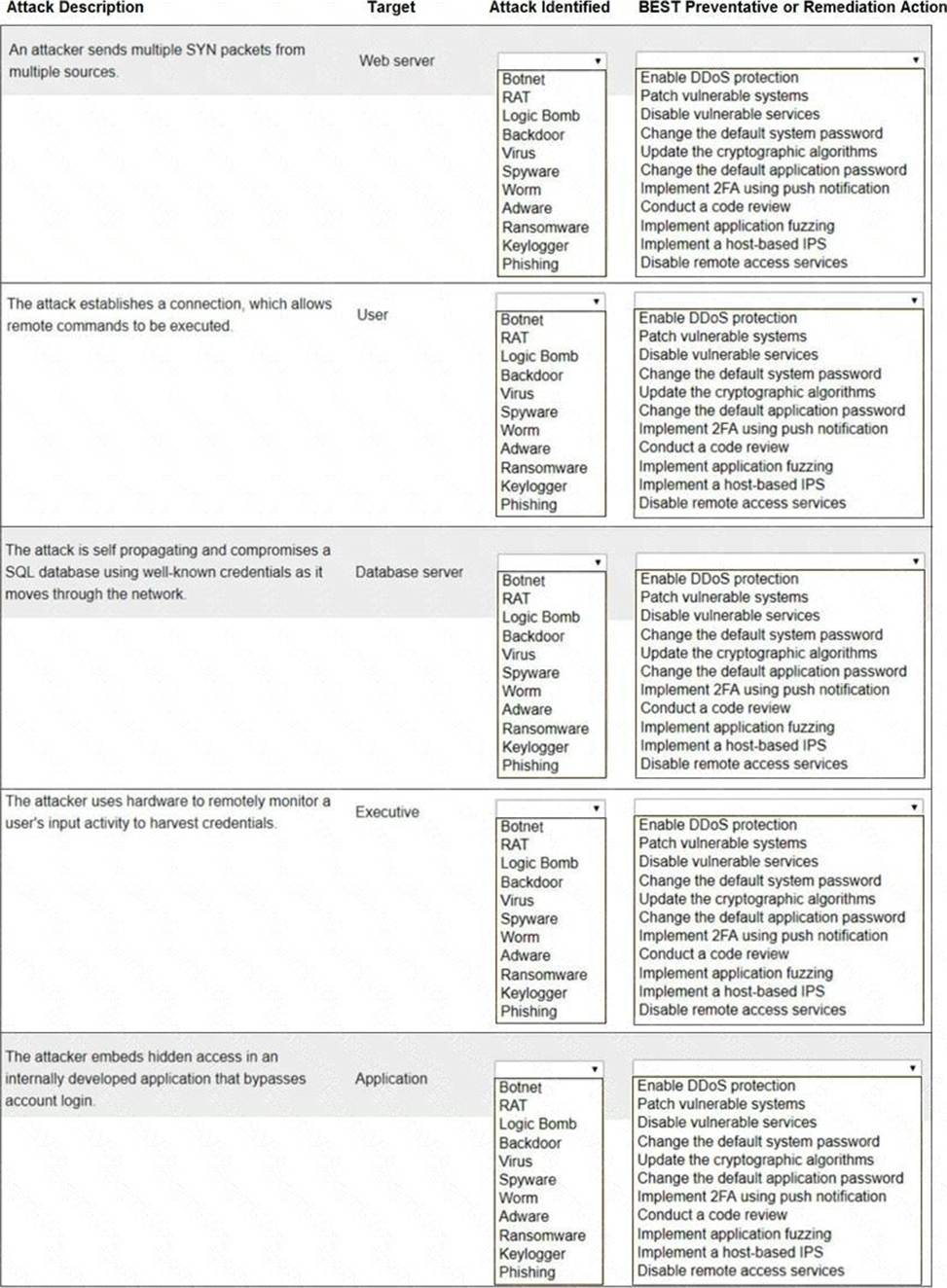
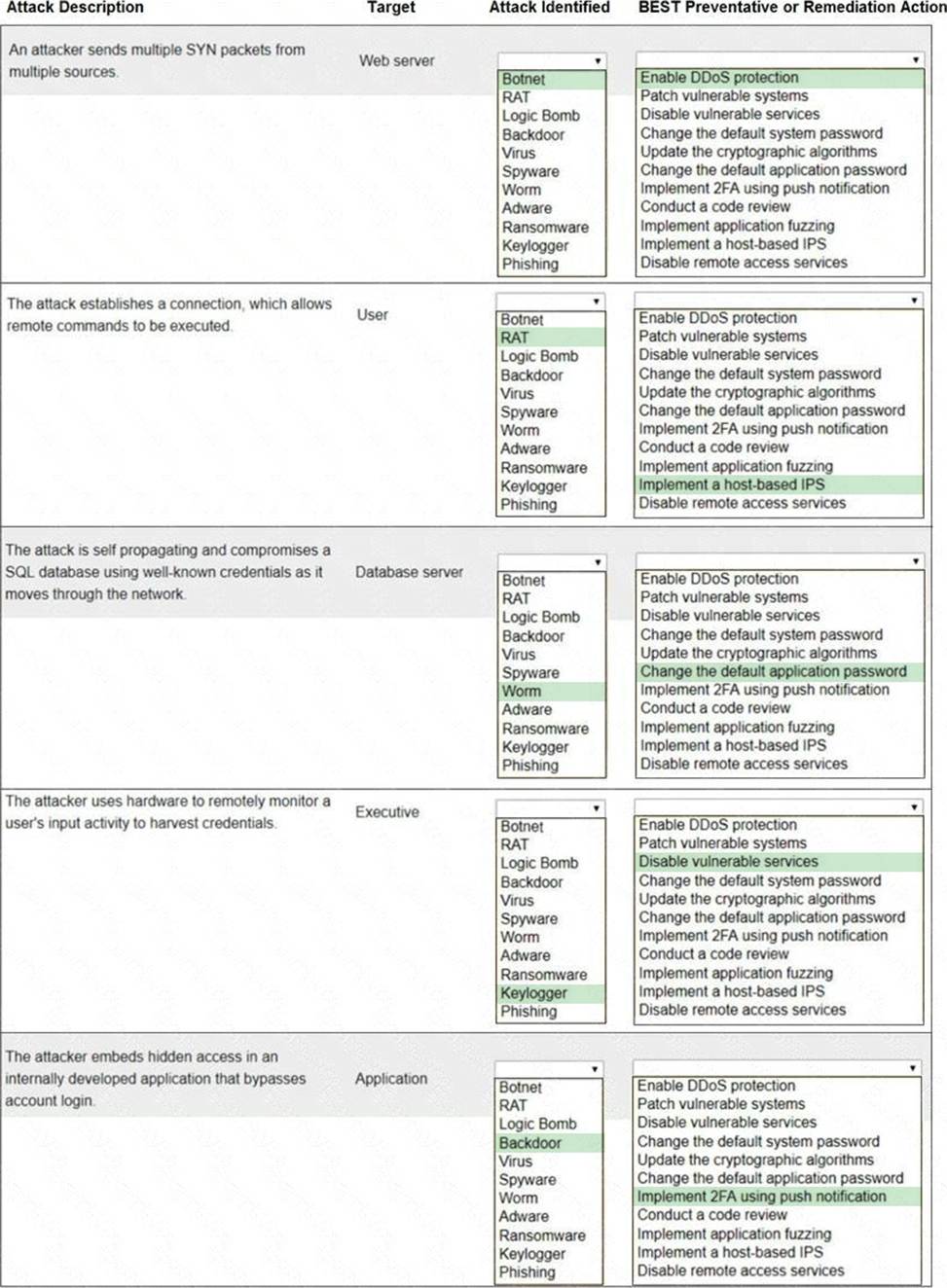
Select the appropriate attack and remediation from each drop-down list to label the corresponding attack with its remediation.
INSTRUCTIONS
Not all attacks and remediation actions will be used.
If at any time you would like to bring back the initial state of the simulation, please click the Reset All button.
Explanation:
Web serverBotnet Enable DDoS protectionUser RAT Implement a host-based IPSDatabase server Worm Change the default application passwordExecutive KeyloggerDisable vulnerable servicesApplication Backdoor Implement 2FA using push notification
A screenshot of a computer program Description automatically generated with low confidence
The Chief Information Security Officer (CISO) at a large company would like to gain an understanding of how the company’s security policies compare to the requirements imposed by external regulators.
Which of the following should the CISO use?
- A . Penetration test
- B . Internal audit
- C . Attestation
- D . External examination
D
Explanation:
An external examination (also known as an external audit or external review) is the best method for the Chief Information Security Officer (CISO) to gain an understanding of how the company’s security policies compare to external regulatory requirements. External examinations are conducted by third-party entities that assess an organization’s compliance with laws, regulations, and industry standards.
Penetration tests focus on identifying vulnerabilities, not compliance.
Internal audits assess internal controls but are not impartial or focused on regulatory requirements.
Attestation is a formal declaration but does not involve the actual evaluation of compliance.
A company recently decided to allow employees to work remotely. The company wants to protect us data without using a VPN.
Which of the following technologies should the company Implement?
- A . Secure web gateway
- B . Virtual private cloud end point
- C . Deep packet Inspection
- D . Next-gene ration firewall
A
Explanation:
A Secure Web Gateway (SWG) protects users by filtering unwanted software/malware from user-initiated web traffic and enforcing corporate and regulatory policy compliance. This technology allows the company to secure remote users’ data and web traffic without relying on a VPN, making it ideal for organizations supporting remote work.
Reference = CompTIA Security+ SY0-701 study materials, particularly in the domain of network security and remote access technologies.
An organization is adopting cloud services at a rapid pace and now has multiple SaaS applications in use. Each application has a separate log-in. so the security team wants to reduce the number of credentials each employee must maintain.
Which of the following is the first step the security team should take?
- A . Enable SAML
- B . Create OAuth tokens.
- C . Use password vaulting.
- D . Select an IdP
D
Explanation:
The first step in reducing the number of credentials each employee must maintain when using multiple SaaS applications is to select an Identity Provider (IdP). An IdP provides a centralized authentication service that supports Single Sign-On (SSO), enabling users to access multiple applications with a single set of credentials.
Enabling SAML would be part of the technical implementation but comes after selecting an IdP. OAuth tokens are used for authorization, but selecting an IdP is the first step in managing authentication.
Password vaulting stores multiple passwords securely but doesn’t reduce the need for separate logins.
A company discovered its data was advertised for sale on the dark web. During the initial investigation, the company determined the data was proprietary data.
Which of the following is the next step the company should take?
- A . Identity the attacker sentry methods.
- B . Report the breach to the local authorities.
- C . Notify the applicable parties of the breach.
- D . Implement vulnerability scanning of the company’s systems.
Which of the following best describe a penetration test that resembles an actual external attach?
- A . Known environment
- B . Partially known environment
- C . Bug bounty
- D . Unknown environment
D
Explanation:
An unknown environment in penetration testing, also known as a black-box test, simulates an actual external attack where the tester has no prior knowledge of the system. This type of penetration test is designed to mimic real-world attack scenarios, where an attacker has little to no information about the target environment. The tester must rely on various reconnaissance and attack techniques to uncover vulnerabilities, much like a real-world attacker would. This approach helps organizations understand their security posture from an external perspective, providing insights into how their defenses would hold up against a true outsider threat.
Reference =
CompTIA Security+ SY0-701 Course Content: The course highlights the importance of understanding different penetration testing environments, including black-box testing, which aligns with the "unknown environment" in the provided answer.
CompTIA Security+ SY0-601 Study Guide: The guide details penetration testing methodologies, including black-box testing, which is crucial for simulating real external attacks.
Which of the following activities is the first stage in the incident response process?
- A . Detection
- B . Declaration
- C . Containment
- D . Vacation
Which of the following actions best addresses a vulnerability found on a company’s web server?
- A . Patching
- B . Segmentation
- C . Decommissioning
- D . Monitoring
A security analyst scans a company’s public network and discovers a host is running a remote
desktop that can be used to access the production network.
Which of the following changes should the security analyst recommend?
- A . Changing the remote desktop port to a non-standard number
- B . Setting up a VPN and placing the jump server inside the firewall
- C . Using a proxy for web connections from the remote desktop server
- D . Connecting the remote server to the domain and increasing the password length
B
Explanation:
A VPN is a virtual private network that creates a secure tunnel between two or more devices over a public network. A VPN can encrypt and authenticate the data, as well as hide the IP addresses and locations of the devices. A jump server is a server that acts as an intermediary between a user and a target server, such as a production server. A jump server can provide an additional layer of security and access control, as well as logging and auditing capabilities. A firewall is a device or software that filters and blocks unwanted network traffic based on predefined rules. A firewall can protect the internal network from external threats and limit the exposure of sensitive services and ports. A security analyst should recommend setting up a VPN and placing the jump server inside the firewall to improve the security of the remote desktop access to the production network. This way, the remote desktop service will not be exposed to the public network, and only authorized users with VPN credentials can access the jump server and then the production server.
Reference: CompTIA Security+ Study Guide: Exam SY0-701, 9th Edition, Chapter 8: Secure Protocols and Services, page 382-383 1; Chapter 9: Network Security, page 441-442 1