
CompTIA SY0-701 Practice Exams
Last updated on Nov 16,2026- Exam Code: SY0-701
- Exam Name: CompTIA Security+
- Certification Provider: CompTIA
- Latest update: Nov 16,2026
A security administrator recently reset local passwords and the following values were recorded in the system:
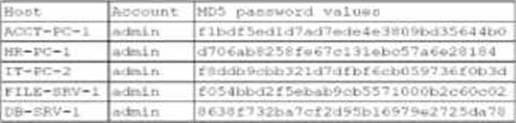
Which of the following in the security administrator most likely protecting against?
- A . Account sharing
- B . Weak password complexity
- C . Pass-the-hash attacks
- D . Password compromise
A company plans to secure its systems by:
Preventing users from sending sensitive data over corporate email Restricting access to potentially harmful websites
Which of the following features should the company set up? (Select two).
- A . DLP software
- B . DNS filtering
- C . File integrity monitoring
- D . Stateful firewall
During the onboarding process, an employee needs to create a password for an intranet account. The password must include ten characters, numbers, and letters, and two special characters. Once the password is created, the company will grant the employee access to other company-owned websites based on the intranet profile.
Which of the following access management concepts is the company most likely using to safeguard intranet accounts and grant access to multiple sites based on a user’s intranet account? (Select two).
- A . Federation
- B . Identity proofing
- C . Password complexity
- D . Default password changes
- E . Password manager
- F . Open authentication
A,C
Explanation:
Federation is an access management concept that allows users to authenticate once and access multiple resources or services across different domains or organizations. Federation relies on a trusted third party that stores the user’s credentials and provides them to the requested resources or services without exposing them. Password complexity is a security measure that requires users to create passwords that meet certain criteria, such as length, character types, and uniqueness. Password complexity can help prevent brute-force attacks, password guessing, and credential stuffing by making passwords harder to crack or guess.
Reference: CompTIA Security+ Study Guide: Exam SY0-701, 9th Edition, page 308-309 and 312-313 1
A security analyst reviews domain activity logs and notices the following:

Which of the following is the best explanation for what the security analyst has discovered?
- A . The user jsmith’s account has been locked out.
- B . A keylogger is installed on [smith’s workstation
- C . An attacker is attempting to brute force ismith’s account.
- D . Ransomware has been deployed in the domain.
C
Explanation:
Brute force is a type of attack that tries to guess the password or other credentials of a user account by using a large number of possible combinations. An attacker can use automated tools or scripts to perform a brute force attack and gain unauthorized access to the account. The domain activity logs show that the user ismith has failed to log in 10 times in a row within a short period of time, which is a strong indicator of a brute force attack. The logs also show that the source IP address of the failed logins is different from the usual IP address of ismith, which suggests that the attacker is using a different device or location to launch the attack. The security analyst should take immediate action to block the attacker’s IP address, reset ismith’s password, and notify ismith of the incident.
Reference = CompTIA Security+ Study Guide with over 500 Practice Test Questions: Exam SY0-701, 9th Edition, Chapter 1, page 14. CompTIA Security+ (SY0-701) Certification Exam Objectives, Domain 1.1, page 2. Threat Actors and Attributes C SY0-601 CompTIA Security+: 1.1
Which of the following data states applies to data that is being actively processed by a database server?
- A . In use
- B . At rest
- C . In transit
- D . Being hashed
An attacker used XSS to compromise a web server.
Which of the following solutions could have been used to prevent this attack?
- A . NGFW
- B . UTM
- C . WAF
- D . NAC
C
Explanation:
Comprehensive and Detailed In-Depth
A Web Application Firewall (WAF) is designed to protect web applications from attacks such as Cross-Site Scripting (XSS) by filtering and monitoring HTTP traffic between the internet and a web application.
Next-Generation Firewalls (NGFW) (A) provide advanced network security but are not specifically designed to protect web applications from XSS attacks.
Unified Threat Management (UTM) (B) provides multiple security functions but lacks the specialized application-layer protection needed to mitigate XSS.
Network Access Control (NAC) (D) controls device access to the network but does not prevent web-based attacks.
A WAF is the best solution for protecting web servers from XSS, SQL injection, and other web-based threats.
A security analyst locates a potentially malicious video file on a server and needs to identify both the creation date and the file’s creator.
Which of the following actions would most likely give the security analyst the information required?
- A . Obtain the file’s SHA-256 hash.
- B . Use hexdump on the file’s contents.
- C . Check endpoint logs.
- D . Query the file’s metadata.
D
Explanation:
Metadata is data that describes other data, such as its format, origin, creation date, author, and other attributes. Video files, like other types of files, can contain metadata that can provide useful information for forensic analysis. For example, metadata can reveal the camera model, location, date and time, and software used to create or edit the video file. To query the file’s metadata, a security analyst can use various tools, such as MediaInfo1, ffprobe2, or hexdump3, to extract and display the metadata from the video file. By querying the file’s metadata, the security analyst can most likely identify both the creation date and the file’s creator, as well as other relevant information. Obtaining the file’s SHA-256 hash, checking endpoint logs, or using hexdump on the file’s contents are other possible actions, but they are not the most appropriate to answer the question. The file’s SHA-256 hash is a cryptographic value that can be used to verify the integrity or uniqueness of the file, but it does not reveal any information about the file’s creation date or creator. Checking endpoint logs can provide some clues about the file’s origin or activity, but it may not be reliable or accurate, especially if the logs are tampered with or incomplete. Using hexdump on the file’s contents can show the raw binary data of the file, but it may not be easy or feasible to interpret the metadata from the hex output, especially if the file is large or encrypted.
Reference: 1: How do I get the meta-data of a video file? 2: How to check if an mp4 file contains malware? 3: [Hexdump – Wikipedia]
Which of the following can be used to compromise a system that is running an RTOS?
- A . Cross-site scripting
- B . Memory injection
- C . Replay attack
- D . Ransomware
In order to strengthen a password and prevent a hacker from cracking it, a random string of 36 characters was added to the password.
Which of the following best describes this technique?
- A . Key stretching
- B . Tokenization
- C . Data masking
- D . Salting
D
Explanation:
Adding a random string of characters, known as a "salt," to a password before hashing it is known as salting. This technique strengthens passwords by ensuring that even if two users have the same
password, their hashes will be different due to the unique salt, making it much harder for attackers to crack passwords using precomputed tables.
Reference: CompTIA Security+ SY0-701 course content and official CompTIA study resources.
Which of the following threat actors is the most likely to be hired by a foreign government to attack critical systems located in other countries?
- A . Hacktivist
- B . Whistleblower
- C . Organized crime
- D . Unskilled attacker
C
Explanation:
Organized crime is a type of threat actor that is motivated by financial gain and often operates across national borders. Organized crime groups may be hired by foreign governments to conduct cyberattacks on critical systems located in other countries, such as power grids, military networks, or financial institutions. Organized crime groups have the resources, skills, and connections to carry out sophisticated and persistent attacks that can cause significant damage and disruption12.
Reference = 1: Threat Actors – CompTIA Security+ SY0-701 – 2.1 2: CompTIA Security+ SY0-701 Certification Study Guide