CompTIA N10-009 Practice Exams
Last updated on Nov 16,2026- Exam Code: N10-009
- Exam Name: CompTIA Network+ Certification
- Certification Provider: CompTIA
- Latest update: Nov 16,2026
Which of the following is the most closely associated with segmenting compute resources within a single cloud account?
- A . Network security group
- B . laaS
- C . VPC
- D . Hybrid cloud
C
Explanation:
Reference: CompTIA Network+ Certification Exam Objectives – Cloud Models section.
Which of the following is the most closely associated with segmenting compute resources within a single cloud account?
- A . Network security group
- B . laaS
- C . VPC
- D . Hybrid cloud
C
Explanation:
Reference: CompTIA Network+ Certification Exam Objectives – Cloud Models section.
A network administrator changed an external DNS to point customers to a new server.
Which of the following tools should the administrator use to test the new server’s configuration?
- A . ping
- B . tracert
- C . tcpdump
- D . nslookup
D
Explanation:
• nslookup allows querying DNS records to verify if the new server is correctly resolving domain names.
• ping (A) tests basic connectivity, not DNS configuration.
• tracert (B) shows network path latency but doesn’t test DNS.
• tcpdump (C) captures packets but isn’t ideal for DNS verification.
Reference: CompTIA Network+ N10-009 Official Documentation C DNS Testing Tools.
Which of the following most likely requires the use of sub interfaces?
- A . A router with only one available LAN port
- B . A firewall performing deep packet inspection
- C . A hub utilizing jumbo frames
- D . A switch using Spanning Tree Protocol
A
Explanation:
Introduction to Subinterfaces:
Subinterfaces are logical interfaces created on a single physical interface. They are used to enable a router to support multiple networks on a single physical interface. Use Case for Subinterfaces:
Subinterfaces are commonly used in scenarios where VLANs are implemented. A router with a single physical LAN port can be configured with multiple subinterfaces, each associated with a different VLAN.
This setup allows the router to route traffic between different VLANs.
Example Configuration:
Consider a router with a single physical interface GigabitEthernet0/0 and two VLANs, 10 and 20.
interface GigabitEthernet0/0.10
encapsulation dot1Q 10
ip address 192.168.10.1 255.255.255.0
!
interface GigabitEthernet0/0.20
encapsulation dot1Q 20
ip address 192.168.20.1 255.255.255.0
The encapsulation dot1Q command specifies the VLAN ID.
Explanation of the Options:
Which of the following is the best VPN to use for reducing data bandwidth requirements of the corporate network?
- A . Split-tunnel
- B . Site-to-site
- C . Full-tunnel client
- D . GRE tunnel
A
Explanation:
A split-tunnel VPN allows a device to route some traffic through the VPN (typically corporate traffic)
while sending other traffic (like general internet browsing) directly over the local internet connection. This reduces the load on the corporate network because not all traffic is routed through the VPN tunnel.
Site-to-site VPNs are for permanent links between locations.
Full-tunnel VPNs route all traffic through the VPN, increasing the bandwidth usage on the corporate network.
GRE (Generic Routing Encapsulation) is a tunneling protocol that doesn’t encrypt and doesn’t reduce
bandwidth usage by itself.
Reference: CompTIA Network+ N10-009 Official Objectives: 3.3 C Given a scenario, configure and deploy common VPN technologies.
A network engineer is now in charge of all SNMP management in the organization. The engineer must use a SNMP version that does not utilize plaintext data.
Which of the following is the minimum version of SNMP that supports this requirement?
- A . v1
- B . v2c
- C . v2u
- D . v3
D
Explanation:
SNMPv3 is the version of the Simple Network Management Protocol that introduces security enhancements, including message integrity, authentication, and encryption. Unlike previous versions (v1 and v2c), SNMPv3 supports encrypted communication, ensuring that data is not transmitted in plaintext. This provides confidentiality and protects against eavesdropping and unauthorized access.
Reference: CompTIA Network+ study materials.
A company is expanding to another floor in the same building. The network engineer configures a new switch with the same VLANs as the existing stack. When the network engineer connects the new switch to the existing stack, all users lose connectivity.
Which of the following is the MOST likely reason?
- A . The new switch has unused ports disabled
- B . The new switch does not have a default gateway
- C . The new switch is connected to an access port
- D . The new switch is in a spanning tree loop
D
Explanation:
This describes a Spanning Tree Protocol (STP) loop. If STP isn’t correctly configured or a redundant link is added without STP protection, it causes broadcast storms and network outages.
A network administrator configured a router interface as 10.0.0.95 255.255.255.240. The administrator discovers that the router is not routing packets to a web server with IP 10.0.0.81/28.
Which of the following is the best explanation?
- A . The web server Is In a different subnet.
- B . The router interface isa broadcast address.
- C . The IP address spaceis a class A network.
- D . The subnet is in a private address space.
B
Explanation:
Understanding Subnetting:
The subnet mask 255.255.255.240 (or /28) indicates that each subnet has 16 IP addresses (14 usable addresses, 1 network address, and 1 broadcast address).
Calculating the Subnet Range:
Subnet Calculation: For the IP address 10.0.0.95 with a /28 subnet mask:
Network address: 10.0.0.80
Usable IP range: 10.0.0.81 to 10.0.0.94
Broadcast address: 10.0.0.95
Router Interface Configuration:
Broadcast Address Issue: The IP address 10.0.0.95 is the broadcast address for the subnet 10.0.0.80/28. Configuring a router interface with the broadcast address will cause routing issues as it is not a valid host address.
Comparison with Other Options:
The web server is in a different subnet: The web server (10.0.0.81) is within the same subnet range (10.0.0.80/28).
The IP address space is a class A network: While 10.0.0.0 is a Class A network, this does not explain the routing issue caused by the broadcast address.
The subnet is in a private address space: The private address space designation (RFC 1918) does not impact the routing issue related to the broadcast address configuration. Resolution:
Reconfigure the router interface with a valid host IP address within the usable range, such as 10.0.0.94.
Reference: CompTIA Network+ study materials on subnetting and IP address configuration.
A network technician is examining the configuration on an access port and notices more than one VLAN has been set.
Which of the following best describes how the port is configured?
- A . With a voice VLAN
- B . With too many VLANs
- C . With a default VLAN
- D . With a native VLAN
A
Explanation:
It is common for an access port to have both a voice VLAN and a data VLAN. A voice VLAN separates voice traffic from regular data traffic, ensuring better quality and security for voice communications.
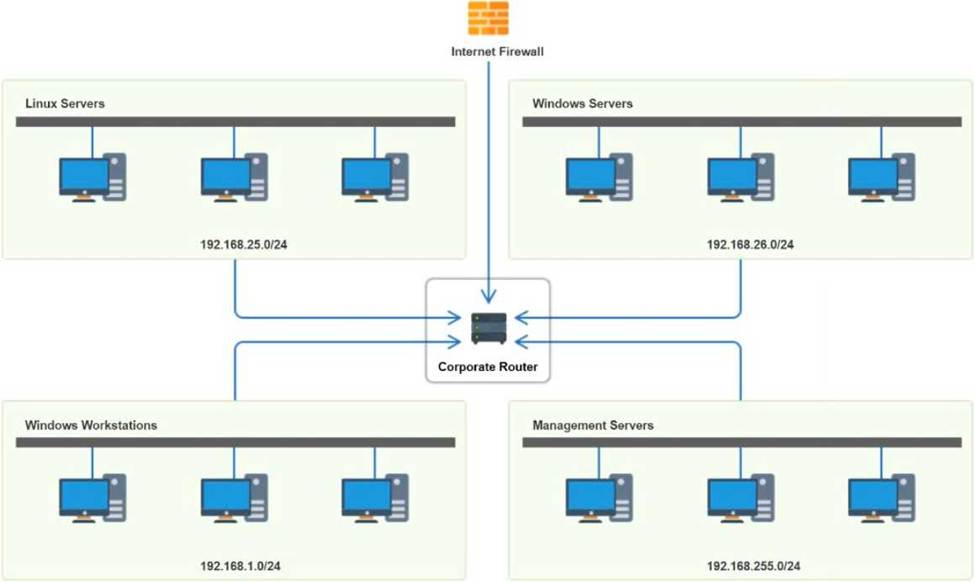
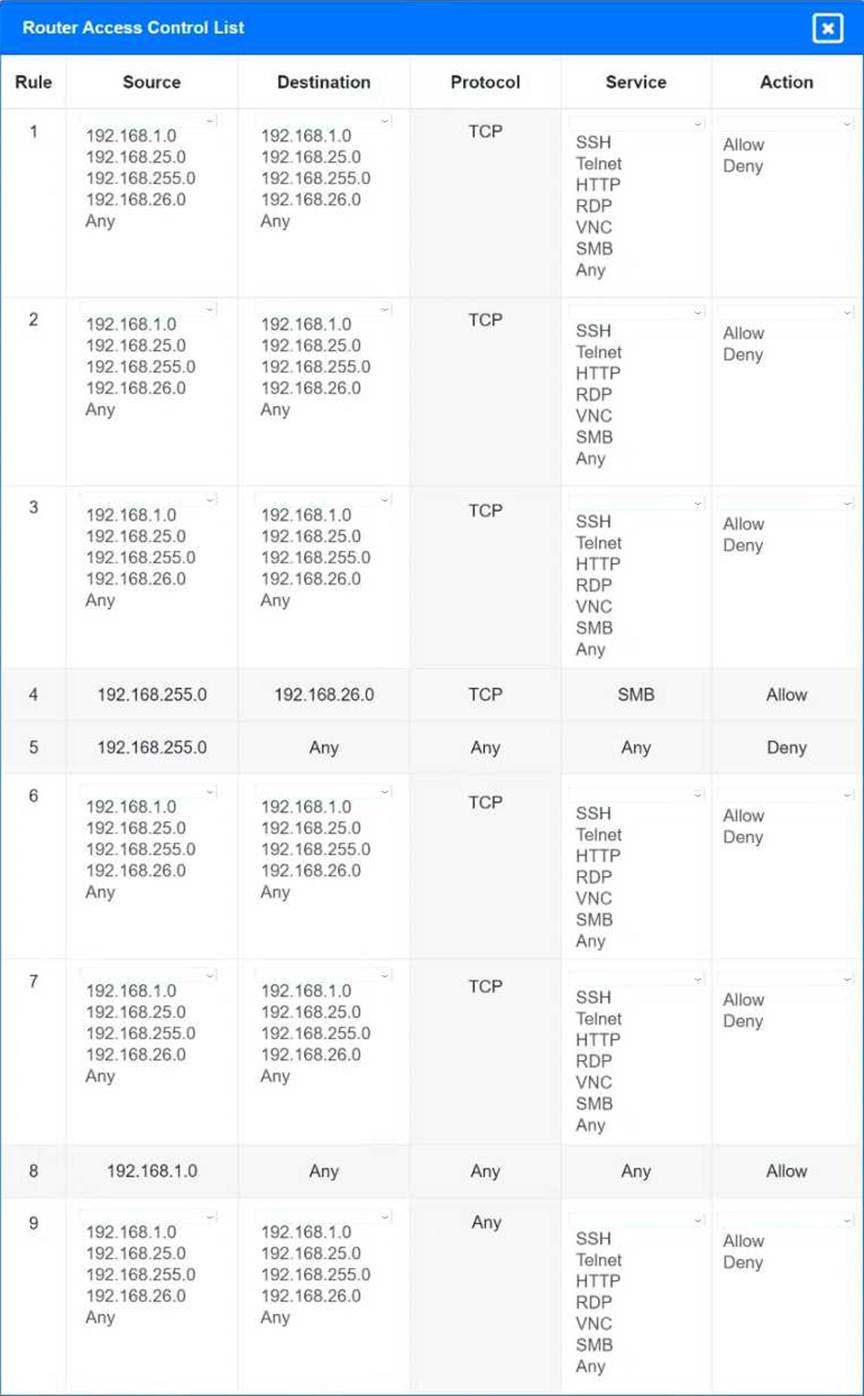
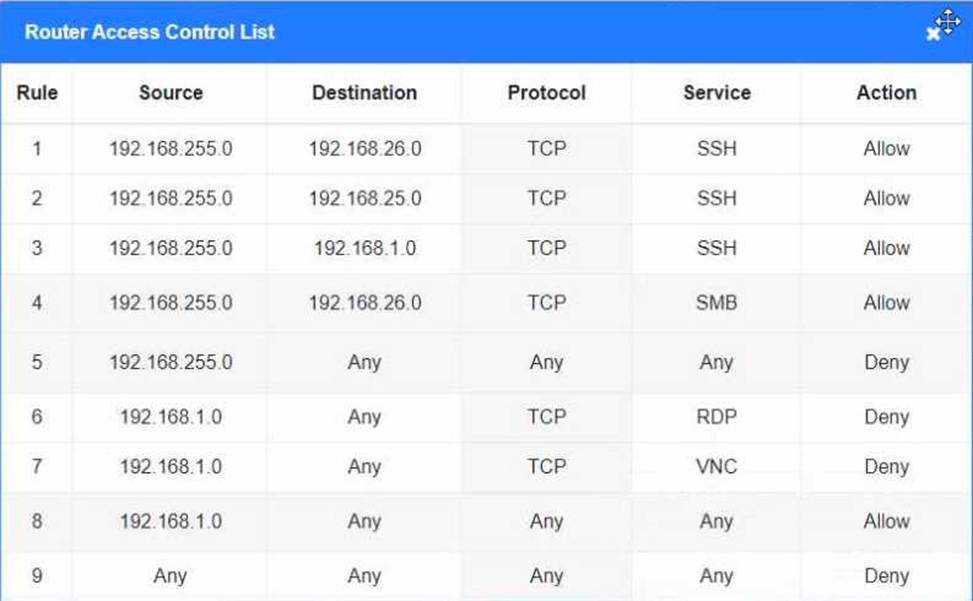
Prohibit any traffic that has not been specifically allowed.
INSTRUCTIONS
Use the drop-downs to complete the ACL
If at any time you would like to bring back the initial state of the simulation, please click the Reset All button.