
CompTIA N10-009 Practice Exams
Last updated on Nov 16,2026- Exam Code: N10-009
- Exam Name: CompTIA Network+ Certification
- Certification Provider: CompTIA
- Latest update: Nov 16,2026
Which of the following VPN types provides secure remote access to the network resources through a web portal?
- A . Proxy
- B . Clientless
- C . Site-to-site
- D . Direct connect
B
Explanation:
Clientless VPNs allow users to access network resources through a secure web portal using a browser, with no VPN software needed. This is ideal for occasional access to internal resources via HTTPS.
A network administrator performed upgrades on a server and installed a new NIC to improve performance. Following the upgrades, user a are unable to reach the server.
Which of the following is the most likely reason.
- A . The PoE power budget was exceeded.
- B . TX/RX was transposed.
- C . A port security violation occured.
- D . An incorrect cable type was installed.
D
Explanation:
When a network administrator installs a new Network Interface Card (NIC) and users are unable to reach the server, one of the common issues is the use of an incorrect cable type. Network cables must match the specifications required by the NIC and the network infrastructure (e.g., Cat5e, Cat6 for Ethernet).
NIC Compatibility: The new NIC might require a specific type of cable to function properly. Using a cable not rated for the NIC’s required speeds or capabilities can result in connectivity issues. Cable Standards: Different NICs and network devices might need different cabling standards (straight-through vs. crossover cables, or specific fiber optic types).
Connection Types: Ensuring that the cable connectors are appropriate for the NIC ports (e.g., RJ45 for Ethernet, LC connectors for fiber optics).
Network
Reference: CompTIA Network+ N10-007 Official Certification Guide: Discusses network cabling standards and NIC specifications.
Cisco Networking Academy: Provides insights into cabling and NIC configurations for optimal network performance.
Network+ Certification All-in-One Exam Guide: Offers comprehensive details on troubleshooting network connectivity issues, including cabling problems.
Which of the following is an XML-based security concept that works by passing sensitve information about users, such as log-in information and attributes, to providers.
- A . IAM
- B . MFA
- C . RADIUS
- D . SAML
D
Explanation:
Security Assertion Markup Language (SAML) is an XML-based standard used for exchanging authentication and authorization data between parties, particularly between an identity provider (IdP) and a service provider (SP). SAML is commonly used in Single Sign-On (SSO) solutions to pass sensitive user information, such as login credentials and attributes, securely between the identity provider and the service provider.
SAML (Security Assertion Markup Language): Facilitates web-based authentication and authorization, allowing users to access multiple services with a single set of credentials.
XML-based: Uses XML to encode the authentication and authorization data, ensuring secure transmission of user information.
Identity Federation: Enables secure sharing of identity information across different security domains,
making it ideal for enterprise SSO solutions.
Network
Reference: CompTIA Network+ N10-007 Official Certification Guide: Covers authentication protocols, including SAML.
Cisco Networking Academy: Provides training on identity management and federation technologies.
Network+ Certification All-in-One Exam Guide: Explains SAML and its role in secure identity management and SSO.
Which of the following fiber connector types is the most likely to be used on a network interface card?
- A . LC
- B . SC
- C . ST
- D . MPO
A
Explanation:
Definition of Fiber Connector Types:
LC (Lucent Connector): A small form-factor fiber optic connector with a push-pull latching mechanism, commonly used for high-density applications.
SC (Subscriber Connector or Standard Connector): A larger form-factor connector with a push-pull latching mechanism, often used in datacom and telecom applications.
ST (Straight Tip): A bayonet-style connector, typically used in multimode fiber optic networks. MPO (Multi-fiber Push On): A connector designed to support multiple fibers (typically 12 or 24 fibers), used in high-density cabling environments.
Common Usage:
LC Connectors: Due to their small size, LC connectors are widely used in network interface cards (NICs) and high-density environments such as data centers. They allow for more connections in a smaller space compared to SC and ST connectors.
SC and ST Connectors: These are larger and more commonly used in patch panels and older fiber installations but are less suitable for high-density applications.
MPO Connectors: Primarily used for trunk cables in data centers and high-density applications but not typically on individual network interface cards. Selection Criteria:
The small form-factor and high-density capabilities of LC connectors make them the preferred choice for network interface cards, where space and connection density are critical considerations.
Reference: CompTIA Network+ study materials on fiber optics and connector types.
A research facility is expecting to see an exponential increase in global network traffic in the near future. The offices are equipped with 2.5Gbps fiber connections from the ISP, but the facility is currently only utilizing 1Gbps connections.
Which of the following would need to be configured in order to use the ISP’s connection speed?
- A . 802.1Q tagging
- B . Network address translation
- C . Port duplex
- D . Link aggregation
D
Explanation:
Understanding Link Aggregation:
Definition: Link aggregation combines multiple network connections into a single logical link to increase bandwidth and provide redundancy.
Usage in High-Bandwidth Scenarios:
Combining Links: By aggregating multiple 1Gbps connections, the facility can utilize the full 2.5Gbps bandwidth provided by the ISP.
Benefits: Enhanced throughput, load balancing, and redundancy, ensuring better utilization of available bandwidth.
Comparison with Other Options:
A network engineer wants to implement a new IDS between the switch and a router connected to the LAN. The engineer does not want to introduce any latency by placing the IDS in line with the gateway. The engineer does want to ensure that the IDS sees all packets without any loss.
Which of the following is the best way for the engineer to implement the IDS?
- A . Use a network tap.
- B . Use Nmap software.
- C . Use a protocol analyzer.
- D . Use a port mirror.
D
Explanation:
Reference: CompTIA Network+ Certification Exam Objectives – Network Security section.
Which of the following panels would be best to facilitate a central termination point for all network cables on the floor of a company building?
- A . Patch
- B . UPS
- C . MDF
- D . Rack
A
Explanation:
Reference: CompTIA Network+ Certification Exam Objectives – Network Installation section.
A network engineer is designing a secure communication link between two sites. The entire data stream needs to remain confidential.
Which of the following will achieve this goal?
- A . GRE
- B . IKE
- C . ESP
- D . AH
C
Explanation:
Definition of ESP (Encapsulating Security Payload):
ESP is a part of the IPsec protocol suite designed to provide confidentiality, integrity, and authenticity of data by encrypting the payload and optional ESP trailer. Ensuring Confidentiality:
Encryption: ESP encrypts the payload, ensuring that the data remains confidential during transmission. Only authorized parties with the correct decryption keys can access the data.
Modes of Operation: ESP can operate in transport mode (encrypts only the payload) or tunnel mode (encrypts the entire IP packet), both providing strong encryption to secure data between sites. Comparison with Other Protocols:
GRE (Generic Routing Encapsulation): A tunneling protocol that does not provide encryption or security features.
IKE (Internet Key Exchange): A protocol used to set up a secure, authenticated communications channel, but it does not encrypt the data itself.
AH (Authentication Header): Provides integrity and authentication for IP packets but does not encrypt the payload.
Implementation:
Use ESP as part of an IPsec VPN configuration to encrypt and secure communication between two sites. This involves setting up IPsec policies and ensuring both endpoints are configured to use ESP for data encryption.
Reference: CompTIA Network+ study materials on IPsec and secure communication protocols.
A network technician is troubleshooting network latency and has determined the issue to be occuring two network switches (Switch10 and Switch11). Symptoms reported included poor video performance and slow file copying. Given the following informtion:
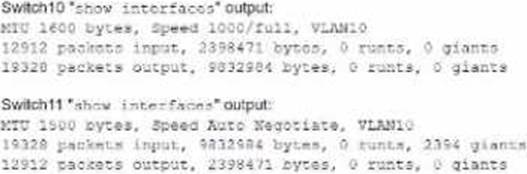
Which of the following should the technician most likely do to resolve the issue?
- A . Disable automatic negotiation on Switch11.
- B . Modify Switch10 MTU value to 1500.
- C . Configure STP on both switches.
- D . Change the native VLAN on the ports.
An organization moved its DNS servers to new IP addresses. After this move, customers are no longer able to access the organization’s website.
Which of the following DNS entries should be updated?
- A . AAAA
- B . CNAME
- C . MX
- D . NS
D
Explanation:
Comprehensive and Detailed
When an organization moves its DNS servers to new IP addresses, the NS (Name Server) records must be updated. The NS record defines which DNS servers are authoritative for a domain. If these
records still point to the old IP addresses, clients will continue to query the outdated servers, leading
to connectivity issues.
Breakdown of Options: