
CompTIA 220-1201 Practice Exams
Last updated on Nov 16,2026- Exam Code: 220-1201
- Exam Name: CompTIA A+ Certification Exam: Core 1
- Certification Provider: CompTIA
- Latest update: Nov 16,2026
A financial institution needs a secure way to protect encryption keys used for unlocking chips on its credit cards.
Which of the following should the institution use?
- A . TLS
- B . AMD
- C . HSM
- D . ARM
C
Explanation:
A Hardware Security Module (HSM) securely manages cryptographic keys, including those used to protect credit card chips.
Why Not A (TLS): TLS secures data in transit, not encryption key storage.
Why Not B (AMD): AMD refers to processors, not security modules.
Why Not D (ARM): ARM is a processor architecture, not a cryptographic security solution.
CompTIA A+ Exam
Reference: Core 2 (220-1102), Section 2.5, cryptographic hardware.
Which of the following types of connectors does an IDE hard drive use for power?
- A . F type
- B . SC
- C . Molex
- D . Lightning
C
Explanation:
An IDE hard drive uses a Molex connector for power. This 4-pin connector is a standard for older drives.
Why Not A (F type): F type connectors are used for coaxial cables in video and internet applications.
Why Not B (SC): SC connectors are for fiber optic cables.
Why Not D (Lightning): Lightning connectors are for Apple devices.
CompTIA A+ Exam
Reference: Core 1 (220-1201), Section 3.1, cable types and connectors.
A customer reports slow network speeds.
Which of the following components is most likely failing?
- A . CPU
- B . NIC
- C . HDD
- D . RAM
B
Explanation:
A Network Interface Card (NIC)is the hardware responsible for network connectivity. If the NIC is failing or underperforming (e.g., due to a bad driver, hardware fault, or misconfiguration), it can cause slow or unstable network speeds.
Option A (CPU): A failing CPU affects overall system performance but not specifically network speed.
Option C (HDD): A slow hard drive causes application lag, but not poor network performance.
Option D (RAM): Affects multitasking and speed, not network throughput.
CompTIA A+ Core 1 Exam Objective
Reference:
Objective 3.5: Given a scenario, troubleshoot problems related to wired and wireless networks.
A small ISP has hired a new technician Joe, the new technician, is being trained to configure customers* home networks The trailing instructor gives me technician a starter kit with cables, cable ends, and other network equipment and asks mm to build a working network.
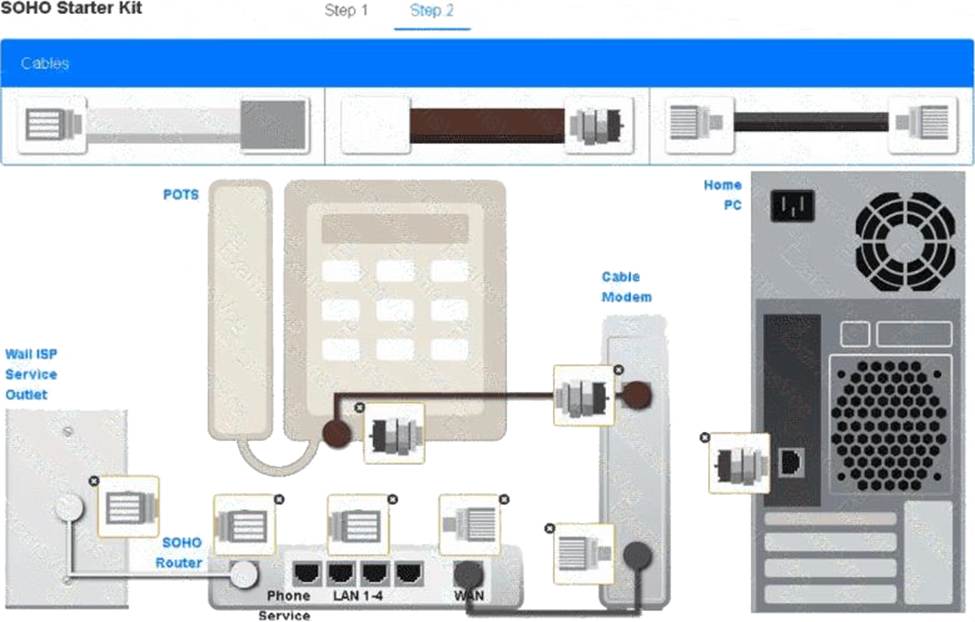
The computer should be connected to have internet connectivity and the phone should be connected to have a dial tone.
INSTRUCTIONS
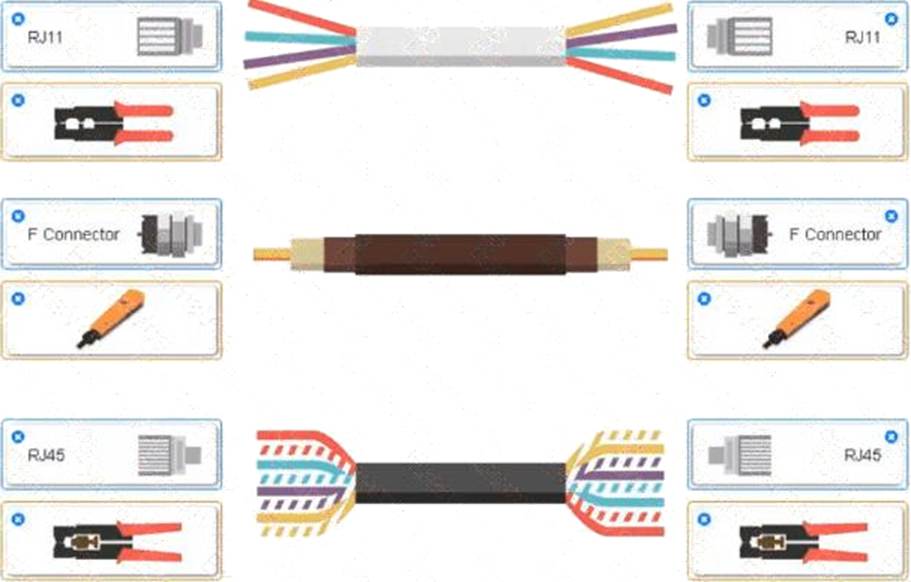
Use the appropriate cables. cable ends, tools and equipment to configure the network ana connect an components accordingly
There are 3 steps and the simulation starts on step 1.
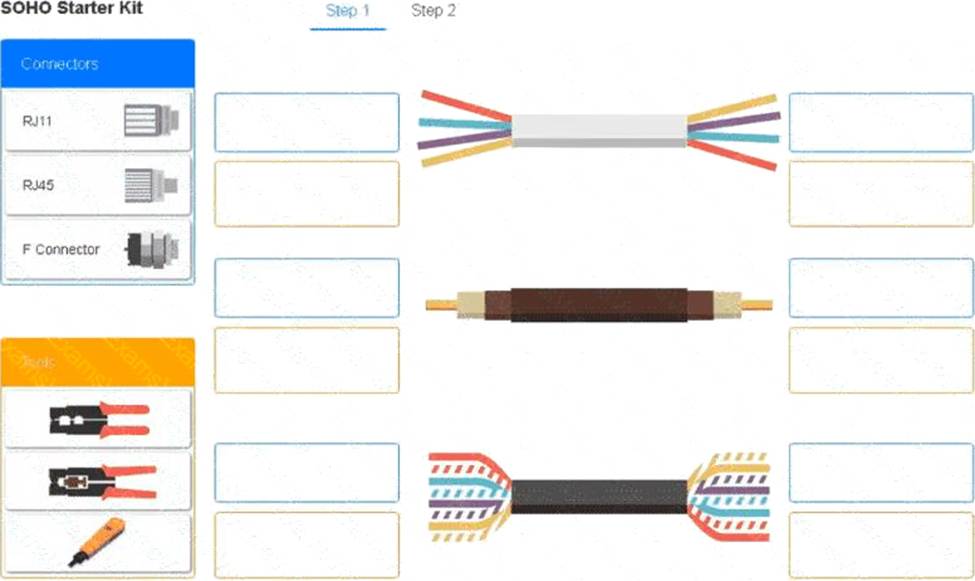
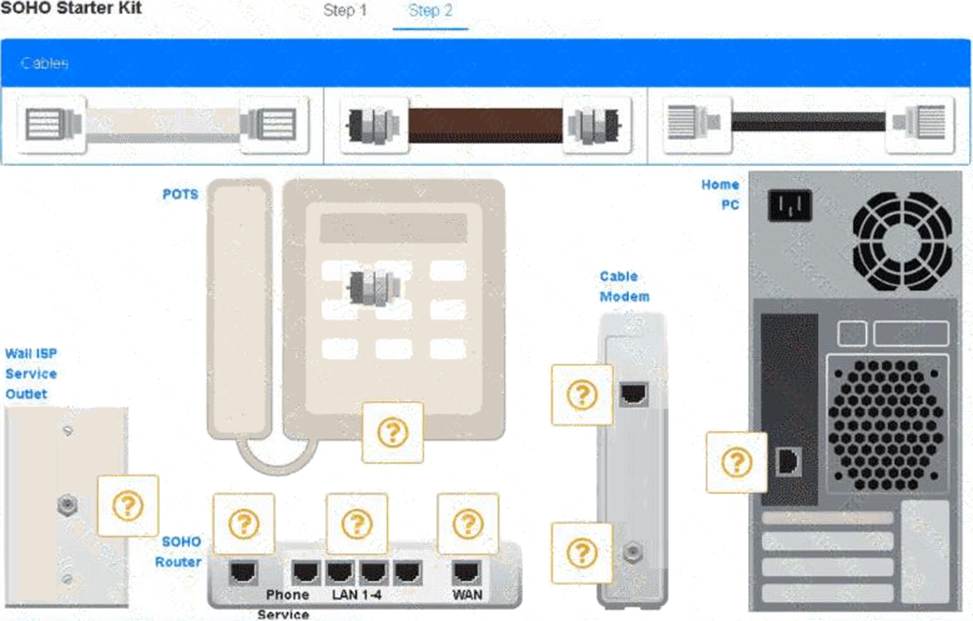
See the answer below in explanation part.
A group of wires with different colors AI-generated content may be incorrect.
A screenshot of a computer AI-generated content may be incorrect.
Which of the following best characterizes the use of a virtual machine as a sandbox?
- A . Run an application on multiple workstations without installation.
- B . Explore how an application behaves in a different environment
- C . Migrate a currently used legacy application from physical to virtual
- D . Create a firewall where the sandbox acts as a perimeter network.
B
Explanation:
A sandbox in virtualization allows testing an application in an isolated environment to observe its behavior without affecting the host system.
Why Not A (Run an application on multiple workstations): This describes application virtualization, not sandboxing.
Why Not C (Migrate a legacy application): This is about virtualization for legacy support, not testing.
Why Not D (Create a firewall): A firewall does not act as a sandbox for application testing.
CompTIA A+ Exam
Reference: Core 1 (220-1201), Section 4.2, virtualization and sandboxing.
Which of the following describes the function of an injector?
- A . To provide only data connectivity
- B . To supply power across a cable
- C . To improve wireless performance
- D . To extend a network connection
B
Explanation:
A PoE injector is used to add power to an Ethernet cable, enabling the cable to deliver both power and data. This is crucial when connecting to PoE-enabled devices like IP cameras or wireless access points that are far from power outlets.
#Reference: "CompTIA A+ Complete Practice Tests" by Jeff T. Parker C Chapter 10, Question 77, page 585.
A technician is replacing a failed power supply in a ten-year-old computer When installing the customer-provided power supply, the technician discovers the ATX connector would not plug into the motherboard. The customer wants a cost-effective solution.
Which of the following should the technician do next?
- A . Adjust the input voltage.
- B . Install a modular power supply.
- C . Rebuild the failed power supply.
- D . Use a 20-pin to 24-pin adapter.
D
Explanation:
Older motherboards use 20-pin connectors, while newer power supplies use 24-pin connectors. An adapter resolves the compatibility issue cost-effectively.
Why Not A (Adjust the input voltage): Input voltage adjustment is unrelated to connector compatibility.
Why Not B (Install a modular power supply): While modular supplies are versatile, this doesn’t address the connector issue directly.
Why Not C (Rebuild the failed power supply): Rebuilding is costly and complex compared to using an adapter.
CompTIA A+ Exam
Reference: Core 1 (220-1201), Section 3.4, power supply compatibility.
Which of the following can a user utilize to share their mobile phone connection with their laptop?
- A . IR
- B . NFC
- C . Wi-Fi Direct
- D . Tethering
D
Explanation:
Tethering refers to sharing a mobile phone’s internet connection with another device, such as a laptop, either through USB, Bluetooth, or Wi-Fi. Tethering effectively turns the mobile phone into a personal hotspot for internet access.
Option A (IR): Incorrect. Infrared (IR) is used for short-range communication, such as remote controls, but it does not support internet sharing.
Option B (NFC): Incorrect. Near-field communication (NFC) is used for close-proximity data transfer, not for internet sharing.
Option C (Wi-Fi Direct): Incorrect. Wi-Fi Direct enables device-to-device communication but does not inherently provide internet sharing.
References:
CompTIA A+ Core 1 Objectives: 1.4 (Configure basic mobile-device network connectivity)
A technician recently updated the firmware on a dual-BIOS motherboard. Following the update, the system has been stuck in a boot loop and cannot start an OS from any internal or external device. The technician cannot access the UEFI menu either.
Which of the following should the technician do next?
- A . Enable the secondary configuration.
- B . Downgrade the firmware via USB.
- C . Start a warranty repair of the motherboard.
- D . Reapply thermal paste to the CPU.
A
Explanation:
Dual-BIOS motherboards contain two firmware chips. If theprimary BIOS becomescorrupted, the system canfailover to the secondary BIOS. Most boards allow manual enabling of the secondary BIOS via a physical switch or jumper.
Option B: Downgrading firmware may not be possible if the system won’t POST or access UEFI.
Option C: Not necessary until both BIOS chips are non-functional.
Option D: Thermal paste affects heat dissipation, not BIOS/boot behavior.
CompTIA A+ Core 1 Exam Objective
Reference:
Objective 3.5: Given a scenario, troubleshoot problems related to motherboards, RAM, CPU, and power.