
Cisco 300-820 Practice Exams
Last updated on Oct 21,2026- Exam Code: 300-820
- Exam Name: Implementing Cisco Collaboration Cloud and Edge Solutions (CLCEI)
- Certification Provider: Cisco
- Latest update: Oct 21,2026
A video device registered with Cisco UCM failed to make an outbound B2B call. From Expressway-C diagnostic logs, an engineer found that the destination pattern is “[email protected]:5061”, and the call was dropped with a 404 response code from Expressway-C. The search rule intended for this call-in Expressway-C is configured for Alias Pattern Match, Pattern type “Su x,” and Pattern “example.com”.
How must the configuration be changed to allow the call?
- A . Update the route pattern in Cisco UCM to send calls to “example.com” to the correct port.
- B . Create a transform on Expressway-C to strip port numbers.
- C . Create a call policy rule on Expressway-E to allow calls to port 5061.
- D . Update the call policy list in Expressway-C to allow calls to “example.com”.
Which entry in the public (external) DNS is valid to configure DNS SRV records for a Cisco Mobile and Remote Access solution?
- A . _cisco-uds._tcp.<domain>
- B . _cisco-mra._tls.<domain>
- C . _collab-edge._tls.<domain>
- D . _cisco-expwy._tls.<domain>
Which two licenses are required for the B2B feature to work? (Choose two.)
- A . Traversal Server
- B . TURN Relays
- C . Rich Media Sessions
- D . Advanced Networking
- E . Device Provisioning
What should be considered when using the Cisco Webex hybrid service?
- A . Directory Connector must be deployed for OBTP to work with on-premises video devices
- B . Directory Connector is required for Azure AD
- C . Hybrid Message service works only with Jabber cloud deployment
- D . Expressway Connector is required for an on-premises Exchange server
B
Explanation:
Reference: https://www.cisco.com/c/en/us/td/docs/solutions/PA/overview/12x/hybpa12x.html
An external Jabber device cannot register. While troubleshooting this issue, the engineer discovers that privately signed certificates are being used on Expressway-C and Expressway-E.
What action will resolve this issue?
- A . The private CA certificate must be placed in the phone trust store
- B . The Jabber client must register to the Cisco UCM internally before it will register externally
- C . The device running the Jabber client must download and trust the private CA certificate
- D . The device running the Jabber client must use a VPN to register
Refer to the exhibit.
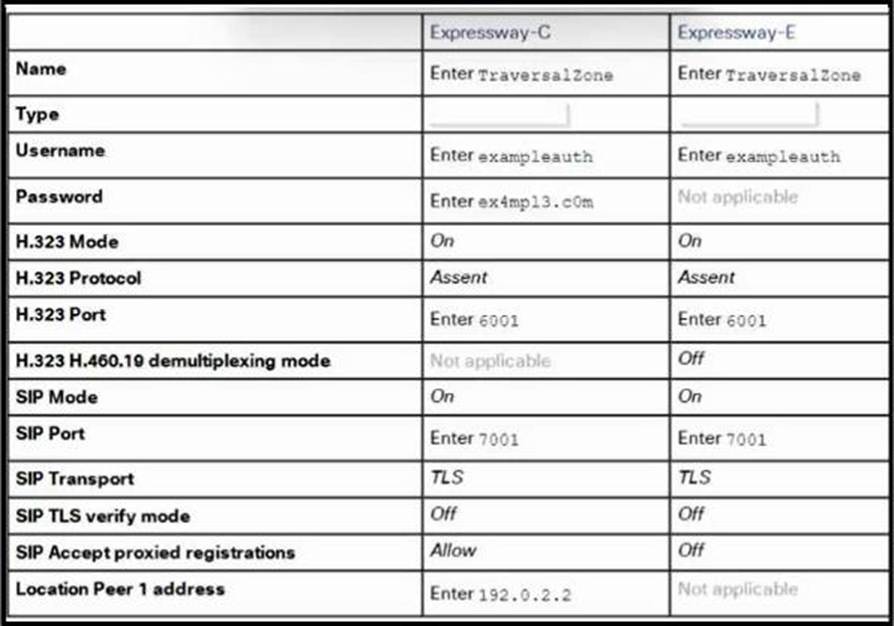
What are “Type” eld values for this Expressway servers zone configuration?
- A . Expressway-C “DNS”, Expressway-E “Traversal server”
- B . Expressway-C “Traversal server”, Expressway-E “Traversal client”
- C . Expressway-C “Neighbor”, Expressway-E “Neighbor”
- D . Expressway-C “Traversal client”, Expressway-E “Traversal server”
What are the steps to access the Service Setup Wizard during the first setup of the Expressway server to license the server?
- A . Factory reset the Expressway server to pass from Smart Licensing to PAK-based licensing.
- B . From the GUI of the Expressway server, go to Status> Overview> Run service setup.
- C . Factory reset the Expressway server to pass from Expressway-C to Expressway-E.
- D . From the GUI of the Expressway server, go to Maintenance> Option keys> First Setup Wizard.
Cisco media traversal technology has enabled a secure environment where internal video endpoints call and receive calls from external video endpoints.
How does the Expressway-C and Expressway-E communicate?
- A . Expressway-C establishes an outgoing request to Expressway-E, enabling the Expressway-E in the DMZ to notify the internal Expressway-C of an incoming call from an external endpoint.
- B . Internal endpoints are registered to Expressway-E in the DMZ. Expressway-C, which is also in the DMZ, will receive and make calls on behalf of Expressway- E because they are in the same network.
- C . Expressway-E establishes an outgoing request to Expressway-C, enabling the Expressway-C in the DMZ to notify the internal Expressway-E of an incoming call from an external endpoint.
- D . Internal endpoints are registered to Expressway-C in the DMZ. Expressway-E, which is also in the DMZ, will receive and make calls on behalf of Expressway- C because they are in the same network.
A
Explanation:
Reference: https://www.cisco.com/c/en/us/td/docs/voice_ip_comm/expressway/cong_guide/X12-5/exwy_b_mra-expressway-deployment-guide/exwy_b_mra- expressway-deployment-guide_chapter_00.html
Which two items are configured when deploying a B2B collaboration solution? (Choose two.)
- A . SIP trunk between Cisco Unified Communications Manager and Cisco Expressway-C
- B . search rules in Cisco Expressway-E
- C . SIP trunk between Cisco Unified Communications Manager and Cisco Expressway-E
- D . traversal client on a Cisco Expressway-E
- E . DNS zone on a Cisco Expressway-C
Refer to the exhibit.
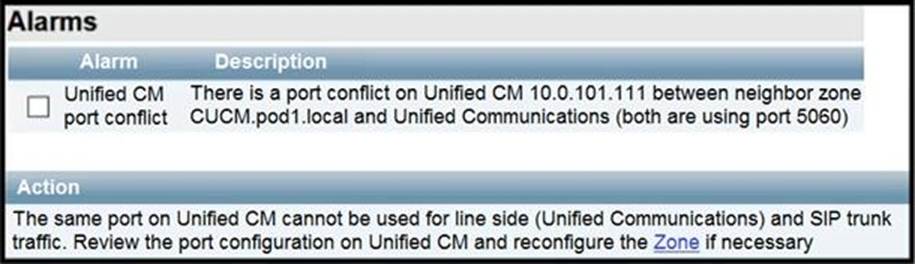
Mobile and remote access is being added to an existing B2B deployment and is failing. When the administrator looks at the alarms on the Expressway-C, the snippets are shown.
Which configuration action should the administrator take to fix this issue?
- A . The listening port on the Expressway-C for SIP TCP must be changed to a value other than 5060
- B . The listening port on the Expressway-C for SIP TLS must be changed to a value other than 5061
- C . The listening port on the Cisco UCM for the Expressway-C SIP trunk must be changed to something other than 5060 or 5061
- D . The listening port on the Cisco UCM for the Expressway-C SIP trunk is set to something other than 5060 or 5061. It must be set to 5060 for insecure and 5061 for secure SIP