
Cisco 300-815 Practice Exams
Last updated on Oct 22,2026- Exam Code: 300-815
- Exam Name: Implementing Cisco Advanced Call Control and Mobility Services (CLACCM)
- Certification Provider: Cisco
- Latest update: Oct 22,2026
A company has users that frequently visit locations outside the office. These users need to be able to make calls and keep the company integrity by presenting a company caller ID. The users are equipped with company-paid mobile phones. The company uses Cisco UCM with Cisco Unified Border Element and Expressway-C and Expressway-E for external communications.
Which technology must be configured to meet this requirement?
- A . Cisco Unified SNR
- B . Cisco Unified Mobility
- C . Cisco FindMe
- D . Cisco Roaming Mobility
CollabCorp is a global company with two clusters, emea.collab corp and apac.collab.corp. URI dialing is implemented and working in each cluster. The company configured routing between clusters to make inter-cluster calls via URI. but this is not working as expected.
Which two configuration elements should be checked to resolve this issue? (Choose two.)
- A . directory URI partition
- B . SIP route pattern
- C . intercluster trunk
- D . calling search space and partition
- E . SIP trunk
An engineer Is configuring a Cisco Unified Border Element. The SIP ITSP requires a DNIS of 10-digits and DTMF tones sent in the RTP stream on the outbound leg of a call.
Which code completes this configuration?
A)
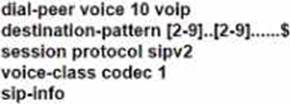
B)
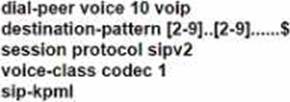
C)
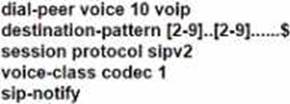
D)
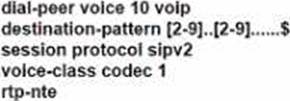
- A . Option A
- B . Option B
- C . Option C
- D . Option D
A new deployment is using MVA for a specific user on the sales team, but the user is having issues when dialing DTMF.
Which DTMF method must be configured in resolve the issue?
- A . gateway
- B . out-of-band
- C . channel
- D . in-band
A new deployment is using MVA for a specific user on the sales team, but the user is having issues when dialing DTMF.
Which DTMF method must be configured in resolve the issue?
- A . gateway
- B . out-of-band
- C . channel
- D . in-band
When locations-based Call Admission Control denies the call, which two masks can AAR apply when routing the call through the PSTN? (Choose two.)
- A . AAR destination mask
- B . called party transform mask
- C . external phone number mask
- D . +E.164 alternate number mask
- E . enterrise alternate number mask
AC
Explanation:
Reference: https://www.cisco.com/c/en/us/td/docs/voice_ip_comm/cucm/srnd/collab10/collab10/dialplan.ht ml
An engineer configures several calling party transformation patterns in Cisco UCM so that calling numbers are shown in the +E.164 format. The route patterns match seven-digit internal numbers and prefix the numbers with 1408. The SIP trunk matches 1408XXXXXXX and prefixes the number with +. When users make outbound calls, the calling number still shows as seven digits.
What is the cause of this problem?
- A . The calling transformation on the SIP trunk is applied first, and then the calling transformation on the route patterns is applied.
- B . Calling transformations cannot be configured on both route patterns and a SIP trunk.
- C . The calling transformation on the route patterns is ignored because there is already a calling transformation on the SIP trunk.
- D . The engineer must also apply a calling transformation at the route group details level.
Refer to the exhibit.
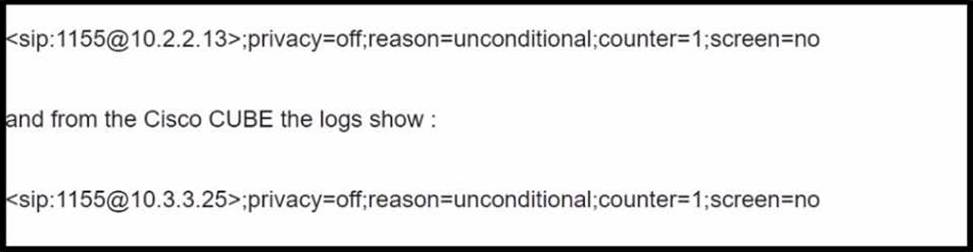
Refer to the exhibit. Users report that outgoing calls do not work on the new SIP trunk for outgoing calls. The solution consists of a Cisco UCM Cluster linked to a Cisco Unified Border Element where the SIP trunk is terminated. The provider required 10 digits. The logs show a line going toward the
Cisco Unified Border Element.
Which code snippet must be added to the configuration to meet the requirement?
- A . request Invite sip-header modify "<sip:1(…)@" "<sip:91355511@" under the SIP translation profile configuration
- B . sip-header modify "<sip:1(…)@" "<sip:91355511@" under the voice translation profile configuration
- C . request Invite sip-header Diversion modify "<sip:1(…)@" "<sip:91355511@" under the SIP profile configuration
- D . request Invite sip-header modify "<sip:1(…)@" "<sip:91355511@" under the voice translation profile configuration
An engineer must configure call queuing under a Hunt Pilot.
After the engineer receives the audio file that will be played to callers during queuing, which two steps should be taken to complete the configuration? (Choose two.)
- A . Assign the uploaded audio file to the hunting Line Group member’s "User Hold MOH Audio Source
- B . Assign the uploaded audio file to the hunting Line Group member’s "Network Hold MOH Audio Source".
- C . Upload the audio file in "TFTP File Management” via OS Administration GUI
- D . Assign the uploaded audio file to "Network Hold MOH Source & Announcements" under Hunt Pilot’s Queuing section.
- E . Upload the audio file in "MOH Audio File Management" via CM Administration GUI
When you troubleshoot H.323 call setup, which message informs you that the called party is being notified about the call?
- A . ALERTING
- B . PROCEEDING
- C . CONNECT
- D . RINGING