
Cisco 300-815 Practice Exams
Last updated on Oct 22,2026- Exam Code: 300-815
- Exam Name: Implementing Cisco Advanced Call Control and Mobility Services (CLACCM)
- Certification Provider: Cisco
- Latest update: Oct 22,2026
An administrator wants to use the Call Queuemg feature on Cisco UCM to allow new customers to wait in the queue while other agents are not available to take their call.
Which configuration step enables this feature?
- A . Call Routing > Route/Hunt > Call Park
- B . Call Routing > Route/Hunt > Hunt Pilot
- C . Call Routing > Route/Hunt > Line Group
- D . Call Routing > Route/Hunt > Hunt List
An administrator is troubleshooting call failures on an H.323 gateway via the CLI.
To see signaling for media and call setup, which two debugs must the administrator turn on? (Choose two).
- A . debug H.245 asn1
- B . debug H.323 message
- C . debug H.225 asn1
- D . debug H.225 media
- E . debug H.323 asn1
In Cisco Unified Communications Manager, which tool do you use to check SIP traces?
- A . MTP
- B . CCSIP
- C . RTMT
- D . OS Administration Page
Refer to the exhibit.
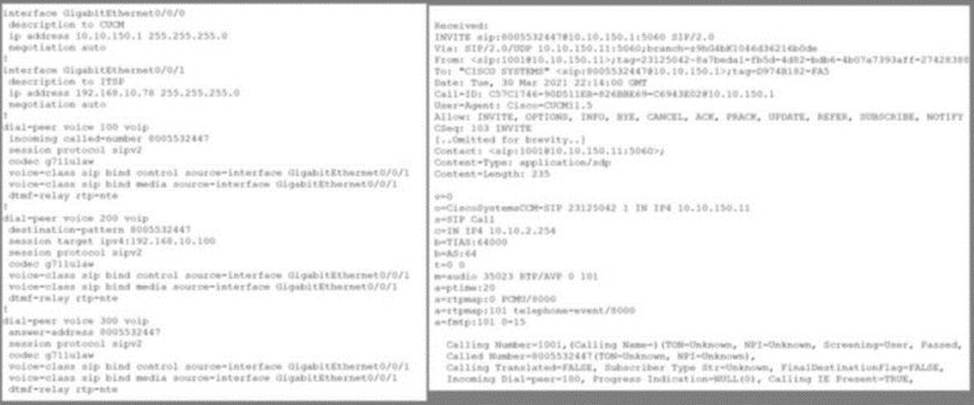
An engineer is troubleshooting a call-establishment problem between Cisco Unified Border Element and Cisco UCM.
Which command set corrects the issue?
- A . SIP binding in SIP configuration mode:
voice service voip sip
bind control source-interface GigabitEthernet 0 /0/0
bind media source-interface GigabitEthernet 0 /0/0 - B . SIP binding In SIP configuration mode:
voice service volp sip
bind control source-Interface GlgabltEthernet 0 /0/1
bind media source-Interface GlgabltEthernet 0 /0/1 - C . SIP binding In dial-peer configuration mode:
dial-peer voice 300 voip
voice-class sip bind control source-interface GigabitEthernet 0 /0/1
voice-class sip bind media source-interface GigabitEthernet 0 /0/1 - D . SIP binding in dial-peer configuration mode:
dial-peer voice 100 volp
voice-class sip bind control source-interface GigabitEthernet 0 /0/0
voice-class sip bind media source-interface GigabitEthernet 0 /0/0
A single site reports that when they dial select numbers, the call connects, but they do not get audio. The administrator finds that the calls are not routing out of the normal gateway but out of another site’s gateway due to a TEHO configuration.
What is the next step to diagnose and solve the issue?
- A . Verify that IP routing is correct between the gateway and the IP phone.
- B . Verify that the route pattern is not blocking calls to the destination number.
- C . Verify that the dial peer of the gateway has the correct destination pattern configured.
- D . Verify that the route pattern has the correct calling-party transformation mask
A customer reports that outbound calls from Cisco UCM to Cisco Unified Border Element are not getting early media. During troubleshooting, the customer finds that Cisco UCM is sending a delayed offer SIP INVITE. Cisco Unified Border Element responds with a 183 Session Progress with SDP message. However, the customer finds that Cisco UCM does not respond to the 183 messages.
Which action must the customer perform to resolve the problem?
- A . On Cisco Unified Border Element, configure midcall-signaling passthru.
- B . On Cisco UCM, change the "Early Offer support for voice and video calls" field on the SIP profile that is applied to the SIP trunk to Disabled.
- C . On Cisco Unified Border Element, configure early-offer forced.
- D . On Cisco UCM. change the "SIP ReHXX Options" field on the SIP profile that is applied to the SIP trunk to Send PRACK if 1xx Contains SDP.
An engineer is configuring a call park feature in Cisco Unified Communications Manager Express.
Which command does the engineer use to ensure that the call is reverted to the user after 60 seconds?
- A . R2(config-ephone-dn)#park reservation-group 60
- B . R2(config-ephone-dn)#park-slot timeout 60 limit 2 recall alternate 3002
- C . R2(config-ephone-dn)#park reservation-group 1
- D . R2(config-ephone-dn)#park-slot timeout 30 limit 2 recall alternate 3002
Refer to the exhibit.
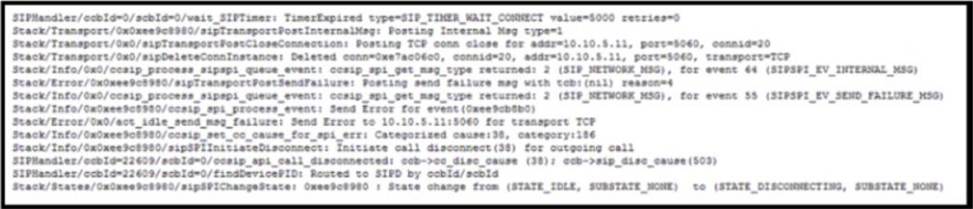
An administrator has configured a SIP trunk between two Cisco UCM clusters. For calls that should use the trunk, the calls fail with a fast busy. The administrator checks the Cisco CallManager SDL traces and found that the cluster to which the calling device is registered never sends an INVITE to the destination cluster. The administrator also verifies that all nodes from both clusters are powered on, and the CallManager service is running.
How is this issue resolved?
- A . The administrator needs to disable OPTIONS pings on the SIP trunks for both clusters.
- B . The administrator must allow connectivity so that TCP connections do not fail between the nodes.
- C . The administrator needs to enable OPTIONS pings on the SIP trunks for both clusters.
- D . The administrator must associate the route pattern with a calling search space the device can dial.
For s SIP to SIP call flow, when does Cisco Unified Border Element require transcoding resources for DTMF?
- A . interworking between an OOB method and RFC2833 for flow-around calls
- B . interworking between h245-signal and rtp-nte
- C . interworking between an OOB method and RFC2833 for flow-through calls
- D . interworking between h245-alpha numeric and sip-kpml
A
Explanation:
Reference: https://www.cisco.com/c/en/us/support/docs/unified-communications/unified-border-element/200412-DTMF-Relay-and-Interworking-on-CUBE.html#anc35
Refer to the exhibit.
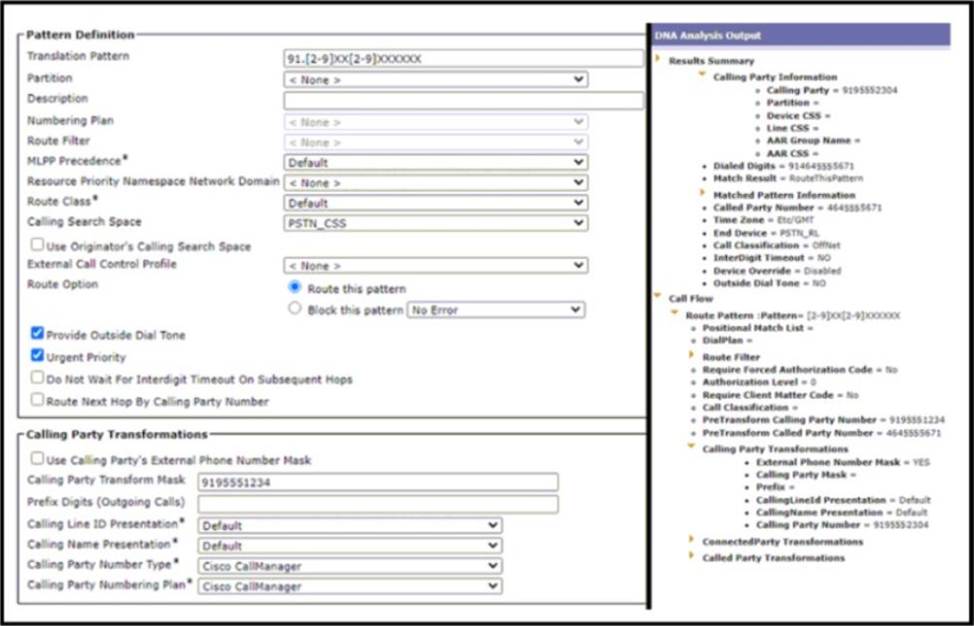
For long-distance calls, users must prefix their dialed number with “91.” The translation pattern was created to strip the 91 as the PSTN expects a 10- digit number. The PSTN also requires the calling number to be set to 9195551234. However, the service provider has said calls with a different calling number are being received.
How is this issue resolved?
- A . Change the partition of the translation pattern from none to pstn_pt.
- B . Enable Force Authorization Code on the route pattern.
- C . Disable Use Calling Party’s External Phone Number Mask on the route pattern.
- D . Enable Use Calling Party’s External Phone Number Mask on the translation pattern.