
Cisco 300-810 Practice Exams
Last updated on Nov 16,2026- Exam Code: 300-810
- Exam Name: Implementing Cisco Collaboration Applications (CLICA)
- Certification Provider: Cisco
- Latest update: Nov 16,2026
Collaboration engineer is enabling desk phone control for an existing group of Cisco Jabber desktop users. The users have been granted the appropriate permissions in Cisco UCM. and the devices correctly configured in Cisco UCM.
Which service must the engineer now enable?
- A . Cisco CTI Manager
- B . Cisco XCP Authentication Service
- C . Cisco Extended Functions
- D . Cisco XCP Connection Manager
A
Explanation:
In the Cisco environment, enabling desk phone control for Jabber desktop users requires the Cisco CTI (Computer Telephony Integration) Manager service to be active. This service allows the Jabber client to control its associated desk phone device over the network, crucial for phone control and status monitoring capabilities.
Fraudulent calls are being made from Cisco Unity Connection.
Which action prevents the calls from reaching the PSTN using SCCP integration?
- A . Change the configuration of the routing rule.
- B . Change the CSS of the voicemail port.
- C . Change the Rerouting CSS on the trunk to Cisco Unity Connection.
- D . Remove values from restriction table.
B
Explanation:
Reference: https://www.cisco.com/c/en/us/support/docs/unified-communications/unity-connection/119337-technote-cuc-00.html
An engineer must configure XMPP federation on a Cisco Instant Messaging and Presence Service node, but the XCP XMPP Federation Connection Manager service fails to start.
Which action must the engineer take to resolve the issue?
- A . Activate XMPP federation service
- B . Enable TLS m the XMPP Federation settings.
- C . Restart the Cisco XCP Router service
- D . Restart the Cisco IM and Presence service.
A
Explanation:
If an engineer is configuring XMPP federation on a Cisco Instant Messaging and Presence Service node and finds that the XCP XMPP Federation Connection Manager service fails to start, the first step should be to ensure that the XMPP federation service is activated. Services typically need to be explicitly activated in Cisco Unified Serviceability or IM and Presence Serviceability. The service will run and be able to start only after it is activated.
Refer to the exhibit
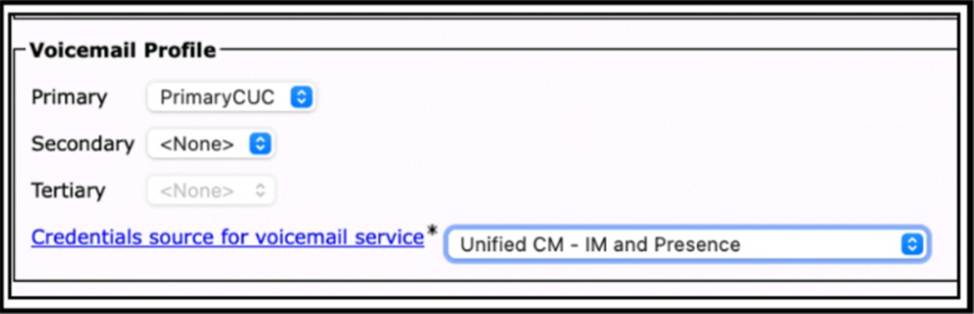
A collaboration engineer is troubleshooting an issue with Cisco Jabber for Windows deployed in phone-only mode. The users are reporting that they cannot access voicemail services via the Cisco Jabber for Windows client on the corporate LAN.
Which steps resolve this issue?
- A . Add a secondary voicemail service to Cisco UCM to allow Cisco Jabber users to receive voice messages
- B . Apply the voicemail service to a service profile so that the client can retrieve the settings
- C . Update the jabber-config xml file with the correct voicemail parameters and restart the appropriate services
- D . Add a primary voicemail service to Cisco UCM to allow Cisco Jabber users to receive voice messages
Refer to the exhibit.
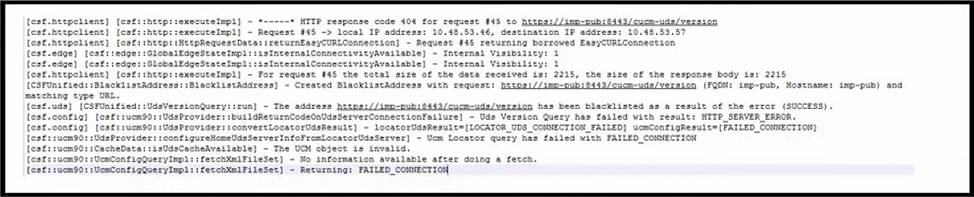
A collaboration engineer is troubleshooting Cisco Jabber for Windows login issues for clients on a corporate network with an on-premises Cisco IM and Presence server. This issue is impacting all users.
Which action resolves the issue?
- A . Add the host "imp-pub" to the proxy exceptions list on the users’ Windows computers.
- B . Restore network connectivity to host "imp-pub”
- C . Restart the IM and Presence services on the host "imp-pub".
- D . Change the DNS SRV record to point to the Cisco UCM node instead of the IM and Presence node.
A customer is using Cisco Unified IM and Presence with high availability and has reported that their primary node is not providing any IM and Presence services.
What is causing this issue?
- A . The presence redundancy group node state of the primary node is ‘idle".
- B . The presence redundancy group node state of the peer node is "normal".
- C . The presence redundancy group node state of the primary node is ‘initializing".
- D . The presence redundancy group node state of the peer node is ‘running in backup mode".
When Cisco IM and Presence is configured to use automatic fallback, how long does the Server Recovery Manager service wait for a failed service/server to remain active before an automatic fallback is initiated?
- A . 10 minutes
- B . 20 minutes
- C . 30 minutes
- D . 1 hour
C
Explanation:
Reference: https://www.cisco.com/c/en/us/support/docs/unified-communications/unified-communications-manager-im-presence-service/200958-IM-and-Presence-Server-High-Availability.html
Automatic Fallback
Automatic fallback takes place when the server monitors the services and the Server Recovery Manager (SRM) service will automatically fallback users to their homed nodes. The key in this configuration is that the Server Recovery Manager (SRM) service will wait 30 minutes for a failed service/server to remain active before an automatic fallback is initiated. Once this 30 minute up time is established, user sessions are moved back to their homed nodes. The Jabber client will apply the re-log in upper and lower limits for the fallback. Automatic fallback is not the default configuration, but it can be enabled. To enable automatic fallback, change the Enable Automatic Fallback parameter in the Server Recovery Manager Service Parameters to value True.
An administrator is configuring Cisco Jabber 12.8 to work with Cisco UCM and Cisco IM and Presence 12.5 using an encrypted SIP profile.
Which record should be configured for Jabber to work when logging into the corporate network with the domain "domain.com?
- A . DNS SRV query _sip._tcp.domain.com
- B . DNS SRV query _cisco-uds._tls.domain.com
- C . DNS SRV query _cisco-uds._tcp.domain.com
- D . DNS SRV query _sip._tls.domain.com
An engineer Is troubleshooting an MWI Issue between Unity Express and CallManager Express. In the debug SIP logs, the engineer can see CallManager Express responding to Unity Express with a 488 Not Acceptable Media message.
Which action resolves the issue?
- A . Ensure that codec G.722 Is configured In the dial peer.
- B . Ensure that codec G.711ulaw is configured in the dial peer.
- C . Ensure that codec G.711alaw is configured In the dial peer.
- D . Ensure that codec G.729 is configured In the dial peer.
An administrator is implementing a Cisco Unity Connection call management plan for a company and configured the transfer rules that specify how Unity Connection transfers the calls that reach the call handler from the automated attendant.
Which call handler setting must be configured to specify whether callers can perform transfers?
- A . caller input settings
- B . call handler owners
- C . message settings
- D . transfer rules
D
Explanation:
In Cisco Unity Connection, the transfer rules are the settings that specify how Unity Connection transfers calls that reach the call handler from the automated attendant. By configuring the transfer rules, an administrator can control whether callers are allowed to perform transfers and the conditions and destinations for those transfers.