
Cisco 300-510 Practice Exams
Last updated on Nov 16,2026- Exam Code: 300-510
- Exam Name: Implementing Cisco Service Provider Advanced Routing Solutions (SPRI)
- Certification Provider: Cisco
- Latest update: Nov 16,2026
Refer to the exhibit.
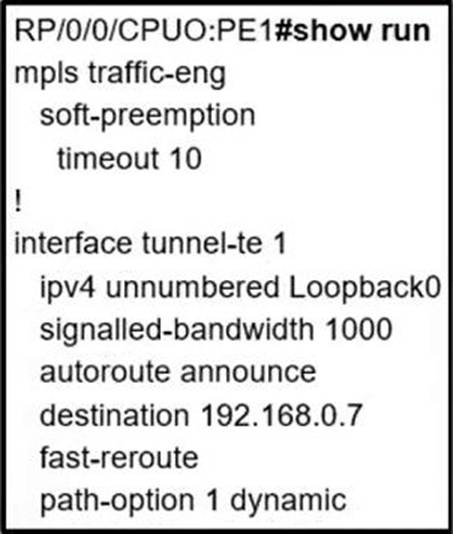
A network operator is troubleshooting TE tunnels and discovers that the soft preemption is not working as desired.
Where should the soft preemption be applied to solve the issue?
- A . on the tail-end device for tunnel-te1 192.168.0.7
- B . under the tunnel-te1 interface on PE1
- C . explicitly for tunnel-te 1 under the Cisco MPLS TE configuration mode after the timeout setting
- D . Under the interface Loopback0 necessary for this deployment type.
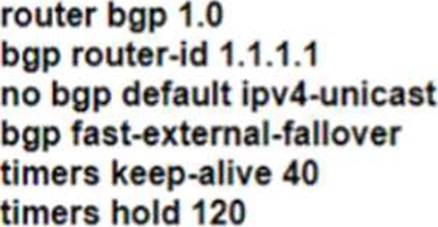
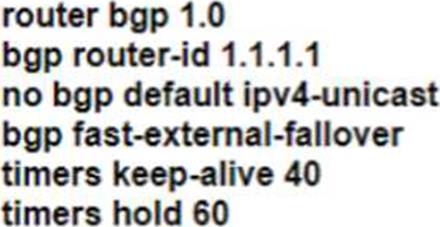
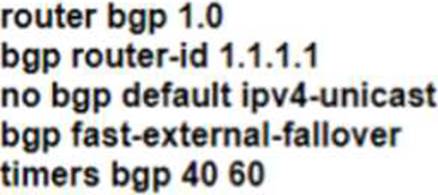
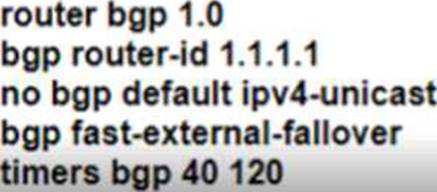
A network administrator working for a private service provider with an employee ID 4784 41 907 wants to configure timers for the BGP process on their Cisco IOS XE router.
Which configuration follows guideline timer recommendations and is a valid BGP timer deployment?
A)
B)
C)
D)
- A . Option A
- B . Option B
- C . Option C
- D . Option D
Refer to the exhibit.
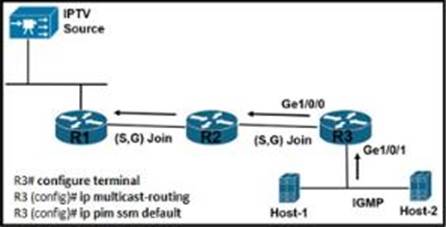
A network engineer is configuring router R3 to handle multicast streams, but Host-2 cannot send subscriptions messages to the IPTV source.
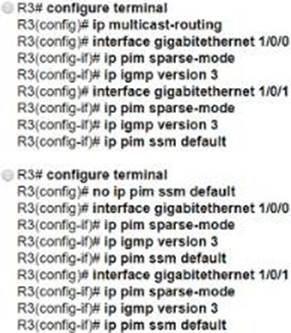
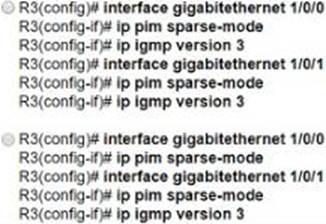
Which configuration must the engineer apply to router R3 so it passes the IPTV stream to Host-2?
- A . Option A
- B . Option B
- C . Option C
- D . Option D
An engineer with an employee ID: 4441 70:118 must implement PIM-SSM in the network to support a new multicast messaging service. All the routers in the network run a distance vector routing protocol. Unicast routing is established on the network and is working normally.
What must the engineer enable to continue the implementation process?
- A . PIM dense mode and IGMPv2 on all interfaces that participate in multicast
- B . IGMPv3 on all interfaces that participate in multicast
- C . PIM dense mode on all devices on the network
- D . PIM RP feature on the network
Refer to the exhibit.
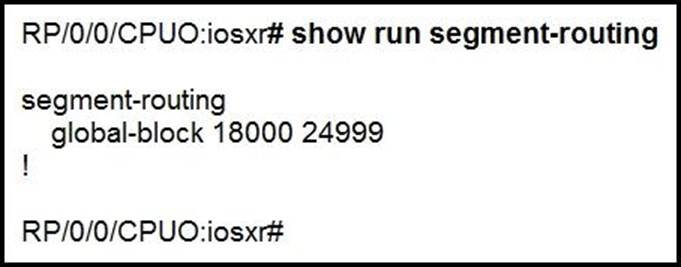
A network engineer implemented this segment routing configuration.
Which statement about the output is true?
- A . This range conflicts with the segment routing local block range.
- B . The device must be reloaded for these ranges to be allocated and used.
- C . The default segment routing global block range is being used on this device.
- D . A nondefault segment routing global block range is being used on this device.
D
Explanation:
Reference: https://www.cisco.com/c/en/us/td/docs/routers/asr920/configuration/guide/segment-routing/segment-routing-book/seg-routing-global-block.html
Refer to the exhibit.
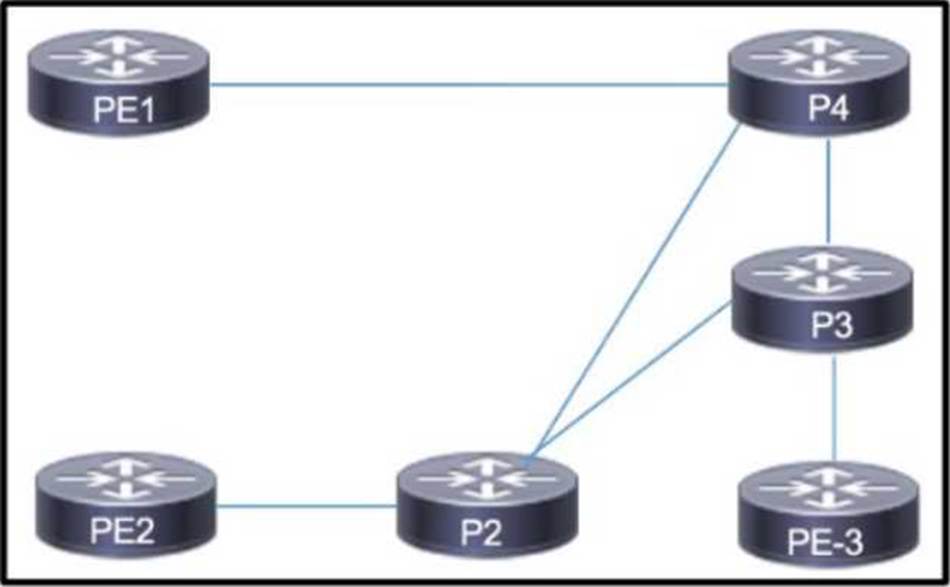
The service provider deployed segment routing in its core P2 is connected to P3 and P4 via a point-to-multipoint link as shown. The service provider provides connectivity for a large enterprise with three main offices in different geographic regions Each office is connected via one of the three PEs The enterprise wants to implement multicast traffic across the service provider to stream mission-critical applications between sites The applications will be sourced from a server connected to the network through PE2.
Which action must the network-engineering team take so that multicast traffic will flow between the enterprise sites over the point-to-multipoint link?
- A . Implement RSVP to reserve bandwidth on the link between PE2 and P2
- B . Implement PIM-DM to flood multicast traffic from the enterprise into the service provider core
- C . Implement MLDP to allow multicast traffic to flow within the single AS
- D . Implement SR Tree-SID to build a multicast replication tree over the point-to-multipoint link
Refer to the exhibit.
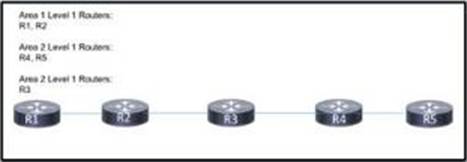
This network is deployed with all connected links configured to run IS-IS. The routing protocol is enacted globally on each router, and the network engineer expects full routing Information to be shared among all routers. R5 is receiving routes from R4 but is missing routes from R1.
Which action corrects the issue so that all routes are shared among the routers?
- A . Configure all routers to reside in toe area.
- B . Configure RI and RS as Level 1"Level 2
- C . Configure R3 as a Level 2 we.
- D . Configure R5 in the same as RI,
Refer to the exhibit.
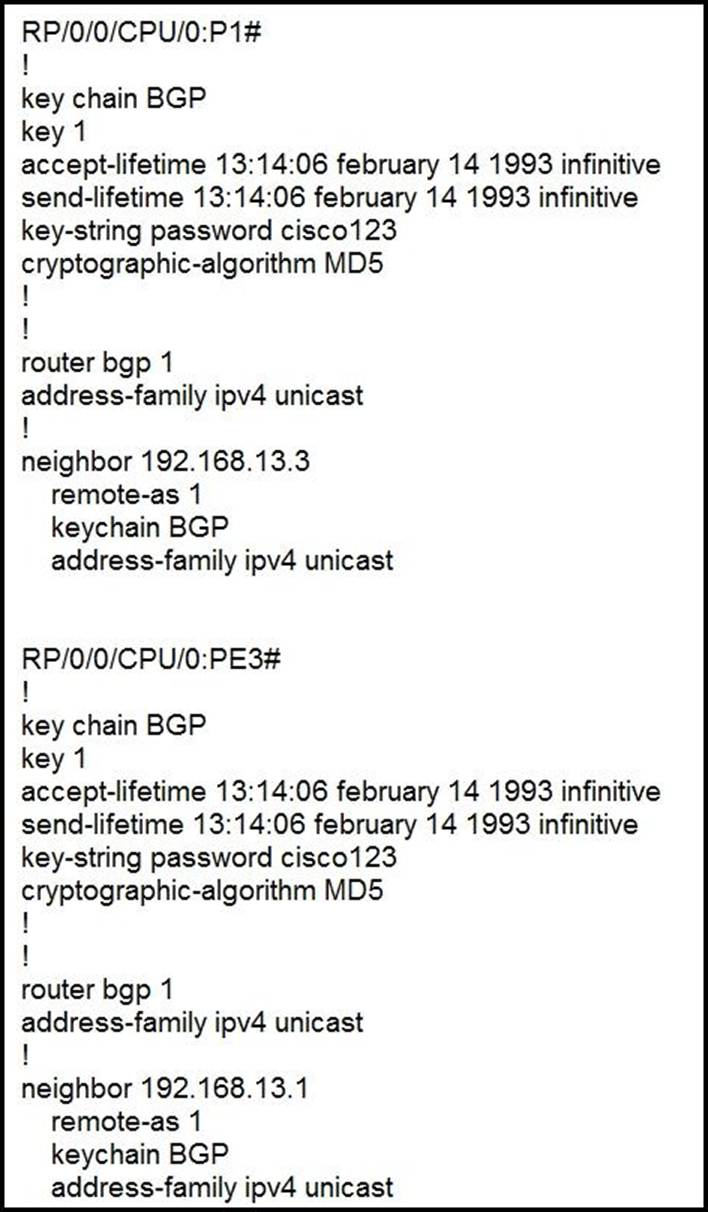
P1 and PE3 Cisco IOS XR routers are directly connected and have this configuration applied. The BGP session is not coming up. Assume that there is no IP reachability problem and both routers can open tcp port 179 to each other.
Which two actions fix the issue? (Choose two.)
- A . Change MD5 to HMAC-SHA1-12
- B . Change MD5 to HMAC-ESP
- C . Change MD5 to SHA-1
- D . Change MD5 to HMAC-MD5
- E . Remove the send and accept lifetime under key 1
AD
Explanation:
Reference: https://www.cisco.com/c/en/us/td/docs/routers/crs/software/crs_r4-0/security/configuration/guide/sc40crsbook_chapter5.html
What can be used to determine a path from the head-end to a tail-end router when implementing SR-TE with a head-end, with little information on the network topology?
- A . traffic controller
- B . path computation engine
- C . tail-end router
- D . SNMP server
An engineer configured OSPF on all routers in the data center in the same exchange as other routers Layer 2 connectivity was established. Now, the engineer plans to implement BFD to detect failures in the forwarding path.
Which action must the engineer take?
- A . Configure BFD on any one of the routers
- B . Configure IS-IS routing before implementing BFD.
- C . Configure BFD between each adjacent router
- D . Configure CEF before implementing BFD