
CIPS L4M2 Practice Exams
Last updated on Oct 22,2026- Exam Code: L4M2
- Exam Name: Defining Business Needs
- Certification Provider: CIPS
- Latest update: Oct 22,2026
Corporation tax
- A . 2 and 4 only
- B . 1 and 2 only
- C . 2 and 3 only
- D . 1 and 4 only
B
Explanation:
Quantity discounts: Changes in order quantities can lead to cost savings, impacting budget forecasts. Substitute goods: Using alternative products can alter planned expenses, causing budget deviations. Loan repayments and taxes are fixed financial obligations and do not directly impact procurement budgeting.
Reference: CIPS Level 4, Cost Management.
Which of the following standards specifies requirements for a quality management system?
- A . ISO 27001
- B . ISO 9001:2015
- C . ISO 22000:2018
- D . ISO 14001:2015
B
Explanation:
ISO 9001:2015 specifies requirements for a quality management system.
ISO 14001:2015 specifies the requirements for an environmental management system that an organization can use to enhance its environmental performance. ISO 14001:2015 is intended for use by an organization seeking to manage its environmental responsibilities in a systematic manner that contributes to the environmental pillar of sustainability.
ISO 22000:2018 specifies food safety management systems ― Requirements for any organization in the food chain
ISO 27001 provides requirements for an information security management system.
LO 3, AC 3.1
To improve the productivity, Plantation Ltd is planning to purchase a tractor, which it has never bought before. The project must be quick to catch up with the next growing season. Leanne, a junior procurement staff at the company, assumes that she could skip market analysis stage to save time.
Is this assumption reasonable?
- A . No, the company assesses supplier’s performance solely based on market analysis
- B . Yes, Leanne just needs to purchase the tractor from her friend’s company
- C . No, market analysis will inform the company of the pricing as well as latest technology trends
- D . Yes, the company has extensive experience in purchasing tractor
C
Explanation:
Market analysis is a stage in CIPS Procurement and Supply Cycle. This stage informs the purchaser about the number of suppliers, the average pricing, and product trends. Even urgent purchase should undergo market analysis. Without undertaking this stage, the buying organisation may not purchase the right product, or they may purchase at higher price.
Reference: CIPS study guide page 63-71
LO 2, AC 2.1
Sealines Inc is developing its fleet of cargo ships. The company is planning to build a new ship powered by natural gas. Brian, the procurement manager at Sealines, suggests the project team to develop a through-life specification before engaging with the supplier.
Is this a correct approach?
- A . Yes, decommissioning and disposal costs will not be accounted in this approach
- B . Yes, this approach will lower the total cost of ownership
- C . No, a ship is used only once, through-life management is unnecessary
- D . No, the company just needs to select the lowest bidder
B
Explanation:
Through-life management is a approach applied to capital asset. According to Ward and Graves, Through-life Management involves the life-cycle management of the products, services and activities required to deliver a fully integrated capability to the customer, while reducing the cost of ownership for the customer.
According to CIPS study guide, through-life management comprises of 6 parts:
In Kano model, which of the following types of requirement should be excluded from the product or service?
- A . Must-be requirements
- B . Performance requirements
- C . Attractive requirements
- D . Reverse requirements
D
Explanation:
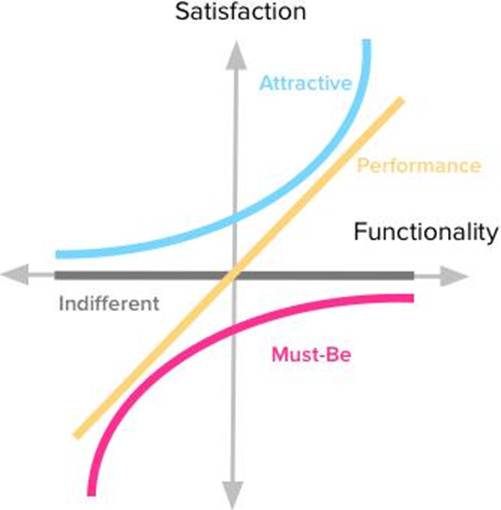
Kano model of excitement and basic quality (Kano et al, 1984; Berger et al, 1993; Matzler et al, 1996) brings a different perspective for the analysis of improvement opportunities in products and services because it takes in consideration the asymmetrical and non-linear relationship between performance and satisfaction. The Kano model classifies customers requirements in three categories (figure 3):
a) Basic Requirements (or Must-be requirement). The basic requirements fulfill the basic functions of a product. If they are not present or their performance is insufficient, customers will be extremely
dissatisfied. On the other hand, if they are present or have sufficient performance, they don’t bring satisfaction. Customers see them as prerequisites. For instance, for luxury automobiles, "air bags" are considered basic. A customer won’t feel satisfied if the automobile has "air bag", however he/she will not buy it if “air bag” is not present.
b) Performance Requirements (or One-dimensional requirements). As for these requirements, satisfaction is proportional to the performance level C the higher the performance, the higher the customer’s satisfaction will be and vice-versa. Gas consumption in automobiles is an example of these requirements. Usually customers explicitly demand performance requirements.
c) Excitement Requirements (or Attractive requirements). These requirements are key to customer satisfaction. If they are present or have sufficient performance, they will bring superior satisfaction. On the other hand, if they are not present or their performance is insufficient, customers will not get dissatisfied. For instance, a surprise gift at the end of a dinner in a restaurant will certainly bring satisfaction, but it will not cause dissatisfaction if not offered. These requirements are not demanded nor expected by customers.
Two other types of requirements may be identified in the Kano model: neutral and reverse ones. Neutral requirements do not bring either satisfaction or dissatisfaction. Reverse requirements bring more satisfaction if absent than if present.
Reference: – Integrating Kano model and QFD for Designing New Products
– CIPS study guide page 171-172
Which of the following might be consequences of over-specification? Select TWO that apply:
- A . Reducing motion waste
- B . Higher cost due to inessential features
- C . Limiting competition in supply market
- D . Lack of essential features
- E . Better contract management
B, D
Explanation:
Over-specification can cause problems to buying organisation, include the following:
– Higher expense due to unnecessary features embedded into the product
– Stifle competition because higher requirements will lead to fewer suppliers in the market are able to supply
– Harder to evaluate the trade-offs between different features and attributes in the specification
Reference: CIPS study guide page 141-142
LO 3, AC 3.3
Acquiring competitors
- A . 3 and 4 only
- B . 3 and 5 only
- C . 1 and 2 only
- D . 2 and 5 only
A
Explanation:
"A firm’s relative position within its industry determines whether a firm’s profitability is above or below the industry average. The fundamental basis of above average profitability in the long run is sustainable competitive advantage. There are two basic types of competitive advantage a firm can possess: low cost or differentiation. The two basic types of competitive advantage combined with the scope of activities for which a firm seeks to achieve them, lead to three generic strategies for achieving above average performance in an industry: cost leadership, differentiation, and focus." (Reference: Porter, Michael E., "Competitive Advantage". 1985, Ch. 1, pp 11-15. The Free Press. New York.)
Creating stand-out products and brands is considered as Differentiation. An organisation that is not clear about which of these three strategies to use is described as ‘stuck in the middle’ LO 2, AC 2.1
Which of the following may allow suppliers free to choose the materials, manufacturing process or delivery process?
- A . Performance specification
- B . Design specification
- C . Technical specifications
- D . Conformance specification
A
Explanation:
The Performance Specifications define what the system being designed must do, and not how it must do it. In this step a list of needs and wants should be created. The needs are customer requirements, while the wants are engineering desires. If a buyer adopts performance specification, the supplier will be free to choose how to make and deliver the product.
A technical specification document outlines how you’re going to address a technical problem by designing and building a solution for it.
A design specification is a detailed document providing a list of points regarding a product or process. For example, the design specification could include required dimensions, environmental fac-tors, ergonomic factors, aesthetic factors, maintenance that will be needed, etc. It may also give
specific examples of how the design should be executed, helping others work properly (a guideline for what the person should do).
With conformance specification the buyer says what they want and how they want it and the supplier has to meet this
Reference: CIPS study guide page 119-124
LO3, AC 3.1