
CIPS L4M2 Practice Exams
Last updated on Oct 23,2026- Exam Code: L4M2
- Exam Name: Defining Business Needs
- Certification Provider: CIPS
- Latest update: Oct 23,2026
Lucy, a junior procurement analyst, has been asked to assess the competitive forces in the garden furniture market. XYZ Ltd is the largest producer of garden furniture in the country. It produces 70% of all the garden furniture manufactured, while the second largest manufacturer produces less than 5% of the garden furniture for the country.
Which power does XYZ Ltd possess?
- A . Purchasing power
- B . Substitute power
- C . Supplier bargaining power
- D . Buyer bargaining power
Threat of backward integration is significant
- A . 3 and 4 only
- B . 2 and 3 only
- C . 1 and 4 only
- D . 2 and 4 only
C
Explanation:
Price sensitivity is the degree to which the price of a product affects consumers’ purchasing behaviours. Buyer power will be stronger if buying organisation are price sensitive and vice versa. Backward integration is a form of vertical integration in which a buying organisation expands its role to fulfil tasks formerly completed by businesses up the supply chain. Buyer power is strong if threat of backward integration is high.
Set-up cost is a determinant of threat of new entry. Some industries require very expensive assets in order to make products. The financial risk of entering the industry and not succeeding can deter many potential new entrants. The fewer new entrants, the fewer available substitutes, then the bar-gaining power of buyer can be negatively affected.
Forward integration is a business strategy that involves a form of vertical integration whereby
business activities are expanded to include control of the direct distribution or supply of a company’s products. Threat of forward integration is a determinant of supplier’s bargaining power.
Reference: CIPS study guide page 88-91
LO 2, AC 2.2
Which of the following are major factors when determining the bargaining power of buyers? Select THREE that apply.
- A . Number of buyers relative to suppliers
- B . Dependence of a buyer’s purchase on a particular supplier
- C . Life cycle costs
- D . Cash flow
- E . Switching costs
- F . Interest costs
ABC Ltd has enormous investment in facilities and machinery. It also employs skilled workforce. To be profitable, the company has to produce at massive quantity.
Which sector does ABC Ltd belong to?
- A . Manufacturing
- B . Retail
- C . Construction
- D . Agriculture
- E . Finance
A
Explanation:
In the scenario, ABC Ltd has the following characteristics:
– Large investment in facilities and machinery
– Access to skilled workforce
– Mass production.
This company is a manufacturer. Manufacturing is an industry that makes products from raw materials by the use of manual labour or machinery and that is usually carried out systematically with a division of labour.
Manufacturing requires investment in machinery and access to a suitably skilled workforce as well as materials and components.
Reference: – CIPS study guide page 74-76
– manufacturing | Definition, Types, & Facts | Britannica LO 2, AC 2.1
Which of the following is an useful tool for value engineering?
- A . SAMOA
- B . Kraljic Portfolio Matrix
- C . Star-burst method
- D . Kano model
D
Explanation:
Value Engineering (VE) is concerned with new products. It is applied during product development. The focus is on reducing costs, improving function or both, by way of teamwork-based product evaluation and analysis. This takes place before any capital is invested in tooling, plant or equipment. This is very significant, because according to many reports, up to 80% of a product’s costs (throughout the rest of its life-cycle), are locked in at the design development stage. This is understandable when you consider the design of any product determines many factors, such as tooling, plant and equipment, labour and skills, training costs, materials, shipping, installation, maintenance, as well as decommissioning and recycle costs.
The Kano model is a theory for product development and customer satisfaction developed in the 1980s by Professor Noriaki Kano, which classifies customer preferences into five categories. Both Kano model and Value Engineering aims at optimising new product, so they can be combined together. CIPS L4M2 study guide consider Kano model is a tool of Value Engineering
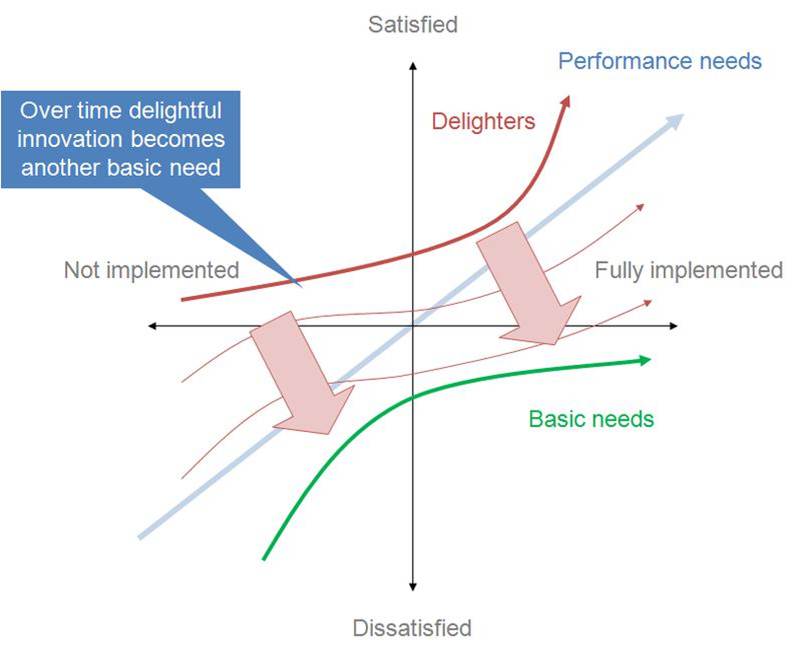
Example of Kano model (source: Wikipedia)
Reference: CIPS study guide page 171-172
LO 3, AC 3.4
Which competitive forces influence markets in our modern environment?
- A . Manufacturing of goods and services
- B . Production companies and relationships
- C . Increased cost in supply and deliveries
- D . Bargaining strength of suppliers and buyers
D
Explanation:
The bargaining strength of suppliers and buyers is a key factor influencing market competitiveness, as outlined in frameworks like Porter’s Five Forces. These forces dictate pricing, supply availability, and value delivery.
Reference: CIPS Level 4, Market Analysis and Competitive Forces.