
CIPS L4M2 Practice Exams
Last updated on Oct 23,2026- Exam Code: L4M2
- Exam Name: Defining Business Needs
- Certification Provider: CIPS
- Latest update: Oct 23,2026
Which of the following is a tool to define roles and responsibilities of a project team?
- A . RACI Matrix
- B . Monte Carlo model
- C . STEEPLE Analysis
- D . SCAMPER Method
A
Explanation:
A responsibility assignment matrix[1] (RAM), also known as RACI matrix[2] (/ˈreɪsi/) or linear responsibility chart[3] (LRC), describes the participation by various roles in completing tasks or deliverables for a project or business process. RACI is an acronym derived from the four key responsibilities most typically used: responsible, accountable, consulted, and informed.[4] It is used for clarifying and defining roles and responsibilities in cross-functional or departmental projects and processes.[5] There are a number of alternatives to the RACI model. Role distinction[edit]
There is a distinction between a role and individually identified people: a role is a descriptor of an associated set of tasks; may be performed by many people; and one person can perform many roles. For example, an organization may have ten people who can perform the role of project manager, although traditionally each project only has one project manager at any one time; and a person who is able to perform the role of project manager may also be able to perform the role of business analyst and tester.
R = Responsible (also recommended)Those who do the work to complete the task.[6] There is at least one role with a participation type of responsible, although others can be delegated to assist in the work required (see also RASCI below for separately identifying those who participate in a sup-porting role).
A = Accountable (also approver or final approving authority) The one ultimately answerable for the correct and thorough completion of the deliverable or task, the one who ensures the prerequisites of the task are met and who delegates the work to those responsible.[6] In other words, an accountable must sign off (approve) work that responsible provides. There must be only one accountable specified for each task or deliverable.[7]
C = Consulted (sometimes consultant or counsel) Those whose opinions are sought, typical-ly subject-matter experts; and with whom there is two-way communication.[6]
I = Informed (also informee) Those who are kept up-to-date on progress, often only on completion of the task or deliverable; and with whom there is just one-way communication.[6]
Very often the role that is accountable for a task or deliverable may also be responsible for completing it (indicated on the matrix by the task or deliverable having a role accountable for it, but no role responsible for its completion, i.e. it is implied). Outside of this exception, it is generally recommended that each role in the project or process for each task receive, at most, just one of the participation types. Where more than one participation type is shown, this generally implies that participation has not yet been fully resolved, which can impede the value of this technique in clarifying the participation of each role on each task.
Reference: – CIPS study guide page 17
– Responsibility assignment matrix – Wikipedia LO 1, AC 1.1
An example of a performance specification is a …
- A . Brand name
- B . List of outputs
- C . List of inputs
- D . Technical drawing
What is the contribution of marketing function to the development of specification?
- A . Marketing ensures that conformance specification will never be used
- B . Marketing ensures that procurement function doesn’t involve in developing specification
- C . Marketing provides ideas on customer’s taste and market trends
- D . Marketing consults on technical requirements of the product
C
Explanation:
Marketing plays a critical role in sales. The marketing department introduces products to the consumer, and creates strategic messaging that elevates appeal and ultimately drives sales. The feed-back and response from consumers is measured by the marketing team on a variety of levels. Advertising is one means of seeing what performs and what does not perform. Marketers will note trends and demand in their specific markets. This plays into new product development, because the marketing team can work with product developers to create products based on that demand.
In development of specification, the role of marketing is largely the same. They provide the market insight so that right specification is developed and it matches the demands from customers.
Reference: – CIPS study guide page 173-175
– Role of Marketing Management in New Product Development (chron.com) LO 3, AC 3.4
FSB Group is developing a specification for the construction of a new building. The project stakeholders need the specification to set specific criteria to ensure fair labour practices and local employment opportunities are prioritised.
Which of the following describes this type of sustainability criteria?
- A . Profit Sustainability
- B . Environmental Sustainability
- C . Social Sustainability
- D . Economic Sustainability
C
Explanation:
Social sustainability focuses on ethical considerations like fair labour practices, inclusivity, and community development. By addressing these criteria, FSB Group aligns with responsible business practices.
Reference: CIPS Level 4, Sustainability in Procurement.
A company has a lists of items that make up 15% of total spend. These items also do not largely impact on quality of final product. The supply continuity is secured.
Which of the following will be the most appropriate managing approach to purchase these items?
- A . Enhance supply continuity
- B . Simplify procurement process
- C . Build partnership with suppliers
- D . Drive down cost based on market competition
B
Explanation:
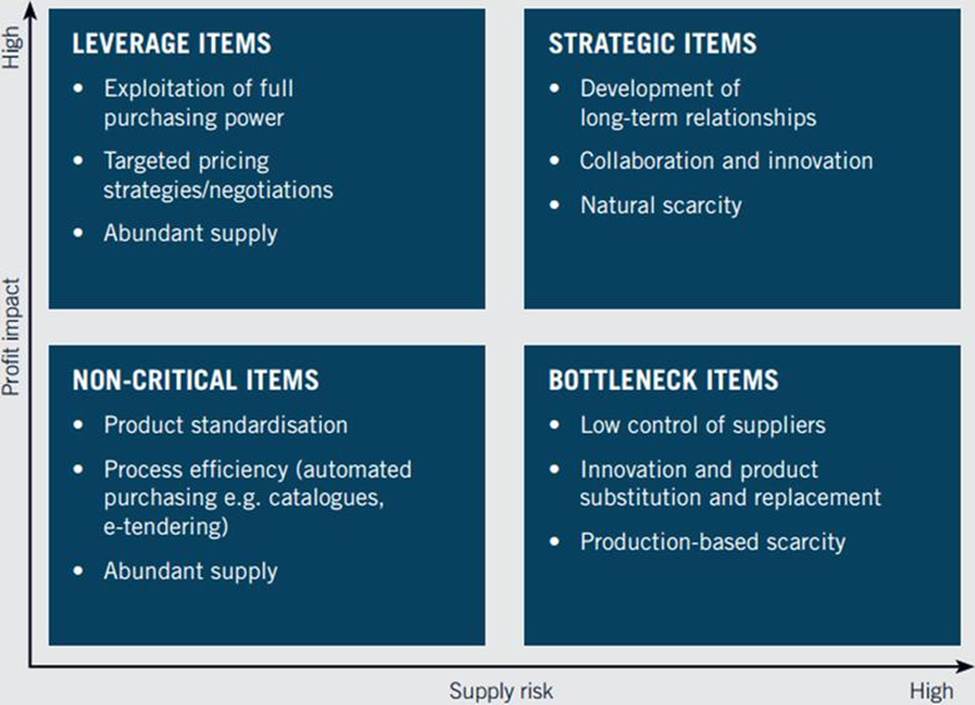
Those items make up small portion of spend and the supply risk is low. So it is tactical item according
to Kraljic portfolio matrix. Procurement should bundle these items into larger contracts, simplify
procurement process.
LO 2, AC 2.1
Procurement should work closely with colleagues in accounts when creating an annual budget. This is because the budget will help the company …
- A . Define terms and conditions of the contract
- B . Plan its finances for the next year
- C . Process supplier invoices quicker
- D . Plan its functional strategy for the next year
Ethan is the newly appointed CEO of ATT Group. He sees that the company is wasting financial resources on unnecessary spends. To solve this problem, Ethan requires all functional managers to prepare their department budget from scratch. Each spend must have justification or it will not be
approved.
Which budgeting method is Ethan using?
- A . Value preposition budget
- B . Zero-based budget
- C . Incremental budget
- D . Activity-based budget
B
Explanation:
There are four common types of budgets that companies use: (1) incremental, (2) activity-based, (3) value proposition, and (4) zero-based.
Incremental budgeting takes last year’s actual figures and adds or subtracts a percentage to obtain the current year’s budget. It is the most common method of budgeting because it is simple and easy to understand.
Activity-based budgeting is a top-down budgeting approach that determines the amount of inputs required to support the targets or outputs set by the company. For example, a company sets an out-put target of $100 million in revenues. The company will need to first determine the activities that need to be undertaken to meet the sales target, and then find out the costs of carrying out these activities.
In value proposition budgeting, the budgeter considers the following questions:
– Why is this amount included in the budget?
– Does the item create value for customers, staff, or other stakeholders?
– Does the value of the item outweigh its cost? If not, then is there another reason why the cost is justified?
Value proposition budgeting is really a mindset about making sure that everything that is included in the budget delivers value for the business. Value proposition budgeting aims to avoid unnecessary expenditures C although it is not as precisely aimed at that goal as our final budgeting option, zero-based budgeting.
As one of the most commonly used budgeting methods, zero-based budgeting starts with the assumption that all department budgets are zero and must be rebuilt from scratch. Managers must be able to justify every single expense. No expenditures are automatically “okayed”. Zero-based budgeting is very tight, aiming to avoid any and all expenditures that are not considered absolutely essential to the company’s successful (profitable) operation. This kind of bottom-up budgeting can be a highly effective way to “shake things up”. This is the method used in the scenario.
Reference: – CIPS study guide page 58
– Types of Budgets – The Four Most Common Budgeting Methods (corporatefinanceinstitute.com) LO 1, AC 1.4
Which of the following is an advantage of competitive benchmarking over other types of bench-marking?
- A . Limited access to competitor’s data
- B . Similarity among processes
- C . Different corporate culture
- D . Cost effectiveness
B
Explanation:
Competitive benchmarking
Competitive benchmarking is a direct competitor-to-competitor comparison of a product, service, process, or method. This form of benchmarking provides an opportunity to know yourself and your competition better; combine forces against another common competitor. An example of competitive benchmarking within the Department of Defense, might include contrasting Army and Air Force supply systems for Joint initiatives. Within the private sector, two or more American car companies might benchmark for mutual benefit against common international competitor; or, rival chemical companies benchmark for environmental compliance.
Benefits
– Comparing like processes
– Know your competition better
– Possible partnership
– Useful for planning and setting goals
– Similar regulatory issues
Challenges
– Difficult legal issues
– Relatively low performance improvement
– Threatening
– Limited by trade secrets
– May provide misleading information
– May not get best-in-class comparisons
– Competitors could capitalize on your weaknesses Source: USN Benchmarking Handbook
Reference: CIPS study guide page 50
LO 1, AC 1.3
A hospital extensively spends on medical and implantable devices, medical, surgical and pharmaceutical supplies, costs of supplies related to buildings and maintenance operations. Hospital’s procurement manager suggests that the hospital has an opportunity to reduce operational costs by reducing variation of medical devices and pharmaceutical supplies.
Which of the following best describe the procurement manager’s suggestion?
- A . Process standardisation
- B . Product standardisation
- C . Value engineering
- D . Process re-engineering
B
Explanation:
The hospital is buying too many product variants. This may cause bottleneck in its operation and increase operational expense. So procurement manager suggests to standardise products. This is an example of the benefits of product standardisation:
Saint Thomas Health, a system of 5 hospitals, needed to find a way to reduce costs. They were purchasing different SKUs for products that were very similar, in this case, labels. They bought label rolls for $3 and a very similar product for $1. This oversight in product purchases impacted the overall costs of the system. After partnering with a sole source vendor it was able to save $200,000 over a four year span. They accomplished this simply by standardizing label products. These savings, however, only account for the immediate savings from standardizing products. The saving that are not factored into that number are the savings from soft or hidden costs.
On a national scale, hospitals lose millions of dollars per year in hidden expenses due to missed opportunities for cost containment and incorporation.
Some of the hidden elements that increase overall costs for a healthcare provider include the following:
– Redundant purchasing
– Freight
– Excessive purchase orders
– Multiple vendor relations
– Low efficiency
– Joint commission fines
– HAI
By implementing product standardization, hospitals and health systems reduce vendors, are able to reduce SKUs, purchase orders, inefficiency, freight costs, fines, and off-contract spending. All of this adds up to large savings for the organization as a whole.
96% of the respondents in the survey agree that consolidating suppliers and standardizing product purchases across organization would reduce hidden costs.
Reference: – CIPS study guide page 157-159
– 3 Ways Product Standardization Can Help You Get a Bonus C ConnectID (pdchealthcare.com) LO 3, AC 3.4