
CIPS L4M2 Practice Exams
Last updated on Oct 23,2026- Exam Code: L4M2
- Exam Name: Defining Business Needs
- Certification Provider: CIPS
- Latest update: Oct 23,2026
Which of the following are considered as direct costs in a construction company? Select TWO op-tions
- A . Raw materials
- B . An employee is hired to work on a project, either exclusively or for an assigned number of hours
- C . The materials and supplies needed for the company’s day-to-day operations.
- D . Advertising and marketing communication
- E . Clerical assistants who maintain the office
A, B
Explanation:
Direct costs are directly associated with the production of a good or service. In this question, ‘An employee is hired to work on a project, either exclusively or for an assigned number of hours’ and ‘Raw materials’ are directly related to producing the product.
Indirect costs are the general costs of the organisation – these costs cannot easily be attributed to specific products or services (also known as overheads). ‘The materials and supplies needed for the company’s day-to-day operations’ or ‘Clerical assistants who maintain the office’ or ‘Advertising and marketing communication’ is example of indirect cost.
Reference: CIPS study guide page 25-26
LO 1, AC 1.2
GSC Ltd is a manufacturer of car parts. To accommodate growing demands of electric cars, the company is developing a new component which requires different type of steel. The project team estimates that the component will be ready for production in 1.5 years. Until then, they need to keep the production busy.
After checking the inventory records, the production team sees that the company has 3 months of stock. The lead time for each batch is two months.
Which of the following should be a priority action of the company?
- A . Create new specification to new supplier
- B . Standardise the specification
- C . Create new specification to current supplier
- D . Make a call-off order to current supplier
D
Explanation:
The scenario is very long with many distracting data. Students need to read carefully and use their experience to solve this problem.
The company is developing a new component which requires different type of material. But this component will not be available for mass production in 1.5 years. This means the company still needs to produce the current components with current materials until the development is finished. They must continue purchase the materials from current supplier through call-off orders. This situation is an example of straight re-buy.
Reference: CIPS study guide page 3
LO 1, AC 1.1
To strengthen its market presence, ABC Group decided to develop a new product. A cross-functional team was formed to discuss the scope and the functions of the product. They will also survey the potential customers to see what they like, what they love, and what they dislike.
What is this process called?
- A . Value analysis
- B . Cash flow analysis
- C . Product standardisation
- D . Value engineering
D
Explanation:
As you can see from the scenario, ABC Group is developing the new product. It might be using value engineering. The latter sentences confirm this: the cross-functional team in ABC is mapping the functions and surveying the customers. Their method is known as Kano model.
Reference: CIPS study guide page 171-172
LO 3, AC 3.4
A procurement team is categorising their purchased items into four quadrants of Kraljic’s supply chain portfolio matrix. They realise that there are some low-value items which come from very few suppliers in the market. The organisation is critically dependent on these suppliers. The team plans
to reduce the dependence by finding alternative sources. Is this a right course of action?
- A . Yes, the organisation needs to reduce the supply risks
- B . No, the organisation should run competitive biddings to exploit the competition
- C . No, there is no way to escape this dependency
- D . Yes, this action will dramatically increase the supplier’s bargaining power
A
Explanation:
According to Kraljic portfolio matrix, the low-value items with high supply risk are bottleneck items.
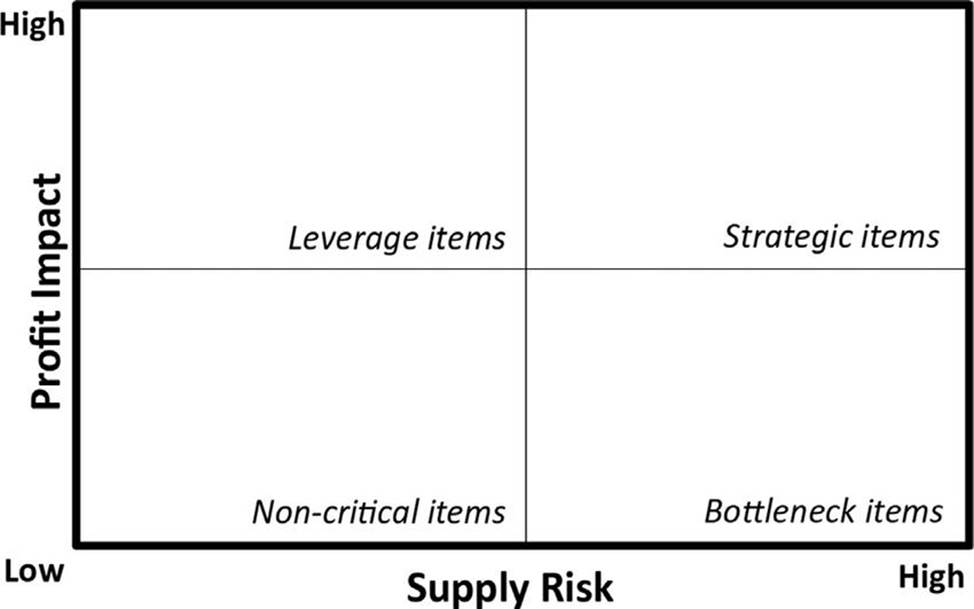
The purchasing strategy that is commonly recommended for these products is primarily based on acceptance of the dependence and reduction of the negative effects of the unfavourable position. An alternative strategy suggested by purchasing practitioners is to find other suppliers and move towards the non-critical quadrant.
– Accept dependence, reduce negative consequences: The main focus of this strategy is to assure supply, if necessary even at additional cost. Examples of this strategy are keeping extra stocks of the materials concerned or developing consigned stock agreements with suppliers. By performing a risk analysis firms can identify the most important bottleneck products and consider the implications. A possible action for dealing with unexpected bad dependence positions for certain products is to employ contingency planning.
– Reduce dependence and risk, find other solutions: This strategy is geared towards reducing the dependence on the supplier. The most common way to achieve this is to broaden the specifications of the product or to search for new suppliers.
The procurement team in the scenario has selected reducing dependency by finding alternatives. This is a right strategy for bottleneck item.
Reference: – CIPS study guide page 82-84
– Purchasing strategies in the Kraljic matrix―A power and dependence perspective, Marjolein C.J. Caniels, Cees J. Gelderman
LO 2, AC 2.1
Company A sells a product for $100. The total unit variable costs are $60. Fixed costs as in its ac-count are $20,000.
How many products does the company have to sell to achieve break-even point?
- A . 600
- B . 550
- C . 400
- D . 500
D
Explanation:
Break even point = Fixed costs/(Price-variable cost). In this case, break even point = 20,000/(100-60) = 500
Reference: CIPS study guide page 28-29
LO 1, AC 1.2
A construction company requires a specification that details the exact composition of the concrete mix and the exact methods of construction required for its use.
Which specification should it adopt?
- A . Design specification
- B . Performance specification
- C . Ergonomic specification
- D . Functional specification
Daytona Ltd is developing a new product which is more environmental friendly. Though the objectives are set, the project team has no idea on which functions will be customers’ favourites.
Which of the following will help them decide the ‘should-have’ functions of the new product?
- A . Kano model
- B . Taguchi method
- C . Thomas-Kilmann model
- D . Six Sigma
A
Explanation:
The Kano model is useful in gaining a thorough understanding of a customer’s needs. You can translate and transform the resulting verbatims using the voice of the customer table that, subsequently, becomes an excellent input as the whatsin a quality function deployment (QFD) House of Quality.
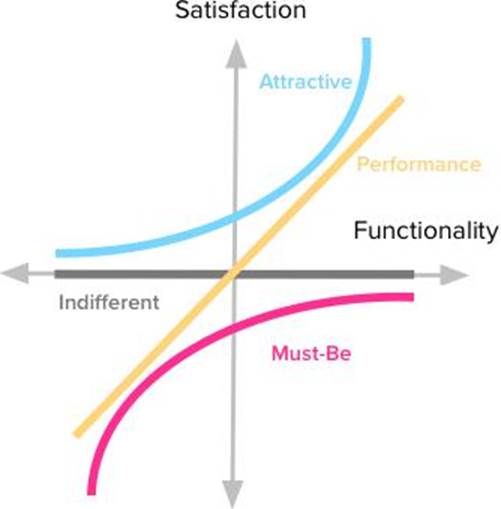
The model involves two dimensions:
Achievement (the horizontal axis), which goes from the supplier didn’t do it at all to the supplier did it very well.
Satisfaction (the vertical axis), which goes from total dissatisfaction with the product or service to total satisfaction with the product or service.
Dr. Noriaki Kano isolated and identified three levels of customer expectations: that is, what it takes to positively impact customer satisfaction. The figure below portrays the three levels of need: expected, normal, and exciting.
The ThomasCKilmann Conflict Mode Instrument (TKI) is a conflict style inventory, which is a tool developed to measure an individual’s response to conflict situations.
Genichi Taguchi, a Japanese engineer, proposed several approaches to experimental designs that are sometimes called "Taguchi Methods." These methods utilize two-, three-, and mixed-level fractional factorial designs. Large screening designs seem to be particularly favored by Taguchi adherents.
Six Sigma is a method that provides organizations tools to improve the capability of their business processes. This increase in performance and decrease in process variation helps lead to defect re-duction and improvement in profits, employee morale, and quality of products or services.
Source:
– CIPS study guide page 171-172- WHAT IS THE KANO MODEL? LO 3, AC 3.4