
CertNexus AIP-210 Practice Exams
Last updated on Oct 22,2026- Exam Code: AIP-210
- Exam Name: CertNexus Certified Artificial Intelligence Practitioner (CAIP)
- Certification Provider: CertNexus
- Latest update: Oct 22,2026
Which of the following tools would you use to create a natural language processing application?
- A . AWS DeepRacer
- B . Azure Search
- C . DeepDream
- D . NLTK
D
Explanation:
NLTK (Natural Language Toolkit) is a Python library that provides a set of tools and resources for natural language processing (NLP). NLP is a branch of AI that deals with analyzing, understanding, and generating natural language texts or speech. NLTK offers modules for various NLP tasks, such as tokenization, stemming, lemmatization, parsing, tagging, chunking, sentiment analysis, named entity recognition, machine translation, text summarization, and more.
Which two techniques are used to build personas in the ML development lifecycle? (Select two.)
- A . Population estimates
- B . Population regression
- C . Population resampling
- D . Population triage
- E . Population variance
AD
Explanation:
Personas are fictional characters that represent the potential users or customers of an ML system. Personas can help understand the needs, goals, preferences, and behaviors of the target audience, as well as design and evaluate the system from their perspective.
Some of the techniques that are used to build personas in the ML development lifecycle are:
Population estimates: Population estimates are statistical methods that estimate the size, characteristics, and distribution of a population based on a sample or a census. Population estimates can help identify and quantify the potential market segments and user groups for an ML system, as well as their demographics, locations, and behaviors.
Population triage: Population triage is a process of prioritizing and selecting the most relevant and representative personas for an ML system based on some criteria or metrics. Population triage can help focus on the key user needs and scenarios, as well as avoid creating too many or too few personas.
You are building a prediction model to develop a tool that can diagnose a particular disease so that individuals with the disease can receive treatment. The treatment is cheap and has no side effects. Patients with the disease who don’t receive treatment have a high risk of mortality.
It is of primary importance that your diagnostic tool has which of the following?
- A . High negative predictive value
- B . High positive predictive value
- C . Low false negative rate
- D . Low false positive rate
C
Explanation:
A false negative is an error where a positive case (belonging to the target class) is incorrectly predicted as negative (not belonging to the target class). A false negative rate is the ratio of false negatives to all actual positive cases. A low false negative rate means that most of the positive cases are correctly identified by the classifier.
For a diagnostic tool that can diagnose a particular disease so that individuals with the disease can receive treatment, it is of primary importance that it has a low false negative rate. This is because false negatives can have serious consequences for patients who have the disease but do not receive treatment, such as increased risk of mortality or complications. A low false negative rate can ensure that most patients who have the disease are diagnosed correctly and receive timely treatment.
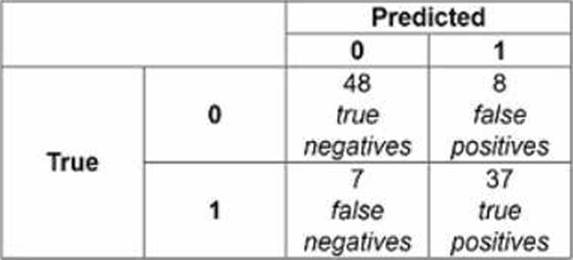
The following confusion matrix is produced when a classifier is used to predict labels on a test dataset.
How precise is the classifier?
- A . 48/(48+37)
- B . 37/(37+8)
- C . 37/(37+7)
- D . (48+37)/100
B
Explanation:
Precision is a measure of how well a classifier can avoid false positives (incorrectly predicted positive cases). Precision is calculated by dividing the number of true positives (correctly predicted positive cases) by the number of predicted positive cases (true positives and false positives). In this confusion matrix, the true positives are 37 and the false positives are 8, so the precision is 37/(37+8) = 0.822.
Which of the following options is a correct approach for scheduling model retraining in a weather prediction application?
- A . As new resources become available
- B . Once a month
- C . When the input format changes
- D . When the input volume changes
C
Explanation:
The input format is the way that the data is structured, organized, and presented to the model. For example, the input format could be a CSV file, an image file, or a JSON object. The input format can affect how the model interprets and processes the data, and therefore how it makes predictions. When the input format changes, it may require retraining the model to adapt to the new format and ensure its accuracy and reliability. For example, if the weather prediction application switches from using numerical values to categorical values for some features, such as wind direction or cloud cover, it may need to retrain the model to handle these changes.
A data scientist is tasked to extract business intelligence from primary data captured from the public.
Which of the following is the most important aspect that the scientist cannot forget to include?
- A . Cyberprotection
- B . Cybersecurity
- C . Data privacy
- D . Data security
C
Explanation:
Data privacy is the right of individuals to control how their personal data is collected, used, shared, and protected. It also involves complying with relevant laws and regulations that govern the handling of personal data. Data privacy is especially important when extracting business intelligence from primary data captured from the public, as it may contain sensitive or confidential information that could harm the individuals if misused or breached.
Which of the following is a common negative side effect of not using regularization?
- A . Overfitting
- B . Slow convergence time
- C . Higher compute resources
- D . Low test accuracy
A
Explanation:
Overfitting is a common negative side effect of not using regularization. Regularization is a technique that reduces the complexity of a model by adding a penalty term to the loss function, which prevents the model from learning too many parameters that may fit the noise in the training data. Overfitting occurs when the model performs well on the training data but poorly on the test data or new data, because it has memorized the training data and cannot generalize well.
Reference: Regularization (mathematics) – Wikipedia, Overfitting in Machine Learning: What It Is and How to Prevent It
For a particular classification problem, you are tasked with determining the best algorithm among SVM, random forest, K-nearest neighbors, and a deep neural network. Each of the algorithms has similar accuracy on your data. The stakeholders indicate that they need a model that can convey each feature’s relative contribution to the model’s accuracy.
Which is the best algorithm for this use case?
- A . Deep neural network
- B . K-nearest neighbors
- C . Random forest
- D . SVM
C
Explanation:
Random forest is an ensemble learning method that combines multiple decision trees to create a more accurate and robust classifier or regressor. Random forest can convey each feature’s relative contribution to the model’s accuracy by measuring how much the prediction error increases when a feature is randomly permuted. This metric is called feature importance or Gini importance. Random forest can also provide insights into the interactions and dependencies among features by visualizing the decision trees.
Which two of the following criteria are essential for machine learning models to achieve before deployment? (Select two.)
- A . Complexity
- B . Data size
- C . Explainability
- D . Portability
- E . Scalability
CE
Explanation:
Scalability and explainability are two criteria that are essential for ML models to achieve before deployment. Scalability is the ability of an ML model to handle increasing amounts of data or requests without compromising its performance or quality. Scalability can help ensure that the model can meet the demand and expectations of users or customers, as well as adapt to changing conditions or environments. Explainability is the ability of an ML model to provide clear and intuitive explanations for its predictions or decisions. Explainability can help increase trust and confidence among users or stakeholders, as well as enable accountability and responsibility for the model’s actions and outcomes.
Which of the following approaches is best if a limited portion of your training data is labeled?
- A . Dimensionality reduction
- B . Probabilistic clustering
- C . Reinforcement learning
- D . Semi-supervised learning
D
Explanation:
Semi-supervised learning is an approach that is best if a limited portion of your training data is labeled. Semi-supervised learning is a type of machine learning that uses both labeled and unlabeled data to train a model. Semi-supervised learning can leverage the large amount of unlabeled data that is easier and cheaper to obtain and use it to improve the model’s performance. Semi-supervised learning can use various techniques, such as self-training, co-training, or generative models, to incorporate unlabeled data into the learning process.