
Amazon SAP-C02 Practice Exams
Last updated on Oct 22,2026- Exam Code: SAP-C02
- Exam Name: AWS Certified Solutions Architect - Professional
- Certification Provider: Amazon
- Latest update: Oct 22,2026
A company wants to deploy an AWS WAF solution to manage AWS WAF rules across multiple AWS accounts. The accounts are managed under different OUs in AWS Organizations.
Administrators must be able to add or remove accounts or OUs from managed AWS WAF rule sets as needed. Administrators also must have the ability to automatically update and remediate noncompliant AWS WAF rules in all accounts
Which solution meets these requirements with the LEAST amount of operational overhead?
- A . Use AWS Firewall Manager to manage AWS WAF rules across accounts in the organization. Use an AWS Systems Manager Parameter Store parameter to store account numbers and OUs to manage Update the parameter as needed to add or remove accounts or OUs Use an Amazon EventBridge (Amazon CloudWatch Events) rule to identify any changes to the parameter and to invoke an AWS Lambda function to update the security policy in the Firewall Manager administrative account
- B . Deploy an organization-wide AWS Conng rule that requires all resources in the selected OUs to associate the AWS WAF rules. Deploy automated remediation actions by using AWS Lambda to fix noncompliant resources. Deploy AWS WAF rules by using an AWS CloudFormation stack set to target the same OUs where the AWS Config rule is applied.
- C . Create AWS WAF rules in the management account of the organization. Use AWS Lambda environment variables to store account numbers and OUs to manage Update environment variables as needed to add or remove accounts or OUs Create cross-account IAM roles in member accounts. Assume the roles by using AWS Security Token Service (AWS STS) in the Lambda function to create and update AWS WAF rules in the member accounts
- D . Use AWS Control Tower to manage AWS WAF rules across accounts in the organization. Use AWS Key Management Service (AWS KMS) to store account numbers and OUs to manage Update AWS KMS as needed to add or remove accounts or OUs. Create IAM users in member accounts Allow AWS Control Tower in the management account to use the access key and secret access key to create and update AWS WAF rules in the member accounts
A company has developed a hybrid solution between its data center and AWS. The company uses Amazon VPC and Amazon EC2 instances that send application togs to Amazon CloudWatch. The EC2 instances read data from multiple relational databases that are hosted on premises.
The company wants to monitor which EC2 instances are connected to the databases in near-real time. The company already has a monitoring solution that uses Splunk on premises. A solutions architect needs to determine how to send networking traffic to Splunk.
How should the solutions architect meet these requirements?
- A . Enable VPC flows logs, and send them to CloudWatch. Create an AWS Lambda function to periodically export the CloudWatch logs to an Amazon S3 bucket by using the pre-defined export function. Generate ACCESS_KEY and SECRET_KEY AWS credentials. Configure Splunk to pull the logs from the S3 bucket by using those credentials.
- B . Create an Amazon Kinesis Data Firehose delivery stream with Splunk as the destination. Configure a pre-processing AWS Lambda function with a Kinesis Data Firehose stream processor that extracts individual log events from records sent by CloudWatch Logs subscription filters. Enable VPC flows logs, and send them to CloudWatch. Create a CloudWatch Logs subscription that sends log events to the Kinesis Data Firehose delivery stream.
- C . Ask the company to log every request that is made to the databases along with the EC2 instance IP address. Export the CloudWatch logs to an Amazon S3 bucket. Use Amazon Athena to query the logs grouped by database name. Export Athena results to another S3 bucket. Invoke an AWS Lambda function to automatically send any new file that is put in the S3 bucket to Splunk.
- D . Send the CloudWatch logs to an Amazon Kinesis data stream with Amazon Kinesis Data Analytics for SOL Applications. Configure a 1 -minute sliding window to collect the events. Create a SQL query that uses the anomaly detection template to monitor any networking traffic anomalies in near-real time. Send the result to an Amazon Kinesis Data Firehose delivery stream with Splunk as the destination.
An ecommerce company runs its infrastructure on AWS. The company exposes its APIs to its web and mobile clients through an Application Load Balancer (ALB) in front of an Amazon Elastic Kubernetes Service (Amazon EKS) cluster. The EKS cluster runs thousands of pods that provide the APIs.
After extending delivery to a new continent, the company adds an Amazon CloudFront distribution and sets the ALB as the origin. The company also adds AWS WAF to its architecture.
After implementation of the new architecture, API calls are significantly. However, there is a sudden increase in HTTP status code 504 (Gateway Timeout) errors and HTTP status code 502 (Bad Gateway) errors. This increase in errors seems to be for a specific domain.
Which factors could be a cause of these errors? (Select TWO.)
- A . AWS WAF is blocking suspicious requests.
- B . The origin is not properly configured in CloudFront.
- C . There is an SSL/TLS handshake issue between CloudFront and the origin.
- D . EKS Kubernetes pods are being cycled.
- E . Some pods are taking more than 30 seconds to answer API calls.
A company runs a serverless application in a single AWS Region. The application accesses external URLs and extracts metadata from those sites. The company uses an Amazon Simple Notification Service (Amazon SNS) topic to publish URLs to an Amazon Simple Queue Service (Amazon SQS) queue An AWS Lambda function uses the queue as an event source and processes the URLs from the queue Results are saved to an Amazon S3 bucket
The company wants to process each URL other Regions to compare possible differences in site localization URLs must be published from the existing Region. Results must be written to the existing S3 bucket in the current Region.
Which combination of changes will produce multi-Region deployment that meets these requirements? (Select TWO.)
- A . Deploy the SOS queue with the Lambda function to other Regions.
- B . Subscribe the SNS topic in each Region to the SQS queue.
- C . Subscribe the SQS queue in each Region to the SNS topics in each Region.
- D . Configure the SQS queue to publish URLs to SNS topics in each Region.
- E . Deploy the SNS topic and the Lambda function to other Regions.
A company runs a customer service center that accepts calls and automatically sends all customers a managed, interactive, two-way experience survey by text message.
The applications that support the customer service center run on machines that the company hosts in an on-premises data center. The hardware that the company uses is old, and the company is experiencing downtime with the system. The company wants to migrate the system to AWS to improve reliability.
Which solution will meet these requirements with the LEAST ongoing operational overhead?
- A . Use Amazon Connect to replace the old call center hardware. Use Amazon Pinpoint to send text message surveys to customers.
- B . Use Amazon Connect to replace the old call center hardware. Use Amazon Simple Notification Service (Amazon SNS) to send text message surveys to customers.
- C . Migrate the call center software to Amazon EC2 instances that are in an Auto Scaling group. Use the EC2 instances to send text message surveys to customers.
- D . Use Amazon Pinpoint to replace the old call center hardware and to send text message surveys to customers.
A solutions architect is designing a publicly accessible web application that is on an Amazon CloudFront distribution with an Amazon S3 website endpoint as the origin. When the solution is deployed, the website returns an Error 403: Access Denied message.
Which steps should the solutions architect take to correct the issue? (Select TWO.)
- A . Remove the S3 block public access option from the S3 bucket.
- B . Remove the requester pays option trom the S3 bucket.
- C . Remove the origin access identity (OAI) from the CloudFront distribution.
- D . Change the storage class from S3 Standard to S3 One Zone-Infrequent Access (S3 One Zone-IA).
- E . Disable S3 object versioning.
A company is running a traditional web application on Amazon EC2 instances. The company needs to refactor the application as microservices that run on containers. Separate versions of the application exist in two distinct environments: production and testing. Load for the application is variable, but the minimum load and the maximum load are known. A solutions architect needs to design the updated application with a serverless architecture that minimizes operational complexity.
Which solution will meet these requirements MOST cost-effectively?
- A . Upload the container images to AWS Lambda as functions. Configure a concurrency limit for the associated Lambda functions to handle the expected peak load. Configure two separate Lambda integrations within Amazon API Gateway: one for production and one for testing.
- B . Upload the container images to Amazon Elastic Container Registry (Amazon ECR). Configure two auto scaled Amazon Elastic Container Service (Amazon ECS) clusters with the Fargate launch type to handle the expected load. Deploy tasks from the ECR images. Configure two separate Application Load Balancers to direct traffic to the ECS clusters.
- C . Upload the container images to Amazon Elastic Container Registry (Amazon ECR). Configure two auto scaled Amazon Elastic Kubernetes Service (Amazon EKS) clusters with the Fargate launch type to handle the expected load. Deploy tasks from the ECR images. Configure two separate Application Load Balancers to direct traffic to the EKS clusters.
- D . Upload the container images to AWS Elastic Beanstalk. In Elastic Beanstalk, create separate environments and deployments for production and testing. Configure two separate Application Load Balancers to direct traffic to the Elastic Beanstalk deployments.
An international delivery company hosts a delivery management system on AWS. Drivers use the system to upload confirmation of delivery. Confirmation includes the recipient’s signature or a photo of the package with the recipient. The driver’s handheld device uploads signatures and photos through FTP to a single Amazon EC2 instance. Each handheld device saves a file in a directory based on the signed-in user, and the file name matches the delivery number. The EC2 instance then adds metadata to the file after querying a central database to pull delivery information. The file is then placed in Amazon S3 for archiving.
As the company expands, drivers report that the system is rejecting connections. The FTP server is having problems because of dropped connections and memory issues. In response to these problems, a system engineer schedules a cron task to reboot the EC2 instance every 30 minutes. The billing team reports that files are not always in the archive and that the central system is not always updated.
A solutions architect needs to design a solution that maximizes scalability to ensure that the archive always receives the files and that systems are always updated. The handheld devices cannot be modified, so the company cannot deploy a new application.
Which solution will meet these requirements?
- A . Create an AMI of the existing EC2 instance. Create an Auto Scaling group of EC2 instances behind an Application Load Balancer. Configure the Auto Scaling group to have a minimum of three instances.
- B . Use AWS Transfer Family to create an FTP server that places the files in Amazon Elastic File System (Amazon EFS). Mount the EFS volume to the existing EC2 instance. Point the EC2 instance to the new path for file processing.
- C . Use AWS Transfer Family to create an FTP server that places the files in Amazon S3. Use an S3 event notification through Amazon Simple Notification Service (Amazon SNS) to invoke an AWS Lambda function. Configure the Lambda function to add the metadata and update the delivery system.
- D . Update the handheld devices to place the files directly in Amazon S3. Use an S3 event notification through Amazon Simple Queue Service (Amazon SQS) to invoke an AWS Lambda function. Configure the Lambda function to add the metadata and update the delivery system.
A company hosts a VPN in an on-premises data center. Employees currently connect to the VPN to access files in their Windows home directories. Recently, there has been a large growth in the number of employees who work remotely. As a result, bandwidth usage for connections into the data center has begun to reach 100% during business hours.
The company must design a solution on AWS that will support the growth of the company’s remote workforce, reduce the bandwidth usage for connections into the data center, and reduce operational overhead.
Which combination of steps will meet these requirements with the LEAST operational overhead? (Select TWO.)
- A . Create an AWS Storage Gateway Volume Gateway. Mount a volume from the Volume Gateway to the on-premises file server.
- B . Migrate the home directories to Amazon FSx for Windows File Server.
- C . Migrate the home directories to Amazon FSx for Lustre.
- D . Migrate remote users to AWS Client VPN
- E . Create an AWS Direct Connect connection from the on-premises data center to AWS.
A company with several AWS accounts is using AWS Organizations and service control policies (SCPs). An Administrator created the following SCP and has attached it to an organizational unit (OU) that contains AWS account 1111-1111-1111:
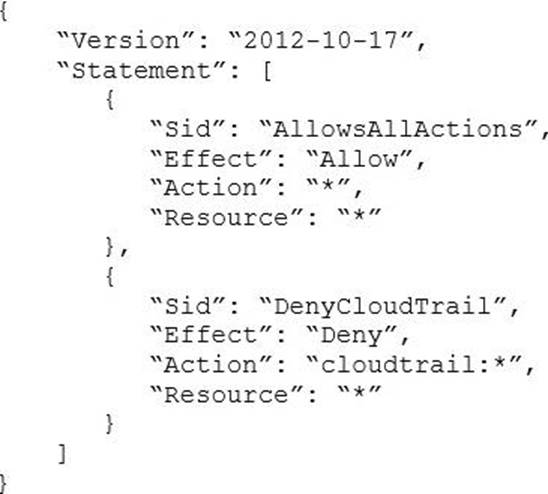
Developers working in account 1111-1111-1111 complain that they cannot create Amazon S3 buckets.
How should the Administrator address this problem?
- A . Add s3:CreateBucket with Allow effect to the SCP.
- B . Remove the account from the OU, and attach the SCP directly to account 1111-1111-1111.
- C . Instruct the Developers to add Amazon S3 permissions to their IAM entities.
- D . Remove the SCP from account 1111-1111-1111.