
Amazon SAP-C02 Practice Exams
Last updated on Oct 22,2026- Exam Code: SAP-C02
- Exam Name: AWS Certified Solutions Architect - Professional
- Certification Provider: Amazon
- Latest update: Oct 22,2026
A company is in the process of implementing AWS Organizations to constrain its developers to use only Amazon EC2, Amazon S3, and Amazon DynamoDB. The developers account resides in a dedicated organizational unit (OU).
The solutions architect has implemented the following SCP on the developers account:
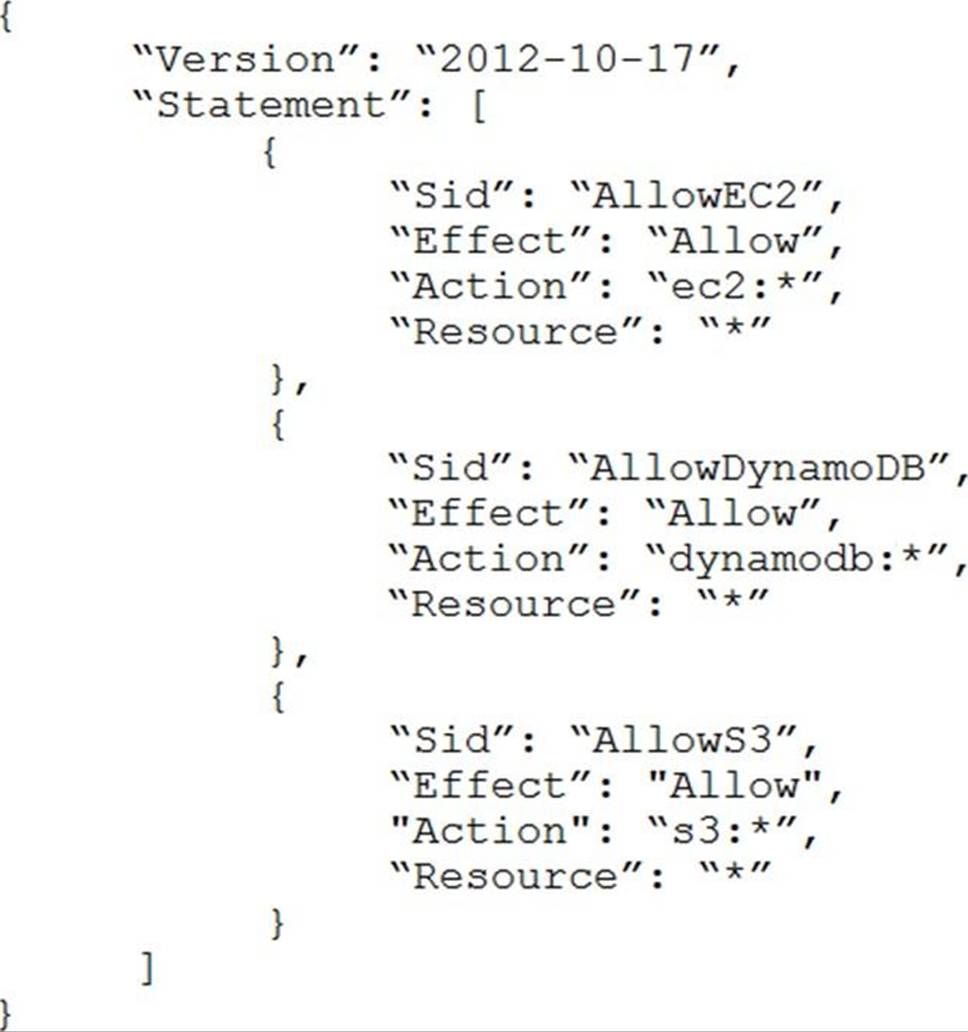
When this policy is deployed, IAM users in the developers account are still able to use AWS services that are not listed in the policy.
What should the solutions architect do to eliminate the developers’ ability to use services outside the scope of this policy?
- A . Create an explicit deny statement for each AWS service that should be constrained.
- B . Remove the FullAWSAccess SCP from the Developer account’s OU.
- C . Modify the FullAWSAccess SCP to explicitly deny all services.
- D . Add an explicit deny statement using a wildcard to the end of the SCP.
A company manufactures smart vehicles. The company uses a custom application to collect vehicle data. The vehicles use the MQTT protocol to connect to the application.
The company processes the data in 5-minute intervals. The company then copies vehicle telematics data to on-premises storage. Custom applications analyze this data to detect anomalies.
The number of vehicles that send data grows constantly. Newer vehicles generate high volumes of data. The on-premises storage solution is not able to scale for peak traffic, which results in data loss. The company must modernize the solution and migrate the solution to AWS to resolve the scaling challenges.
Which solution will meet these requirements with the LEAST operational overhead?
- A . Use AWS IOT Greengrass to send the vehicle data to Amazon Managed Streaming for Apache Kafka (Amazon MSK). Create an Apache Kafka application to store the data in Amazon S3. Use a pretrained model in Amazon SageMaker to detect anomalies.
- B . Use AWS IOT Core to receive the vehicle data. Configure rules to route data to an Amazon Kinesis Data Firehose delivery stream that stores the data in Amazon S3. Create an Amazon Kinesis Data Analytics application that reads from the delivery stream to detect anomalies.
- C . Use AWS IOT FleetWise to collect the vehicle data. Send the data to an Amazon Kinesis data stream. Use an Amazon Kinesis Data Firehose delivery stream to store the data in Amazon S3. Use the built-in machine learning transforms in AWS Glue to detect anomalies.
- D . Use Amazon MQ for RabbitMQ to collect the vehicle data. Send the data to an Amazon Kinesis Data Firehose delivery stream to store the data in Amazon S3. Use Amazon Lookout for Metrics to detect anomalies.
A solutions architect is building a web application that uses an Amazon RDS for PostgreSQL DB instance. The DB instance is expected to receive many more reads than writes. The solutions architect needs to ensure that the large amount of read traffic can be accommodated and that the DB instance is highly available.
Which steps should the solutions architect take to meet these requirements? (Select THREE)
- A . Create multiple read replicas and put them into an Auto Scaling group.
- B . Create multiple read replicas in different Availability Zones.
- C . Create an Amazon Route 53 hosted zone and a record set for each read replica with a TTL and a weighted routing policy.
- D . Create an Application Load Balancer (ALB) and put the read replicas behind the ALB.
- E . Configure an Amazon CloudWatch alarm to detect a failed read replica. Set the alarm to directly invoke an AWS Lambda function to delete its Route 53 record set.
- F . Configure an Amazon Route 53 health check for each read replica using its endpoint
A financial company needs to create a separate AWS account for a new digital wallet application. The company uses AWS Organizations to manage its accounts. A solutions architect uses the 1AM user Supportl from the management account to create a new member account with [email protected] as the email address.
What should the solutions architect do to create IAM users in the new member account?
- A . Sign in to the AWS Management Console with AWS account root user credentials by using the 64-character password from the initial AWS Organizations email [email protected]. Set up the IAM users as required.
- B . From the management account, switch roles to assume the OrganizationAccountAccessRole role with the account ID of the new member account. Set up the IAM users as required.
- C . Go to the AWS Management Console sign-in page. Choose "Sign in using root account credentials." Sign in in by using the email address [email protected] and the management account’s root password. Set up the IAM users as required.
- D . Go to the AWS Management Console sign-in page. Sign in by using the account ID of the new member account and the Supportl IAM credentials. Set up the IAM users as required.
A company runs an intranet application on premises. The company wants to configure a cloud backup of the application. The company has selected AWS Elastic Disaster Recovery for this solution.
The company requires that replication traffic does not travel through the public internet. The application also must not be accessible from the internet. The company does not want this solution to consume all available network bandwidth because other applications require bandwidth.
Which combination of steps will meet these requirements? (Select THREE.)
- A . Create a VPC that has at least two private subnets, two NAT gateways, and a virtual private gateway.
- B . Create a VPC that has at least two public subnets, a virtual private gateway, and an internet gateway.
- C . Create an AWS Site-to-Site VPN connection between the on-premises network and the target AWS network.
- D . Create an AWS Direct Connect connection and a Direct Connect gateway between the on-premises network and the target AWS network.
- E . During configuration of the replication servers, select the option to use private IP addresses for data replication.
- F . During configuration of the launch settings for the target servers, select the option to ensure that the Recovery instance’s private IP address matches the source server’s private IP address.
A company is deploying a new web-based application and needs a storage solution for the Linux application servers. The company wants to create a single location for updates to application data for all instances. The active dataset will be up to 100 GB in size. A solutions architect has determined that peak operations will occur for 3 hours daily and will require a total of 225 MiBps of read throughput.
The solutions architect must design a Multi-AZ solution that makes a copy of the data available in another AWS Region for disaster recovery (DR). The DR copy has an RPO of less than 1 hour.
Which solution will meet these requirements?
- A . Deploy a new Amazon Elastic File System (Amazon EFS) Multi-AZ file system. Configure the file system for 75 MiBps of provisioned throughput. Implement replication to a file system in the DR Region.
- B . Deploy a new Amazon FSx for Lustre file system. Configure Bursting Throughput mode for the file system. Use AWS Backup to back up the file system to the DR Region.
- C . Deploy a General Purpose SSD (gp3) Amazon Elastic Block Store (Amazon EBS) volume with 225 MiBps of throughput. Enable Multi-Attach for the EBS volume. Use AWS Elastic Disaster Recovery to replicate the EBS volume to the DR Region.
- D . Deploy an Amazon FSx for OpenZFS file system in both the production Region and the DR Region. Create an AWS DataSync scheduled task to replicate the data from the production file system to the DR file system every 10 minutes.
A solutions architect at a largo company needs to set up network security for outbound traffic to the internet from all AWS accounts within an organization m AWS Organizations. The organization has more than 100 AWS accounts, and the accounts route to each other by using a centralized AWS Transit Gateway. Each account has both an internet gateway and a NAT gateway for outbound traffic to the interne). The company deploys resources only Into a single AWS Region
The company needs the ability to add centrally managed rule-based filtering on all outbound traffic to the internet for all AWS accounts in the organization. The peak load of outbound traffic will not exceed 25 Gbps in each Availability Zone
Which solution meets these requirements?
- A . Creates a new VPC for outbound traffic to the internet Connect the existing transit gateway to the new VPC Configure a new NAT gateway Create an Auto Scaling group of Amazon EC2 Instances that run an open-source internet proxy for rule-based filtering across all Availability Zones in the Region Modify all default routes to point to the proxy’s Auto Scaling group
- B . Create a new VPC for outbound traffic to the internet Connect the existing transit gateway to the new VPC Configure a new NAT gateway Use an AWS Network Firewall firewall for rule-based filtering Create Network Firewall endpoints In each Availability Zone Modify all default routes to point to the Network Firewall endpoints
- C . Create an AWS Network Firewall firewal for rule-based filtering in each AWS account Modify all default routes to point to the Network Firewall firewalls in each account.
- D . In each AWS account, create an Auto Scaling group of network-optimized Amazon EC2 instances that run an open-source internet proxy for rule-based filtering Modify all default routes to point to the proxy’s Auto Scaling group.
A new application is running on Amazon Elastic Container Service (Amazon ECS) with
AWS Fargate. The application uses an Amazon Aurora MySQL database. The application and the database run m the same subnets of a VPC with distinct security groups that are configured.
The password (or the database is stored m AWS Secrets Manager and is passed to the application through the D8_PASSWORD environment variable. The hostname of the database is passed to the application through the DB_HOST environment variable. The application Is failing to access the database.
Which combination of actions should a solutions architect take to resolve this error? (Select THREE)
- A . Ensure that the container has the environment variable with name "DB_PASSWORD" specified with a "ValueFrom" and the ARN of the secret
- B . Ensure that the container has the environment variable with name *D8_PASSWORD" specified with a "ValueFrom" and the secret name of the secret.
- C . Ensure that the Fargate service security group allows inbound network traffic from the Aurora MySQL database on the MySQL TCP port 3306.
- D . Ensure that the Aurora MySQL database security group allows inbound network traffic from the Fargate service on the MySQL TCP port 3306.
- E . Ensure that the container has the environment variable with name "D8_HOST" specified with the hostname of a DB instance endpoint.
- F . Ensure that the container has the environment variable with name "DB_HOST" specified with the hostname of the OB duster endpoint.
An enterprise company is building an infrastructure services platform for its users.
The company has the following requirements:
Provide least privilege access to users when launching AWS infrastructure so users cannot provision unapproved services.
Use a central account to manage the creation of infrastructure services.
Provide the ability to distribute infrastructure services to multiple accounts in AWS Organizations.
Provide the ability to enforce tags on any infrastructure that is started by users.
Which combination of actions using AWS services will meet these requirements? (Choose three.)
- A . Develop infrastructure services using AWS Cloud Formation templates. Add the templates to a central Amazon S3 bucket and add the-IAM roles or users that require access to the S3 bucket policy.
- B . Develop infrastructure services using AWS Cloud Formation templates. Upload each template as an AWS Service Catalog product to portfolios created in a central AWS account. Share these portfolios with the Organizations structure created for the company.
- C . Allow user IAM roles to have AWSCloudFormationFullAccess and AmazonS3ReadOnlyAccess permissions. Add an Organizations SCP at the AWS account root user level to deny all services except AWS CloudFormation and Amazon S3.
- D . Allow user IAM roles to have ServiceCatalogEndUserAccess permissions only. Use an automation script to import the central portfolios to local AWS accounts, copy the TagOption assign users access and apply launch constraints.
- E . Use the AWS Service Catalog TagOption Library to maintain a list of tags required by the company.
Apply the TagOption to AWS Service Catalog products or portfolios. - F . Use the AWS CloudFormation Resource Tags property to enforce the application of tags to any CloudFormation templates that will be created for users.
A company needs to implement a patching process for its servers. The on-premises servers and Amazon EC2 instances use a variety of tools to perform patching.
Management requires a single report showing the patch status of all the servers and instances.
Which set of actions should a solutions architect take to meet these requirements?
- A . Use AWS Systems Manager to manage patches on the on-premises servers and EC2 instances. Use Systems Manager to generate patch compliance reports.
- B . Use AWS OpsWorks to manage patches on the on-premises servers and EC2 instances. Use Amazon OuickSight integration with OpsWorks to generate patch compliance reports.
- C . Use an Amazon EventBridge (Amazon CloudWatch Events) rule to apply patches by scheduling an AWS Systems Manager patch remediation job. Use Amazon Inspector to generate patch compliance reports.
- D . Use AWS OpsWorks to manage patches on the on-premises servers and EC2 instances. Use AWS X-Ray to post the patch status to AWS Systems Manager OpsCenter to generate patch compliance reports.