
Amazon SAA-C03 Practice Exams
Last updated on Nov 16,2026- Exam Code: SAA-C03
- Exam Name: AWS Certified Solutions Architect - Associate
- Certification Provider: Amazon
- Latest update: Nov 16,2026
A company uses Amazon EC2 instances and AWS Lambda functions to run its application. The company has VPCs with public subnets and private subnets in its AWS account. The EC2 instances run in a private subnet in one of the VPCs. The Lambda functions need direct network access to the EC2 instances for the application to work.
The application will run for at least 1 year. The company expects the number of Lambda functions that the application uses to increase during that time. The company wants to maximize its savings on all application resources and to keep network latency between the services low.
Which solution will meet these requirements?
- A . Purchase on an EC2 instance Savings Plan. Optimize the Lambda functions duration and memory usage and the number of invocations. Connect the Lambda functions to the private subnet that contains the EC2 instances.
- B . Purchase on an EC2 instance Savings Plan. Optimize the Lambda functions duration and memory
usage and the number of invocation, and the amount of data that is transfered. Connect the Lambda functions to a public subnet in the same VPC where the EC2 instances run. - C . Purchase a Compute Savings Plan. Optimize the Lambda functions duration and memory usage, the number of invocations, and the amount of data that is transferred Connect the Lambda function to the Private subnet that contains the EC2 instances.
- D . Purchase a Compute Savings Plan. Optimize the Lambda functions‘ duration and memory usage, the number of invocations, and the amount of data that is transferred Keep the Lambda functions in the Lambda service VPC.
How can DynamoDB data be made available for long-term analytics with minimal operational overhead?
- A . Configure DynamoDB incremental exports to S3.
- B . Configure DynamoDB Streams to write records to S3.
- C . Configure EMR to copy DynamoDB data to S3.
- D . Configure EMR to copy DynamoDB data to HDFS.
An image-hosting company stores its objects in Amazon S3 buckets. The company wants to avoid accidental exposure of the objects in the S3 buckets to the public. All S3 objects in the entire AWS account need to remain private
Which solution will meal these requirements?
- A . Use Amazon GuardDuty to monitor S3 bucket policies Create an automatic remediation action rule that uses an AWS Lambda function to remediate any change that makes the objects public
- B . Use AWS Trusted Advisor to find publicly accessible S3 Dockets Configure email notifications In Trusted Advisor when a change is detected manually change the S3 bucket policy if it allows public access
- C . Use AWS Resource Access Manager to find publicly accessible S3 buckets Use Amazon Simple Notification Service (Amazon SNS) to invoke an AWS Lambda function when a change it detected. Deploy a Lambda function that programmatically remediates the change.
- D . Use the S3 Block Public Access feature on the account level. Use AWS Organizations to create a service control policy (SCP) that prevents IAM users from changing the setting Apply tie SCP to tie account
A company hosts its applications in multiple private and public subnets in a VPC. The applications in the private subnets need to access an API. The API is available on the internet and is hosted in the
company’s on-premises data center. A solutions architect needs to establish connectivity for applications in the private subnets.
Which solution will meet these requirements MOST cost-effectively?
- A . Create a transit gateway to connect the VPC to the on-premises network. Use the transit gateway to route API calls from the private subnets to the on-premises data center.
- B . Create a NAT gateway in the public subnet of the VPC. Use the NAT gateway to allow the private subnets to access the API over the internet.
- C . Establish an AWS PrivateLink connection to connect the VPC to the on-premises network. Use PrivateLink to make API calls from the private subnets to the on-premises data center.
- D . Implement an AWS Site-to-Site VPN connection between the VPC and the on-premises data center. Use the VPN connection to make API calls from the private subnets to the on-premises data center.
A solutions architect wants to use the following JSON text as an identity-based policy to grant specific permissions:
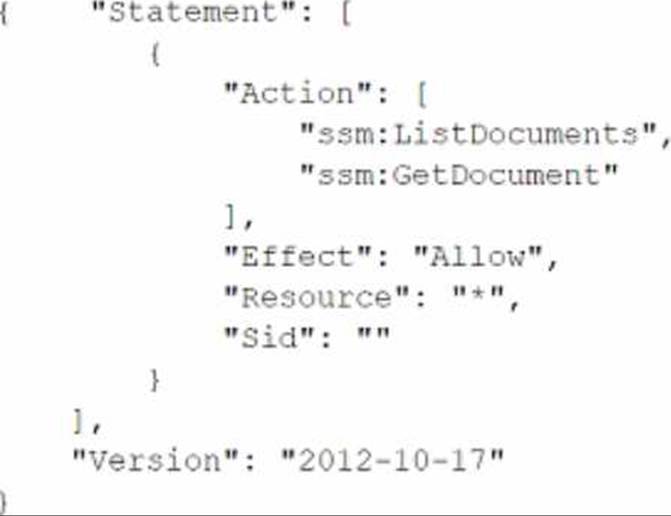
Which IAM principals can the solutions architect attach this policy to? (Select TWO.)
- A . Role
- B . Group
- C . Organization
- D . Amazon Elastic Container Service (Amazon ECS) resource
- E . Amazon EC2 resource
A company wants to move its application to a serverless solution. The serverless solution needs to analyze existing and new data by using SL. The company stores the data in an Amazon S3 bucket. The data requires encryption and must be replicated to a different AWS Region.
Which solution will meet these requirements with the LEAST operational overhead?
- A . Create a new S3 bucket. Load the data into the new S3 bucket. Use S3 Cross-Region Replication (CRR) to replicate encrypted objects to an S3 bucket in another Region. Use server-side encryption with AWS KMS multi-Region kays (SSE-KMS). Use Amazon Athena to query the data.
- B . Create a new S3 bucket. Load the data into the new S3 bucket. Use S3 Cross-Region Replication (CRR) to replicate encrypted objects to an S3 bucket in another Region. Use server-side encryption with AWS KMS multi-Region keys (SSE-KMS). Use Amazon RDS to query the data.
- C . Load the data into the existing S3 bucket. Use S3 Cross-Region Replication (CRR) to replicate encrypted objects to an S3 bucket in another Region. Use server-side encryption with Amazon S3
managed encryption keys (SSE-S3). Use Amazon Athena to query the data. - D . Load the data into the existing S3 bucket. Use S3 Cross-Region Replication (CRR) to replicate encrypted objects to an S3 bucket in another Region. Use server-side encryption with Amazon S3 managed encryption keys (SSE-S3). Use Amazon RDS to query the data.
A company has registered its domain name with Amazon Route 53. The company uses Amazon API Gateway in the ca-central-1 Region as a public interface for its backend microservice APIs. Third-party services consume the APIs securely. The company wants to design its API Gateway URL with the company’s domain name and corresponding certificate so that the third-party services can use HTTPS.
Which solution will meet these requirements?
- A . Create stage variables in API Gateway with Name="Endpoint-URL" and Value="Company Domain Name" to overwrite the default URL. Import the public certificate associated with the company’s
domain name into AWS Certificate Manager (ACM). - B . Create Route 53 DNS records with the company’s domain name. Point the alias record to the Regional API Gateway stage endpoint. Import the public certificate associated with the company’s domain name into AWS Certificate Manager (ACM) in the us-east-1 Region.
- C . Create a Regional API Gateway endpoint. Associate the API Gateway endpoint with the company’s domain name. Import the public certificate associated with the company’s domain name into AWS Certificate Manager (ACM) in the same Region. Attach the certificate to the API Gateway endpoint. Configure Route 53 to route traffic to the API Gateway endpoint.
- D . Create a Regional API Gateway endpoint. Associate the API Gateway endpoint with the company’s domain name. Import the public certificate associated with the company’s domain name into AWS Certificate Manager (ACM) in the us-east-1 Region. Attach the certificate to the API Gateway APIs. Create Route 53 DNS records with the company’s domain name. Point an A record to the company’s domain name.
A company sells datasets to customers who do research in artificial intelligence and machine learning (Al/ML). The datasets are large, formatted files that are stored in an Amazon S3 bucket in the us-east-
1 Region. The company hosts a web application that the customers use to purchase access to a given dataset. The web application is deployed on multiple Amazon EC2 instances behind an Application Load Balancer After a purchase is made customers receive an S3 signed URL that allows access to the files.
The customers are distributed across North America and Europe. The company wants to reduce the cost that is associated with data transfers and wants to maintain or improve performance.
What should a solutions architect do to meet these requirements?
- A . Configure S3 Transfer Acceleration on the existing S3 bucket Direct customer requests to the S3 Transfer Acceleration endpoint Continue to use S3 signed URLs for access control
- B . Deploy an Amazon CloudFront distribution with the existing S3 bucket as the origin Direct customer requests to the CloudFront URL Switch to CloudFront signed URLs for access control
- C . Set up a second S3 bucket in the eu-central-1 Region with S3 Cross-Region Replication between the buckets Direct customer requests to the closest Region Continue to use S3 signed URLs for access control
- D . Modify the web application to enable streaming of the datasets to end users. Configure the web application to read the data from the existing S3 bucket Implement access control directly in the application
A solutions architect has created a new AWS account and must secure AWS account root user access.
Which combination of actions will accomplish this? (Choose two.)
- A . Ensure the root user uses a strong password.
- B . Enable multi-factor authentication to the root user.
- C . Store root user access keys in an encrypted Amazon S3 bucket.
- D . Add the root user to a group containing administrative permissions.
- E . Apply the required permissions to the root user with an inline policy document.
How can a company detect and notify security teams about PII in S3 buckets?
- A . Use Amazon Macie. Create an EventBridge rule for SensitiveData findings and send an SNS notification.
- B . Use Amazon GuardDuty. Create an EventBridge rule for CRITICAL findings and send an SNS notification.
- C . Use Amazon Macie. Create an EventBridge rule for SensitiveData:S3Object/Personal findings and send an SQS notification.
- D . Use Amazon GuardDuty. Create an EventBridge rule for CRITICAL findings and send an SQS notification.