
Amazon SAA-C03 Practice Exams
Last updated on Nov 16,2026- Exam Code: SAA-C03
- Exam Name: AWS Certified Solutions Architect - Associate
- Certification Provider: Amazon
- Latest update: Nov 16,2026
A company has applications that run in an organization in AWS Organizations. The company outsources operational support of the applications. The company needs to provide access for the external support engineers without compromising security.
The external support engineers need access to the AWS Management Console. The external support engineers also need operating system access to the company’s fleet of Amazon EC2 instances that run Amazon Linux in private subnets.
Which solution will meet these requirements MOST securely?
- A . Confirm that AWS Systems Manager Agent (SSM Agent) is installed on all instances. Assign an instance profile with the necessary policy to connect to Systems Manager. Use AWS 1AM Identity Center to provide the external support engineers console access. Use Systems Manager Session Manager to assign the required permissions.
- B . Confirm that AWS Systems Manager Agent {SSM Agent) is installed on all instances. Assign an instance profile with the necessary policy to connect to Systems Manager. Use Systems Manager Session Manager to provide local 1AM user credentials in each AWS account to the external support engineers for console access.
- C . Confirm that all instances have a security group that allows SSH access only from the external support engineers source IP address ranges. Provide local 1AM user credentials in each AWS account to the external support engineers for console access. Provide each external support engineer an SSH key pair to log in to the application instances.
- D . Create a bastion host in a public subnet. Set up the bastion host security group to allow access from only the external engineers’ IP address ranges Ensure that all instances have a security group that allows SSH access from the bastion host. Provide each external support engineer an SSH key pair to log in to the application instances. Provide local account 1AM user credentials to the engineers for console access.
A company’s application is running on Amazon EC2 instances within an Auto Scaling group behind an Elastic Load Balancing (ELB) load balancer Based on the application’s history, the company anticipates a spike in traffic during a holiday each year. A solutions architect must design a strategy to ensure that the Auto Scaling group proactively increases capacity to minimize any performance impact on application users.
Which solution will meet these requirements?
- A . Create an Amazon CloudWatch alarm to scale up the EC2 instances when CPU utilization exceeds 90%.
- B . Create a recurring scheduled action to scale up the Auto Scaling group before the expected period of peak demand
- C . Increase the minimum and maximum number of EC2 instances in the Auto Scaling group during the peak demand period
- D . Configure an Amazon Simple Notification Service (Amazon SNS) notification to send alerts when there are autoscaling:EC2_INSTANCE_LAUNCH events.
A company hosts a serverless application on AWS. The application uses Amazon API Gateway, AWS Lambda, and an Amazon RDS for PostgreSQL database. The company notices an increase in application errors that result from database connection timeouts during times Of peak traffic or unpredictable traffic. The company needs a solution that reduces the application failures with the least amount of change to the code.
What should a solutions architect do to meet these requirements?
- A . Reduce the Lambda concurrency rate.
- B . Enable RDS Proxy on the RDS DB instance.
- C . Resize the RDS DB instance class to accept more connections.
- D . Migrate the database to Amazon DynamoDB with on-demand scaling.
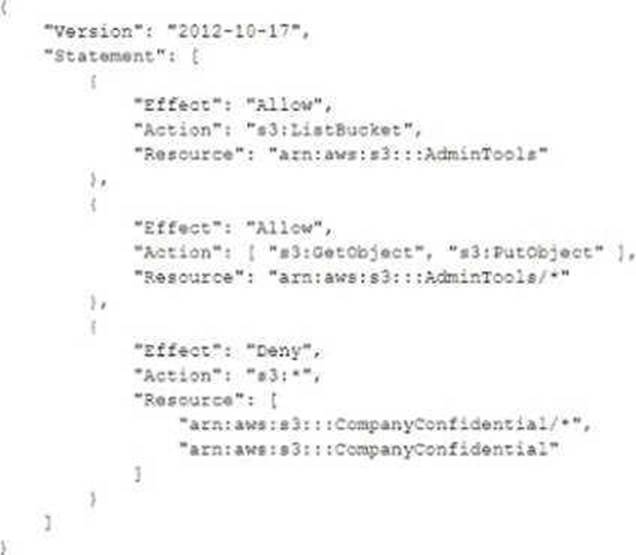
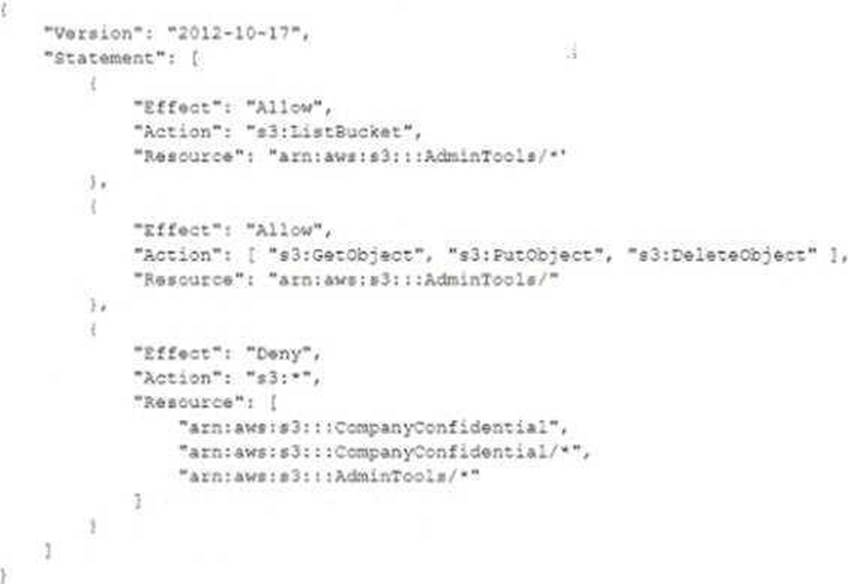
A corporation has recruited a new cloud engineer who should not have access to the CompanyConfidential Amazon S3 bucket. The cloud engineer must have read and write permissions on an S3 bucket named AdminTools.
Which IAM policy will satisfy these criteria?
A)
B)
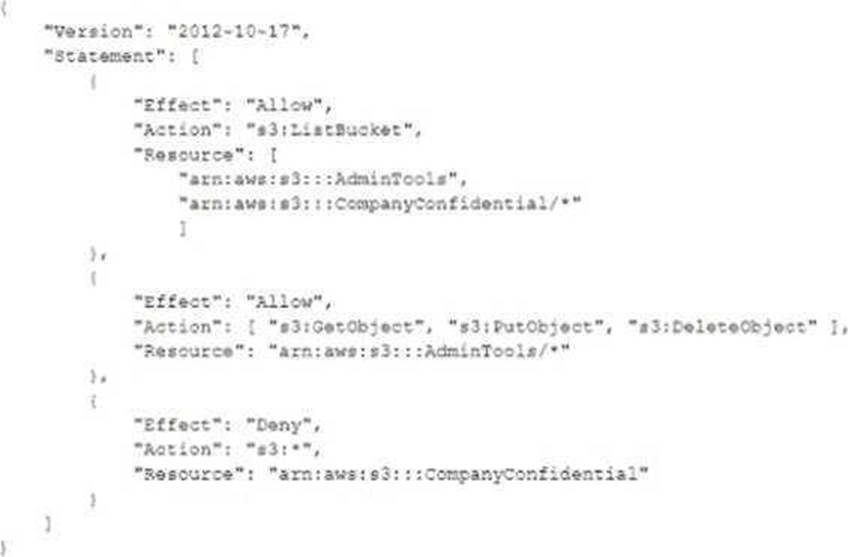
C)
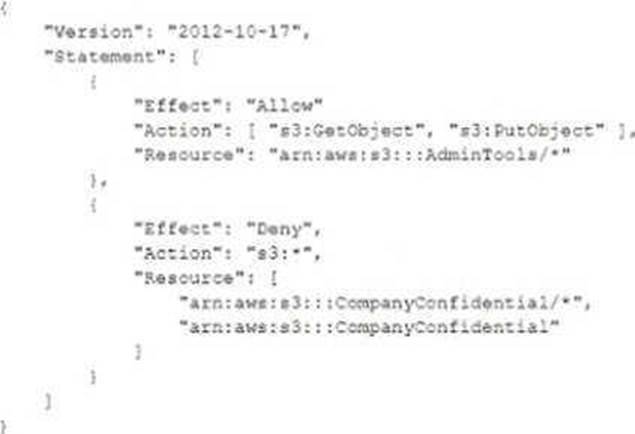
D)
- A . Option A
- B . Option B
- C . Option C
- D . Option D
A company hosts an application on Amazon EC2 instances that are part of a target group behind an Application Load Balancer (ALB). The company has attached a security group to the ALB.
During a recent review of application logs, the company found many unauthorized login attempts from IP addresses that belong to countries outside the company’s normal user base. The company wants to allow traffic only from the United States and Australia.
- A . Edit the default network ACL to block IP addresses from outside of the allowed countries.
- B . Create a geographic match rule in AWS WAF. Attach the rule to the ALB.
- C . Configure the ALB security group to allow the IP addresses of company employees. Edit the default network ACL to block IP addresses from outside of the allowed countries.
- D . Use a host-based firewall on the EC2 instances to block IP addresses from outside of the allowed countries. Configure the ALB security group to allow the IP addresses of company employees.
A company has a Microsoft NET application that runs on an on-premises Windows Server Trie application stores data by using an Oracle Database Standard Edition server. The company is planning a migration to AWS and wants to minimize development changes while moving the application. The AWS application environment should be highly available
Which combination of actions should the company take to meet these requirements? (Select TWO)
- A . Refactor the application as serverless with AWS Lambda functions running NET Cote
- B . Rehost the application in AWS Elastic Beanstalk with the NET platform in a Multi-AZ deployment
- C . Replatform the application to run on Amazon EC2 with the Amazon Linux Amazon Machine Image (AMI)
- D . Use AWS Database Migration Service (AWS DMS) to migrate from the Oracle database to Amazon DynamoDB in a Multi-AZ deployment
- E . Use AWS Database Migration Service (AWS DMS) to migrate from the Oracle database to Oracle on Amazon RDS in a Multi-AZ deployment
A company has one million users that use its mobile app. The company must analyze the data usage in near-real time. The company also must encrypt the data in near-real time and must store the data in a centralized location in Apache Parquet format for further processing.
Which solution will meet these requirements with the LEAST operational overhead?
- A . Create an Amazon Kinesis data stream to store the data in Amazon S3. Create an Amazon Kinesis Data Analytics application to analyze the data. Invoke an AWS Lambda function to send the data to the Kinesis Data Analytics application.
- B . Create an Amazon Kinesis data stream to store the data in Amazon S3. Create an Amazon EMR cluster to analyze the data. Invoke an AWS Lambda function to send the data to the EMR cluster.
- C . Create an Amazon Kinesis Data Firehose delivery stream to store the data in Amazon S3. Create an
Amazon EMR cluster to analyze the data. - D . Create an Amazon Kinesis Data Firehose delivery stream to store the data in Amazon S3. Create an Amazon Kinesis Data Analytics application to analyze the data
A company hosts an application used to upload files to an Amazon S3 bucket Once uploaded, the files are processed to extract metadata which takes less than 5 seconds. The volume and frequency of the uploads varies from a few files each hour to hundreds of concurrent uploads. The company has asked a solutions architect to design a cost-effective architecture that will meet these requirements.
What should the solutions architect recommend?
- A . Configure AWS CloudTrail trails to tog S3 API calls Use AWS AppSync to process the files.
- B . Configure an object-created event notification within the S3 bucket to invoke an AWS Lambda function to process the files.
- C . Configure Amazon Kinesis Data Streams to process and send data to Amazon S3. Invoke an AWS Lambda function to process the files.
- D . Configure an Amazon Simple Notification Service (Amazon SNS) topic to process the files uploaded to Amazon S3 Invoke an AWS Lambda function to process the files.
A company has developed a new video game as a web application. The application is in a three-tier architecture in a VPC with Amazon RDS for MySQL in the database layer. Several players will compete concurrently online. The game’s developers want to display a top-10 scoreboard in near-real time and offer the ability to stop and restore the game while preserving the current scores.
What should a solutions architect do to meet these requirements?
- A . Set up an Amazon ElastiCache for Memcached cluster to cache the scores for the web application to display.
- B . Set up an Amazon ElastiCache for Redis cluster to compute and cache the scores for the web application to display.
- C . Place an Amazon CloudFront distribution in front of the web application to cache the scoreboard in a section of the application.
- D . Create a read replica on Amazon RDS for MySQL to run queries to compute the scoreboard and serve the read traffic to the web application.
A company has an application that runs on Amazon EC2 instances and uses an Amazon Aurora database. The EC2 instances connect to the database by using user names and passwords that are stored locally in a file. The company wants to minimize the operational overhead of credential management.
What should a solutions architect do to accomplish this goal?
- A . Use AWS Secrets Manager. Turn on automatic rotation.
- B . Use AWS Systems Manager Parameter Store. Turn on automatic rotation.
- C . Create an Amazon S3 bucket lo store objects that are encrypted with an AWS Key C. Management Service (AWS KMS) encryption key. Migrate the credential file to the S3 bucket. Point the application to the S3 bucket.
- D . Create an encrypted Amazon Elastic Block Store (Amazon EBS) volume (or each EC2 instance.
Attach the new EBS volume to each EC2 instance. Migrate the credential file to the new EBS volume.
Point the application to the new EBS volume.