
Amazon MLS-C01 Practice Exams
Last updated on Oct 22,2026- Exam Code: MLS-C01
- Exam Name: AWS Certified Machine Learning - Specialty
- Certification Provider: Amazon
- Latest update: Oct 22,2026
A Machine Learning Specialist is designing a system for improving sales for a company. The objective is to use the large amount of information the company has on users’ behavior and product preferences to predict which products users would like based on the users’ similarity to other users.
What should the Specialist do to meet this objective?
- A . Build a content-based filtering recommendation engine with Apache Spark ML on Amazon EMR.
- B . Build a collaborative filtering recommendation engine with Apache Spark ML on Amazon EMR.
- C . Build a model-based filtering recommendation engine with Apache Spark ML on Amazon EMR.
- D . Build a combinative filtering recommendation engine with Apache Spark ML on Amazon EMR.
B
Explanation:
A collaborative filtering recommendation engine is a type of machine learning system that can improve sales for a company by using the large amount of information the company has on users’ behavior and product preferences to predict which products users would like based on the users’ similarity to other users. A collaborative filtering recommendation engine works by finding the users who have similar ratings or preferences for the products, and then recommending the products that the similar users have liked but the target user has not seen or rated. A collaborative filtering recommendation engine can leverage the collective wisdom of the users and discover the hidden patterns and associations among the products and the users. A collaborative filtering recommendation engine can be implemented using Apache Spark ML on Amazon EMR, which are two services that can handle large-scale data processing and machine learning tasks. Apache Spark ML is a library that provides various tools and algorithms for machine learning, such as classification, regression, clustering, recommendation, etc. Apache Spark ML can run on Amazon EMR, which is a service that provides a managed cluster platform that simplifies running big data frameworks, such as Apache Spark, on AWS. Apache Spark ML on Amazon EMR can build a collaborative filtering recommendation engine using the Alternating Least Squares (ALS) algorithm, which is a matrix factorization technique that can learn the latent factors that represent the users and the products, and then use them to predict the ratings or preferences of the users for the products. Apache Spark ML on Amazon EMR can also support both explicit feedback, such as ratings or reviews, and implicit feedback, such as views or clicks, for building a collaborative filtering recommendation engine12
A retail company wants to update its customer support system. The company wants to implement automatic routing of customer claims to different queues to prioritize the claims by category. Currently, an operator manually performs the category assignment and routing. After the operator classifies and routes the claim, the company stores the claim’s record in a central database. The claim’s record includes the claim’s category.
The company has no data science team or experience in the field of machine learning (ML). The company’s small development team needs a solution that requires no ML expertise.
Which solution meets these requirements?
- A . Export the database to a .csv file with two columns: claim_label and claim_text. Use the Amazon SageMaker Object2Vec algorithm and the .csv file to train a model. Use SageMaker to deploy the model to an inference endpoint. Develop a service in the application to use the inference endpoint to process incoming claims, predict the labels, and route the claims to the appropriate queue.
- B . Export the database to a .csv file with one column: claim_text. Use the Amazon SageMaker Latent Dirichlet Allocation (LDA) algorithm and the .csv file to train a model. Use the LDA algorithm to detect labels automatically. Use SageMaker to deploy the model to an inference endpoint. Develop a service in the application to use the inference endpoint to process incoming claims, predict the labels, and route the claims to the appropriate queue.
- C . Use Amazon Textract to process the database and automatically detect two columns: claim_label and claim_text. Use Amazon Comprehend custom classification and the extracted information to train the custom classifier. Develop a service in the application to use the Amazon Comprehend API to process incoming claims, predict the labels, and route the claims to the appropriate queue.
- D . Export the database to a .csv file with two columns: claim_label and claim_text. Use Amazon Comprehend custom classification and the .csv file to train the custom classifier. Develop a service in the application to use the Amazon Comprehend API to process incoming claims, predict the labels, and route the claims to the appropriate queue.
D
Explanation:
Amazon Comprehend is a natural language processing (NLP) service that can analyze text and extract insights such as sentiment, entities, topics, and language. Amazon Comprehend also provides custom classification and custom entity recognition features that allow users to train their own models using their own data and labels. For the scenario of routing customer claims to different queues based on categories, Amazon Comprehend custom classification is a suitable solution. The custom classifier can be trained using a .csv file that contains the claim text and the claim label as columns. The custom classifier can then be used to process incoming claims and predict the labels using the Amazon Comprehend API. The predicted labels can be used to route the claims to the appropriate queue. This solution does not require any machine learning expertise or model deployment, and it can be easily integrated with the existing application. The other options are not suitable because:
Option A: Amazon SageMaker Object2Vec is an algorithm that can learn embeddings of objects such as words, sentences, or documents. It can be used for tasks such as text classification, sentiment analysis, or recommendation systems. However, using this algorithm requires machine learning expertise and model deployment using SageMaker, which are not available for the company.
Option B: Amazon SageMaker Latent Dirichlet Allocation (LDA) is an algorithm that can discover the topics or themes in a collection of documents. It can be used for tasks such as topic modeling, document clustering, or text summarization. However, using this algorithm requires machine learning expertise and model deployment using SageMaker, which are not available for the company. Moreover, LDA does not provide labels for the topics, but rather a distribution of words for each topic, which may not match the existing categories of the claims.
Option C: Amazon Textract is a service that can extract text and data from scanned documents or images. It can be used for tasks such as document analysis, data extraction, or form processing.
However, using this service is unnecessary and inefficient for the scenario, since the company already has the claim text and label in a database. Moreover, Amazon Textract does not provide custom classification features, so it cannot be used to train a custom classifier using the existing data and labels.
References:
Amazon Comprehend Custom Classification
Amazon SageMaker Object2Vec
Amazon SageMaker Latent Dirichlet Allocation
Amazon Textract
An ecommerce company wants to use machine learning (ML) to monitor fraudulent transactions on its website. The company is using Amazon SageMaker to research, train, deploy, and monitor the ML models.
The historical transactions data is in a .csv file that is stored in Amazon S3. The data contains features such as the user’s IP address, navigation time, average time on each page, and the number of clicks for ….session. There is no label in the data to indicate if a transaction is anomalous.
Which models should the company use in combination to detect anomalous transactions? (Select TWO.)
- A . IP Insights
- B . K-nearest neighbors (k-NN)
- C . Linear learner with a logistic function
- D . Random Cut Forest (RCF)
- E . XGBoost
DE
Explanation:
To detect anomalous transactions, the company can use a combination of Random Cut Forest (RCF) and XGBoost models. RCF is an unsupervised algorithm that can detect outliers in the data by measuring the depth of each data point in a collection of random decision trees. XGBoost is a supervised algorithm that can learn from the labeled data points generated by RCF and classify them as normal or anomalous. RCF can also provide anomaly scores that can be used as features for XGBoost to improve the accuracy of the classification.
References:
1: Amazon SageMaker Random Cut Forest
2: Amazon SageMaker XGBoost Algorithm
3: Anomaly Detection with Amazon SageMaker Random Cut Forest and Amazon SageMaker XGBoost
A company plans to build a custom natural language processing (NLP) model to classify and prioritize user feedback. The company hosts the data and all machine learning (ML) infrastructure in the AWS Cloud. The ML team works from the company’s office, which has an IPsec VPN connection to one VPC in the AWS Cloud.
The company has set both the enableDnsHostnames attribute and the enableDnsSupport attribute of the VPC to true. The company’s DNS resolvers point to the VPC DNS. The company does not allow the ML team to access Amazon SageMaker notebooks through connections that use the public internet. The connection must stay within a private network and within the AWS internal network.
Which solution will meet these requirements with the LEAST development effort?
- A . Create a VPC interface endpoint for the SageMaker notebook in the VPC. Access the notebook through a VPN connection and the VPC endpoint.
- B . Create a bastion host by using Amazon EC2 in a public subnet within the VPC. Log in to the bastion host through a VPN connection. Access the SageMaker notebook from the bastion host.
- C . Create a bastion host by using Amazon EC2 in a private subnet within the VPC with a NAT gateway. Log in to the bastion host through a VPN connection. Access the SageMaker notebook from the bastion host.
- D . Create a NAT gateway in the VPC. Access the SageMaker notebook HTTPS endpoint through a VPN connection and the NAT gateway.
A
Explanation:
In this scenario, the company requires that access to the Amazon SageMaker notebook remain within the AWS internal network, avoiding the public internet. By creating a VPC interface endpoint for SageMaker, the company can ensure that traffic to the SageMaker notebook remains internal to the VPC and is accessible over a private connection. The VPC interface endpoint allows private network access to AWS services, and it operates over AWS’s internal network, respecting the security and connectivity policies the company requires.
This solution requires minimal development effort compared to options involving bastion hosts or NAT gateways, as it directly provides private network access to the SageMaker notebook.
A retail chain has been ingesting purchasing records from its network of 20,000 stores to Amazon S3 using Amazon Kinesis Data Firehose To support training an improved machine learning model, training records will require new but simple transformations, and some attributes will be combined. The model needs lo be retrained daily
Given the large number of stores and the legacy data ingestion, which change will require the LEAST amount of development effort?
- A . Require that the stores to switch to capturing their data locally on AWS Storage Gateway for loading into Amazon S3 then use AWS Glue to do the transformation
- B . Deploy an Amazon EMR cluster running Apache Spark with the transformation logic, and have the cluster run each day on the accumulating records in Amazon S3, outputting new/transformed records to Amazon S3
- C . Spin up a fleet of Amazon EC2 instances with the transformation logic, have them transform the data records accumulating on Amazon S3, and output the transformed records to Amazon S3.
- D . Insert an Amazon Kinesis Data Analytics stream downstream of the Kinesis Data Firehouse stream that transforms raw record attributes into simple transformed values using SQL.
D
Explanation:
Amazon Kinesis Data Analytics is a service that can analyze streaming data in real time using SQL or Apache Flink applications. It can also use machine learning algorithms, such as Random Cut Forest (RCF), to perform anomaly detection on streaming data. By inserting a Kinesis Data Analytics stream downstream of the Kinesis Data Firehose stream, the retail chain can transform the raw record attributes into simple transformed values using SQL queries. This can be done without changing the existing data ingestion process or deploying additional resources. The transformed records can then be outputted to another Kinesis Data Firehose stream that delivers them to Amazon S3 for training the machine learning model. This approach will require the least amount of development effort, as it leverages the existing Kinesis Data Firehose stream and the built-in SQL capabilities of Kinesis Data Analytics.
Reference: Amazon Kinesis Data Analytics – Amazon Web Services
Anomaly Detection with Amazon Kinesis Data Analytics – Amazon Web Services Amazon Kinesis Data Firehose – Amazon Web Services Amazon S3 – Amazon Web Services
A manufacturer of car engines collects data from cars as they are being driven. The data collected includes timestamp, engine temperature, rotations per minute (RPM), and other sensor readings. The company wants to predict when an engine is going to have a problem so it can notify drivers in advance to get engine maintenance. The engine data is loaded into a data lake for training.
Which is the MOST suitable predictive model that can be deployed into production’?
- A . Add labels over time to indicate which engine faults occur at what time in the future to turn this into a supervised learning problem Use a recurrent neural network (RNN) to train the model to recognize when an engine might need maintenance for a certain fault.
- B . This data requires an unsupervised learning algorithm Use Amazon SageMaker k-means to cluster the data
- C . Add labels over time to indicate which engine faults occur at what time in the future to turn this into a supervised learning problem Use a convolutional neural network (CNN) to train the model to recognize when an engine might need maintenance for a certain fault.
- D . This data is already formulated as a time series Use Amazon SageMaker seq2seq to model the time series.
A
Explanation:
A recurrent neural network (RNN) is a type of neural network that can process sequential data, such as time series, by maintaining a hidden state that captures the temporal dependencies between the inputs. RNNs are well suited for predicting future events based on past observations, such as forecasting engine failures based on sensor readings. To train an RNN model, the data needs to be labeled with the target variable, which in this case is the type and time of the engine fault. This makes the problem a supervised learning problem, where the goal is to learn a mapping from the input sequence (sensor readings) to the output sequence (engine faults). By using an RNN model, the manufacturer can leverage the temporal information in the data and detect patterns that indicate when an engine might need maintenance for a certain fault.
References:
Recurrent Neural Networks – Amazon SageMaker
Use Amazon SageMaker Built-in Algorithms or Pre-trained Models Recurrent Neural Network Definition | DeepAI
What are Recurrent Neural Networks? An Ultimate Guide for Newbies! Lee and Carter go Machine Learning: Recurrent Neural Networks – SSRN
An office security agency conducted a successful pilot using 100 cameras installed at key locations within the main office. Images from the cameras were uploaded to Amazon S3 and tagged using Amazon Rekognition, and the results were stored in Amazon ES. The agency is now looking to expand the pilot into a full production system using thousands of video cameras in its office locations globally. The goal is to identify activities performed by non-employees in real time.
Which solution should the agency consider?
- A . Use a proxy server at each local office and for each camera, and stream the RTSP feed to a unique Amazon Kinesis Video Streams video stream. On each stream, use Amazon Rekognition Video and create a stream processor to detect faces from a collection of known employees, and alert when non-Employees are detected.
- B . Use a proxy server at each local office and for each camera, and stream the RTSP feed to a unique Amazon Kinesis Video Streams video stream. On each stream, use Amazon Rekognition Image to detect faces from a collection of known employees and alert when non-employees are detected.
- C . Install AWS DeepLens cameras and use the DeepLens_Kinesis_Video module to stream video to Amazon Kinesis Video Streams for each camera. On each stream, use Amazon Rekognition Video and create a stream processor to detect faces from a collection on each stream, and alert when nonemployees are detected.
- D . Install AWS DeepLens cameras and use the DeepLens_Kinesis_Video module to stream video to Amazon Kinesis Video Streams for each camera. On each stream, run an AWS Lambda function to capture image fragments and then call Amazon Rekognition Image to detect faces from a collection of known employees, and alert when non-employees are detected.
A
Explanation:
The solution that the agency should consider is to use a proxy server at each local office and for each camera, and stream the RTSP feed to a unique Amazon Kinesis Video Streams video stream. On each stream, use Amazon Rekognition Video and create a stream processor to detect faces from a collection of known employees, and alert when non-employees are detected.
This solution has the following advantages:
It can handle thousands of video cameras in real time, as Amazon Kinesis Video Streams can scale elastically to support any number of producers and consumers1.
It can leverage the Amazon Rekognition Video API, which is designed and optimized for video analysis, and can detect faces in challenging conditions such as low lighting, occlusions, and different poses2.
It can use a stream processor, which is a feature of Amazon Rekognition Video that allows you to create a persistent application that analyzes streaming video and stores the results in a Kinesis data stream3. The stream processor can compare the detected faces with a collection of known employees, which is a container for persisting faces that you want to search for in the input video stream4. The stream processor can also send notifications to Amazon Simple Notification Service (Amazon SNS) when non-employees are detected, which can trigger downstream actions such as sending alerts or storing the events in Amazon Elasticsearch Service (Amazon ES)3.
References:
1: What Is Amazon Kinesis Video Streams? – Amazon Kinesis Video Streams
2: Detecting and Analyzing Faces – Amazon Rekognition
3: Using Amazon Rekognition Video Stream Processor – Amazon Rekognition
4: Working with Stored Faces – Amazon Rekognition
A credit card company wants to build a credit scoring model to help predict whether a new credit card applicant will default on a credit card payment. The company has collected data from a large number of sources with thousands of raw attributes. Early experiments to train a classification model revealed that many attributes are highly correlated, the large number of features slows down the training speed significantly, and that there are some overfitting issues.
The Data Scientist on this project would like to speed up the model training time without losing a lot of information from the original dataset.
Which feature engineering technique should the Data Scientist use to meet the objectives?
- A . Run self-correlation on all features and remove highly correlated features
- B . Normalize all numerical values to be between 0 and 1
- C . Use an autoencoder or principal component analysis (PCA) to replace original features with new features
- D . Cluster raw data using k-means and use sample data from each cluster to build a new dataset
C
Explanation:
The best feature engineering technique to speed up the model training time without losing a lot of information from the original dataset is to use an autoencoder or principal component analysis (PCA) to replace original features with new features. An autoencoder is a type of neural network that learns a compressed representation of the input data, called the latent space, by minimizing the reconstruction error between the input and the output. PCA is a statistical technique that reduces the dimensionality of the data by finding a set of orthogonal axes, called the principal components, that capture the maximum variance of the data. Both techniques can help reduce the number of features and remove the noise and redundancy in the data, which can improve the model performance and speed up the training process.
References:
AWS Machine Learning Specialty Exam Guide
AWS Machine Learning Training – Dimensionality Reduction for Machine Learning AWS Machine Learning Training – Deep Learning with Amazon SageMaker
A data scientist is designing a repository that will contain many images of vehicles. The repository must scale automatically in size to store new images every day. The repository must support versioning of the images. The data scientist must implement a solution that maintains multiple immediately accessible copies of the data in different AWS Regions.
Which solution will meet these requirements?
- A . Amazon S3 with S3 Cross-Region Replication (CRR)
- B . Amazon Elastic Block Store (Amazon EBS) with snapshots that are shared in a secondary Region
- C . Amazon Elastic File System (Amazon EFS) Standard storage that is configured with Regional availability
- D . AWS Storage Gateway Volume Gateway
A
Explanation:
For a repository containing a large and dynamically scaling collection of images, Amazon S3 is ideal due to its scalability and versioning capabilities. Amazon S3 natively supports automatic scaling to accommodate increasing storage needs and allows versioning, which enables tracking and managing different versions of objects.
To meet the requirement of maintaining multiple, immediately accessible copies of data across AWS Regions, S3 Cross-Region Replication (CRR) can be enabled. CRR automatically replicates new or updated objects to a specified destination bucket in another AWS Region, ensuring low-latency access and disaster recovery. By setting up CRR with versioning enabled, the data scientist can achieve a multi-Region, scalable, and version-controlled repository in Amazon S3.
A data scientist is training a text classification model by using the Amazon SageMaker built-in BlazingText algorithm. There are 5 classes in the dataset, with 300 samples for category A, 292 samples for category B, 240 samples for category C, 258 samples for category D, and 310 samples for category E.
The data scientist shuffles the data and splits off 10% for testing. After training the model, the data scientist generates confusion matrices for the training and test sets.
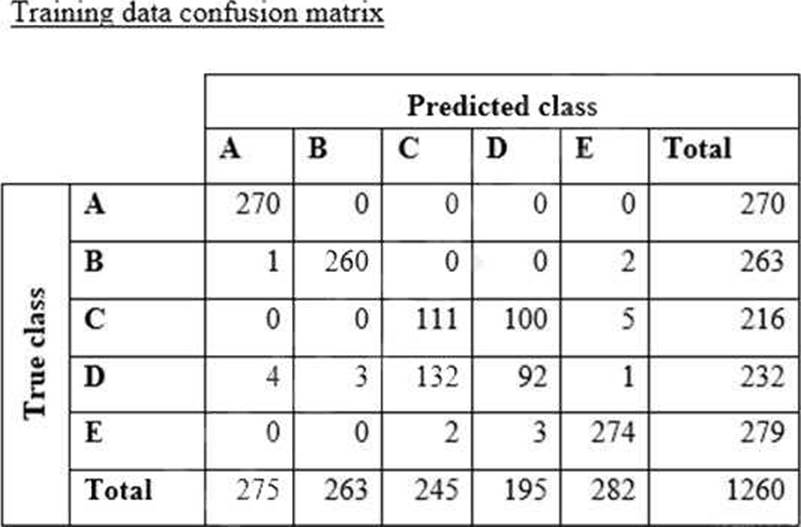
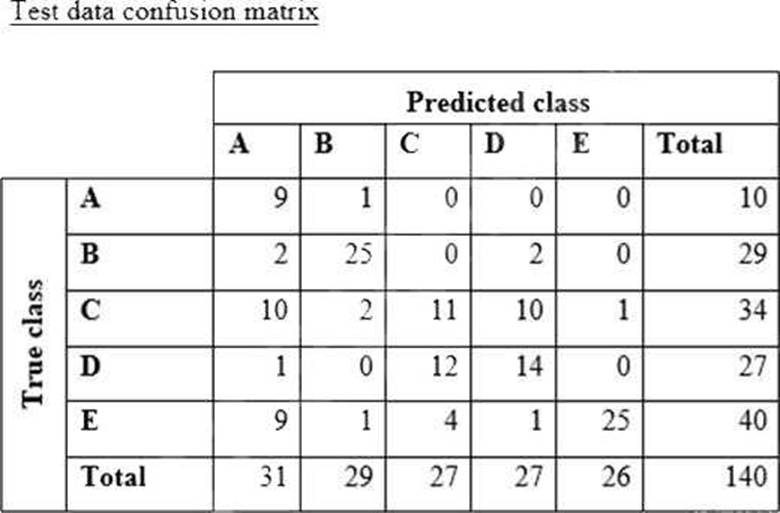
What could the data scientist conclude form these results?
- A . Classes C and D are too similar.
- B . The dataset is too small for holdout cross-validation.
- C . The data distribution is skewed.
- D . The model is overfitting for classes B and E.
D
Explanation:
A confusion matrix is a matrix that summarizes the performance of a machine learning model on a set of test data. It displays the number of true positives (TP), true negatives (TN), false positives (FP), and false negatives (FN) produced by the model on the test data1. For multi-class classification, the matrix shape will be equal to the number of classes i.e for n classes it will be nXn1. The diagonal values represent the number of correct predictions for each class, and the off-diagonal values represent the number of incorrect predictions for each class1.
The BlazingText algorithm is a proprietary machine learning algorithm for forecasting time series using causal convolutional neural networks (CNNs). BlazingText works best with large datasets containing hundreds of time series. It accepts item metadata, and is the only Forecast algorithm that accepts related time series data without future values2.
From the confusion matrices for the training and test sets, we can observe the following:
The model has a high accuracy on the training set, as most of the diagonal values are high and the off-diagonal values are low. This means that the model is able to learn the patterns and features of the training data well.
However, the model has a lower accuracy on the test set, as some of the diagonal values are lower and some of the off-diagonal values are higher. This means that the model is not able to generalize well to the unseen data and makes more errors.
The model has a particularly high error rate for classes B and E on the test set, as the values of M_22 and M_55 are much lower than the values of M_12, M_21, M_15, M_25, M_51, and M_52. This means that the model is confusing classes B and E with other classes more often than it should.
The model has a relatively low error rate for classes A, C, and D on the test set, as the values of M_11, M_33, and M_44 are high and the values of M_13, M_14, M_23, M_24, M_31, M_32, M_34, M_41, M_42, and M_43 are low. This means that the model is able to distinguish classes A, C, and D from other classes well.
These results indicate that the model is overfitting for classes B and E, meaning that it is memorizing the specific features of these classes in the training data, but failing to capture the general features that are applicable to the test data. Overfitting is a common problem in machine learning, where the model performs well on the training data, but poorly on the test data3.
Some possible causes of overfitting are:
The model is too complex or has too many parameters for the given data. This makes the model flexible enough to fit the noise and outliers in the training data, but reduces its ability to generalize to new data.
The data is too small or not representative of the population. This makes the model learn from a limited or biased sample of data, but fails to capture the variability and diversity of the population. The data is imbalanced or skewed. This makes the model learn from a disproportionate or uneven distribution of data, but fails to account for the minority or rare classes.
Some possible solutions to prevent or reduce overfitting are:
Simplify the model or use regularization techniques. This reduces the complexity or the number of parameters of the model, and prevents it from fitting the noise and outliers in the data. Regularization techniques, such as L1 or L2 regularization, add a penalty term to the loss function of the model, which shrinks the weights of the model and reduces overfitting3.
Increase the size or diversity of the data. This provides more information and examples for the model to learn from, and increases its ability to generalize to new data. Data augmentation techniques, such as rotation, flipping, cropping, or noise addition, can generate new data from the existing data by applying some transformations3.
Balance or resample the data. This adjusts the distribution or the frequency of the data, and ensures that the model learns from all classes equally. Resampling techniques, such as oversampling or undersampling, can create a balanced dataset by increasing or decreasing the number of samples for each class3.
References:
Confusion Matrix in Machine Learning – GeeksforGeeks
BlazingText algorithm – Amazon SageMaker
Overfitting and Underfitting in Machine Learning – GeeksforGeeks