
Amazon MLS-C01 Practice Exams
Last updated on Oct 23,2026- Exam Code: MLS-C01
- Exam Name: AWS Certified Machine Learning - Specialty
- Certification Provider: Amazon
- Latest update: Oct 23,2026
A Machine Learning Specialist prepared the following graph displaying the results of k-means for k = [1:10]
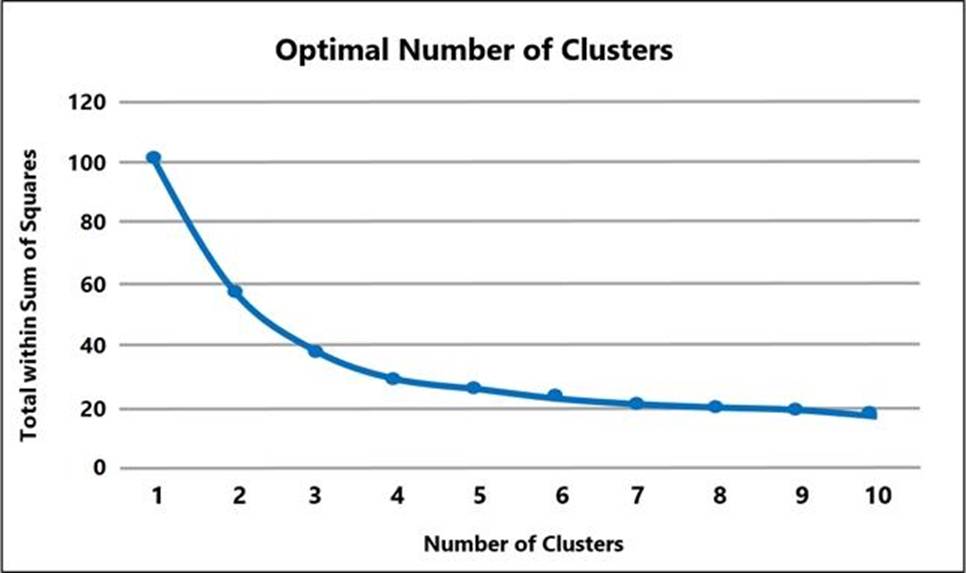
Considering the graph, what is a reasonable selection for the optimal choice of k?
- A . 1
- B . 4
- C . 7
- D . 10
B
Explanation:
The elbow method is a technique that we use to determine the number of centroids (k) to use in a k-means clustering algorithm. In this method, we plot the within-cluster sum of squares (WCSS) against the number of clusters (k) and look for the point where the curve bends sharply. This point is called the elbow point and it indicates that adding more clusters does not improve the model significantly. The graph in the question shows that the elbow point is at k = 4, which means that 4 is a reasonable choice for the optimal number of clusters.
References:
Elbow Method for optimal value of k in KMeans: A tutorial on how to use the elbow method with Amazon SageMaker.
K-Means Clustering: A video that explains the concept and benefits of k-means clustering.
A Data Scientist needs to analyze employment data. The dataset contains approximately 10 million observations on people across 10 different features. During the preliminary analysis, the Data Scientist notices that income and age distributions are not normal. While income levels shows a right skew as expected, with fewer individuals having a higher income, the age distribution also show a right skew, with fewer older individuals participating in the workforce.
Which feature transformations can the Data Scientist apply to fix the incorrectly skewed data? (Choose two.)
- A . Cross-validation
- B . Numerical value binning
- C . High-degree polynomial transformation
- D . Logarithmic transformation
- E . One hot encoding
B, D
Explanation:
To fix the incorrectly skewed data, the Data Scientist can apply two feature transformations: numerical value binning and logarithmic transformation. Numerical value binning is a technique that groups continuous values into discrete bins or categories. This can help reduce the skewness of the data by creating more balanced frequency distributions. Logarithmic transformation is a technique that applies the natural logarithm function to each value in the data. This can help reduce the right skewness of the data by compressing the large values and expanding the small values. Both of these transformations can make the data more suitable for machine learning algorithms that assume normality of the data.
References:
Data Transformation – Amazon SageMaker
Transforming Skewed Data for Machine Learning
A global financial company is using machine learning to automate its loan approval process. The company has a dataset of customer information. The dataset contains some categorical fields, such as customer location by city and housing status. The dataset also includes financial fields in different units, such as account balances in US dollars and monthly interest in US cents.
The company’s data scientists are using a gradient boosting regression model to infer the credit score for each customer. The model has a training accuracy of 99% and a testing accuracy of 75%. The data scientists want to improve the model’s testing accuracy.
Which process will improve the testing accuracy the MOST?
- A . Use a one-hot encoder for the categorical fields in the dataset. Perform standardization on the financial fields in the dataset. Apply L1 regularization to the data.
- B . Use tokenization of the categorical fields in the dataset. Perform binning on the financial fields in
the dataset. Remove the outliers in the data by using the z-score. - C . Use a label encoder for the categorical fields in the dataset. Perform L1 regularization on the financial fields in the dataset. Apply L2 regularization to the data.
- D . Use a logarithm transformation on the categorical fields in the dataset. Perform binning on the financial fields in the dataset. Use imputation to populate missing values in the dataset.
A
Explanation:
The question is about improving the testing accuracy of a gradient boosting regression model. The testing accuracy is much lower than the training accuracy, which indicates that the model is overfitting the training data.
To reduce overfitting, the following steps are recommended:
Use a one-hot encoder for the categorical fields in the dataset. This will create binary features for each category and avoid imposing an ordinal relationship among them. This can help the model learn the patterns better and generalize to unseen data.
Perform standardization on the financial fields in the dataset. This will scale the features to have zero mean and unit variance, which can improve the convergence and performance of the model. This can also help the model handle features with different units and ranges.
Apply L1 regularization to the data. This will add a penalty term to the loss function that is proportional to the absolute value of the coefficients. This can help the model reduce the complexity and select the most relevant features by shrinking the coefficients of less important features to zero.
References:
1: AWS Machine Learning Specialty Exam Guide
2: AWS Machine Learning Specialty Course
3: AWS Machine Learning Blog
A data scientist is using the Amazon SageMaker Neural Topic Model (NTM) algorithm to build a model that recommends tags from blog posts. The raw blog post data is stored in an Amazon S3 bucket in JSON format. During model evaluation, the data scientist discovered that the model recommends certain stopwords such as "a," "an,” and "the" as tags to certain blog posts, along with a few rare words that are present only in certain blog entries. After a few iterations of tag review with the content team, the data scientist notices that the rare words are unusual but feasible. The data scientist also must ensure that the tag recommendations of the generated model do not include the stopwords.
What should the data scientist do to meet these requirements?
- A . Use the Amazon Comprehend entity recognition API operations. Remove the detected words from the blog post data. Replace the blog post data source in the S3 bucket.
- B . Run the SageMaker built-in principal component analysis (PCA) algorithm with the blog post data from the S3 bucket as the data source. Replace the blog post data in the S3 bucket with the results of the training job.
- C . Use the SageMaker built-in Object Detection algorithm instead of the NTM algorithm for the training job to process the blog post data.
- D . Remove the stop words from the blog post data by using the Count Vectorizer function in the scikit-learn library. Replace the blog post data in the S3 bucket with the results of the vectorizer.
D
Explanation:
The data scientist should remove the stop words from the blog post data by using the Count Vectorizer function in the scikit-learn library, and replace the blog post data in the S3 bucket with the results of the vectorizer.
This is because:
The Count Vectorizer function is a tool that can convert a collection of text documents to a matrix of token counts 1. It also enables the pre-processing of text data prior to generating the vector representation, such as removing accents, converting to lowercase, and filtering out stop words 1. By using this function, the data scientist can remove the stop words such as “a,” “an,” and “the” from the blog post data, and obtain a numerical representation of the text that can be used as input for the NTM algorithm.
The NTM algorithm is a neural network-based topic modeling technique that can learn latent topics from a corpus of documents 2. It can be used to recommend tags from blog posts by finding the most probable topics for each document, and ranking the words associated with each topic 3. However, the NTM algorithm does not perform any text pre-processing by itself, so it relies on the quality of the input data. Therefore, the data scientist should replace the blog post data in the S3 bucket with the results of the vectorizer, to ensure that the NTM algorithm does not include the stop words in the tag recommendations.
The other options are not suitable for the following reasons:
Option A is not relevant because the Amazon Comprehend entity recognition API operations are used to detect and extract named entities from text, such as people, places, organizations, dates, etc4. This is not the same as removing stop words, which are common words that do not carry much meaning or information. Moreover, removing the detected entities from the blog post data may reduce the quality and diversity of the tag recommendations, as some entities may be relevant and useful as tags.
Option B is not optimal because the SageMaker built-in principal component analysis (PCA) algorithm is used to reduce the dimensionality of a dataset by finding the most important features that capture the maximum amount of variance in the data 5. This is not the same as removing stop words, which are words that have low variance and high frequency in the data. Moreover, replacing the blog post data in the S3 bucket with the results of the PCA algorithm may not be compatible with the input format expected by the NTM algorithm, which requires a bag-of-words representation of the text 2.
Option C is not suitable because the SageMaker built-in Object Detection algorithm is used to detect and localize objects in images 6. This is not related to the task of recommending tags from blog posts, which are text documents. Moreover, using the Object Detection algorithm instead of the NTM algorithm would require a different type of input data (images instead of text), and a different type of output data (bounding boxes and labels instead of topics and words).
References:
Neural Topic Model (NTM) Algorithm
Introduction to the Amazon SageMaker Neural Topic Model Amazon Comprehend – Entity Recognition sklearn.feature_extraction.text.CountVectorizer Principal Component Analysis (PCA) Algorithm Object Detection Algorithm
A company ingests machine learning (ML) data from web advertising clicks into an Amazon S3 data lake. Click data is added to an Amazon Kinesis data stream by using the Kinesis Producer Library (KPL). The data is loaded into the S3 data lake from the data stream by using an Amazon Kinesis Data Firehose delivery stream. As the data volume increases, an ML specialist notices that the rate of data ingested into Amazon S3 is relatively constant. There also is an increasing backlog of data for Kinesis Data Streams and Kinesis Data Firehose to ingest.
Which next step is MOST likely to improve the data ingestion rate into Amazon S3?
- A . Increase the number of S3 prefixes for the delivery stream to write to.
- B . Decrease the retention period for the data stream.
- C . Increase the number of shards for the data stream.
- D . Add more consumers using the Kinesis Client Library (KCL).
C
Explanation:
The data ingestion rate into Amazon S3 can be improved by increasing the number of shards for the data stream. A shard is the base throughput unit of a Kinesis data stream. One shard provides 1 MB/second data input and 2 MB/second data output. Increasing the number of shards increases the data ingestion capacity of the stream. This can help reduce the backlog of data for Kinesis Data Streams and Kinesis Data Firehose to ingest.
References:
Shard – Amazon Kinesis Data Streams
Scaling Amazon Kinesis Data Streams with AWS CloudFormation – AWS Big Data Blog
A financial services company wants to adopt Amazon SageMaker as its default data science environment. The company’s data scientists run machine learning (ML) models on confidential financial data. The company is worried about data egress and wants an ML engineer to secure the environment.
Which mechanisms can the ML engineer use to control data egress from SageMaker? (Choose three.)
- A . Connect to SageMaker by using a VPC interface endpoint powered by AWS PrivateLink.
- B . Use SCPs to restrict access to SageMaker.
- C . Disable root access on the SageMaker notebook instances.
- D . Enable network isolation for training jobs and models.
- E . Restrict notebook presigned URLs to specific IPs used by the company.
- F . Protect data with encryption at rest and in transit. Use AWS Key Management Service (AWS KMS) to manage encryption keys.
A, D, F
Explanation:
To control data egress from SageMaker, the ML engineer can use the following mechanisms: Connect to SageMaker by using a VPC interface endpoint powered by AWS PrivateLink. This allows the ML engineer to access SageMaker services and resources without exposing the traffic to the public internet. This reduces the risk of data leakage and unauthorized access1
Enable network isolation for training jobs and models. This prevents the training jobs and models from accessing the internet or other AWS services. This ensures that the data used for training and inference is not exposed to external sources2
Protect data with encryption at rest and in transit. Use AWS Key Management Service (AWS KMS) to manage encryption keys. This enables the ML engineer to encrypt the data stored in Amazon S3 buckets, SageMaker notebook instances, and SageMaker endpoints. It also allows the ML engineer to encrypt the data in transit between SageMaker and other AWS services. This helps protect the data from unauthorized access and tampering3
The other options are not effective in controlling data egress from SageMaker:
Use SCPs to restrict access to SageMaker. SCPs are used to define the maximum permissions for an organization or organizational unit (OU) in AWS Organizations. They do not control the data egress from SageMaker, but rather the access to SageMaker itself4
Disable root access on the SageMaker notebook instances. This prevents the users from installing additional packages or libraries on the notebook instances. It does not prevent the data from being transferred out of the notebook instances.
Restrict notebook presigned URLs to specific IPs used by the company. This limits the access to the notebook instances from certain IP addresses. It does not prevent the data from being transferred out of the notebook instances.
Reference:
1: Amazon SageMaker Interface VPC Endpoints (AWS PrivateLink) – Amazon SageMaker
2: Network Isolation – Amazon SageMaker
3: Encrypt Data at Rest and in Transit – Amazon SageMaker
4: Using Service Control Policies – AWS Organizations
: Disable Root Access – Amazon SageMaker
: Create a Presigned Notebook Instance URL – Amazon SageMaker
A Data Scientist is developing a machine learning model to classify whether a financial transaction is fraudulent. The labeled data available for training consists of 100,000 non-fraudulent observations and 1,000 fraudulent observations.
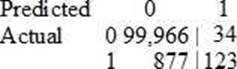
The Data Scientist applies the XGBoost algorithm to the data, resulting in the following confusion matrix when the trained model is applied to a previously unseen validation dataset. The accuracy of the model is 99.1%, but the Data Scientist needs to reduce the number of false negatives.
Which combination of steps should the Data Scientist take to reduce the number of false negative predictions by the model? (Choose two.)
- A . Change the XGBoost eval_metric parameter to optimize based on Root Mean Square Error (RMSE).
- B . Increase the XGBoost scale_pos_weight parameter to adjust the balance of positive and negative weights.
- C . Increase the XGBoost max_depth parameter because the model is currently underfitting the data.
- D . Change the XGBoost eval_metric parameter to optimize based on Area Under the ROC Curve (AUC).
- E . Decrease the XGBoost max_depth parameter because the model is currently overfitting the data.
B, D
Explanation:
The Data Scientist should increase the XGBoost scale_pos_weight parameter to adjust the balance of positive and negative weights and change the XGBoost eval_metric parameter to optimize based on Area Under the ROC Curve (AUC). This will help reduce the number of false negative predictions by the model.
The scale_pos_weight parameter controls the balance of positive and negative weights in the XGBoost algorithm. It is useful for imbalanced classification problems, such as fraud detection, where the number of positive examples (fraudulent transactions) is much smaller than the number of negative examples (non-fraudulent transactions). By increasing the scale_pos_weight parameter, the Data Scientist can assign more weight to the positive class and make the model more sensitive to detecting fraudulent transactions.
The eval_metric parameter specifies the metric that is used to measure the performance of the model during training and validation. The default metric for binary classification problems is the error rate, which is the fraction of incorrect predictions. However, the error rate is not a good metric for imbalanced classification problems, because it does not take into account the cost of different types of errors. For example, in fraud detection, a false negative (failing to detect a fraudulent transaction) is more costly than a false positive (flagging a non-fraudulent transaction as fraudulent). Therefore, the Data Scientist should use a metric that reflects the trade-off between the true positive rate (TPR) and the false positive rate (FPR), such as the Area Under the ROC Curve (AUC). The AUC is a measure of how well the model can distinguish between the positive and negative classes, regardless of the classification threshold. A higher AUC means that the model can achieve a higher TPR with a lower FPR, which is desirable for fraud detection.
References:
XGBoost Parameters – Amazon Machine Learning
Using XGBoost with Amazon SageMaker – AWS Machine Learning Blog
A data scientist is training a large PyTorch model by using Amazon SageMaker. It takes 10 hours on average to train the model on GPU instances. The data scientist suspects that training is not converging and that resource utilization is not optimal.
What should the data scientist do to identify and address training issues with the LEAST development effort?
- A . Use CPU utilization metrics that are captured in Amazon CloudWatch. Configure a CloudWatch alarm to stop the training job early if low CPU utilization occurs.
- B . Use high-resolution custom metrics that are captured in Amazon CloudWatch. Configure an AWS Lambda function to analyze the metrics and to stop the training job early if issues are detected.
- C . Use the SageMaker Debugger vanishing_gradient and LowGPUUtilization built-in rules to detect issues and to launch the StopTrainingJob action if issues are detected.
- D . Use the SageMaker Debugger confusion and feature_importance_overweight built-in rules to detect issues and to launch the StopTrainingJob action if issues are detected.
C
Explanation:
The solution C is the best option to identify and address training issues with the least development effort.
The solution C involves the following steps:
Use the SageMaker Debugger vanishing_gradient and LowGPUUtilization built-in rules to detect issues. SageMaker Debugger is a feature of Amazon SageMaker that allows data scientists to monitor, analyze, and debug machine learning models during training. SageMaker Debugger provides a set of built-in rules that can automatically detect common issues and anomalies in model training, such as vanishing or exploding gradients, overfitting, underfitting, low GPU utilization, and more1. The data scientist can use the vanishing_gradient rule to check if the gradients are becoming too small and causing the training to not converge. The data scientist can also use the LowGPUUtilization rule to check if the GPU resources are underutilized and causing the training to be inefficient2.
Launch the StopTrainingJob action if issues are detected. SageMaker Debugger can also take actions
based on the status of the rules. One of the actions is StopTrainingJob, which can terminate the training job if a rule is in an error state. This can help the data scientist to save time and money by stopping the training early if issues are detected3.
The other options are not suitable because:
Option A: Using CPU utilization metrics that are captured in Amazon CloudWatch and configuring a CloudWatch alarm to stop the training job early if low CPU utilization occurs will not identify and address training issues effectively. CPU utilization is not a good indicator of model training performance, especially for GPU instances. Moreover, CloudWatch alarms can only trigger actions based on simple thresholds, not complex rules or conditions4.
Option B: Using high-resolution custom metrics that are captured in Amazon CloudWatch and configuring an AWS Lambda function to analyze the metrics and to stop the training job early if issues are detected will incur more development effort than using SageMaker Debugger. The data scientist will have to write the code for capturing, sending, and analyzing the custom metrics, as well as for invoking the Lambda function and stopping the training job. Moreover, this solution may not be able to detect all the issues that SageMaker Debugger can5.
Option D: Using the SageMaker Debugger confusion and feature_importance_overweight built-in rules and launching the StopTrainingJob action if issues are detected will not identify and address training issues effectively. The confusion rule is used to monitor the confusion matrix of a classification model, which is not relevant for a regression model that predicts prices. The feature_importance_overweight rule is used to check if some features have too much weight in the model, which may not be related to the convergence or resource utilization issues2.
References:
1: Amazon SageMaker Debugger
2: Built-in Rules for Amazon SageMaker Debugger
3: Actions for Amazon SageMaker Debugger
4: Amazon CloudWatch Alarms
5: Amazon CloudWatch Custom Metrics
A large mobile network operating company is building a machine learning model to predict customers who are likely to unsubscribe from the service. The company plans to offer an incentive for these customers as the cost of churn is far greater than the cost of the incentive.
The model produces the following confusion matrix after evaluating on a test dataset of 100 customers:

Based on the model evaluation results, why is this a viable model for production?
- A . The model is 86% accurate and the cost incurred by the company as a result of false negatives is less than the false positives.
- B . The precision of the model is 86%, which is less than the accuracy of the model.
- C . The model is 86% accurate and the cost incurred by the company as a result of false positives is less than the false negatives.
- D . The precision of the model is 86%, which is greater than the accuracy of the model.
C
Explanation:
Based on the model evaluation results, this is a viable model for production because the model is 86% accurate and the cost incurred by the company as a result of false positives is less than the false negatives. The accuracy of the model is the proportion of correct predictions out of the total predictions, which can be calculated by adding the true positives and true negatives and dividing by the total number of observations. In this case, the accuracy of the model is (10 + 76) / 100 = 0.86, which means that the model correctly predicted 86% of the customers’ churn status. The cost incurred by the company as a result of false positives and false negatives is the loss or damage that the company suffers when the model makes incorrect predictions. A false positive is when the model predicts that a customer will churn, but the customer actually does not churn. A false negative is when the model predicts that a customer will not churn, but the customer actually churns. In this case, the cost of a false positive is the incentive that the company offers to the customer who is predicted to churn, which is a relatively low cost. The cost of a false negative is the revenue that the company loses when the customer churns, which is a relatively high cost. Therefore, the cost of a false positive is less than the cost of a false negative, and the company would prefer to have more false positives than false negatives. The model has 10 false positives and 4 false negatives, which means that the company’s cost is lower than if the model had more false negatives and fewer false positives.
An ecommerce company has observed that customers who use the company’s website rarely view items that the website recommends to customers. The company wants to recommend items to customers that customers are more likely to want to purchase.
Which solution will meet this requirement in the SHORTEST amount of time?
- A . Host the company’s website on Amazon EC2 Accelerated Computing instances to increase the website response speed.
- B . Host the company’s website on Amazon EC2 GPU-based instances to increase the speed of the website’s search tool.
- C . Integrate Amazon Personalize into the company’s website to provide customers with personalized recommendations.
- D . Use Amazon SageMaker to train a Neural Collaborative Filtering (NCF) model to make product recommendations.
C
Explanation:
Amazon Personalize is a managed AWS service specifically designed to deliver personalized recommendations with minimal development time. It uses machine learning algorithms tailored for recommendation systems, making it highly suitable for applications where quick integration is essential. By using Amazon Personalize, the company can leverage existing customer data to generate real-time, personalized product recommendations that align better with customer preferences, enhancing the likelihood of customer engagement with recommended items.
Options involving EC2 instances with GPU or accelerated computing primarily enhance computational performance but do not inherently improve recommendation relevance, while Amazon SageMaker would require more development effort to achieve similar results.