
Amazon MLS-C01 Practice Exams
Last updated on Oct 23,2026- Exam Code: MLS-C01
- Exam Name: AWS Certified Machine Learning - Specialty
- Certification Provider: Amazon
- Latest update: Oct 23,2026
A Machine Learning Specialist is working for a credit card processing company and receives an unbalanced dataset containing credit card transactions. It contains 99,000 valid transactions and 1,000 fraudulent transactions. The Specialist is asked to score a model that was run against the dataset. The Specialist has been advised that identifying valid transactions is equally as important as identifying fraudulent transactions
What metric is BEST suited to score the model?
- A . Precision
- B . Recall
- C . Area Under the ROC Curve (AUC)
- D . Root Mean Square Error (RMSE)
C
Explanation:
Area Under the ROC Curve (AUC) is a metric that is best suited to score the model for the given scenario. AUC is a measure of the performance of a binary classifier, such as a model that predicts whether a credit card transaction is valid or fraudulent. AUC is calculated based on the Receiver Operating Characteristic (ROC) curve, which is a plot that shows the trade-off between the true positive rate (TPR) and the false positive rate (FPR) of the classifier as the decision threshold is varied. The TPR, also known as recall or sensitivity, is the proportion of actual positive cases (fraudulent transactions) that are correctly predicted as positive by the classifier. The FPR, also known as the fall-out, is the proportion of actual negative cases (valid transactions) that are incorrectly predicted as positive by the classifier. The ROC curve illustrates how well the classifier can distinguish between the two classes, regardless of the class distribution or the error costs. A perfect classifier would have a TPR of 1 and an FPR of 0 for all thresholds, resulting in a ROC curve that goes from the bottom left to the top left and then to the top right of the plot. A random classifier would have a TPR and an FPR that are equal for all thresholds, resulting in a ROC curve that goes from the bottom left to the top right of the plot along the diagonal line. AUC is the area under the ROC curve, and it ranges from 0 to 1. A higher AUC indicates a better classifier, as it means that the classifier has a higher TPR and a lower FPR for all thresholds. AUC is a useful metric for imbalanced classification problems, such as the credit card transaction dataset, because it is insensitive to the class imbalance and the error costs. AUC can capture the overall performance of the classifier across all possible scenarios, and it can be used to compare different classifiers based on their ROC curves.
The other options are not as suitable as AUC for the given scenario for the following reasons: Precision: Precision is the proportion of predicted positive cases (fraudulent transactions) that are actually positive. Precision is a useful metric when the cost of a false positive is high, such as in spam detection or medical diagnosis. However, precision is not a good metric for imbalanced classification problems, because it can be misleadingly high when the positive class is rare. For example, a classifier that predicts all transactions as valid would have a precision of 0, but a very high accuracy of 99%. Precision is also dependent on the decision threshold and the error costs, which may vary for different scenarios.
Recall: Recall is the same as the TPR, and it is the proportion of actual positive cases (fraudulent transactions) that are correctly predicted as positive by the classifier. Recall is a useful metric when the cost of a false negative is high, such as in fraud detection or cancer diagnosis. However, recall is not a good metric for imbalanced classification problems, because it can be misleadingly low when the positive class is rare. For example, a classifier that predicts all transactions as fraudulent would have a recall of 1, but a very low accuracy of 1%. Recall is also dependent on the decision threshold and the error costs, which may vary for different scenarios.
Root Mean Square Error (RMSE): RMSE is a metric that measures the average difference between the predicted and the actual values. RMSE is a useful metric for regression problems, where the goal is to predict a continuous value, such as the price of a house or the temperature of a city. However, RMSE is not a good metric for classification problems, where the goal is to predict a discrete value, such as the class label of a transaction. RMSE is not meaningful for classification problems, because it does not capture the accuracy or the error costs of the predictions.
References:
ROC Curve and AUC
How and When to Use ROC Curves and Precision-Recall Curves for Classification in Python Precision-Recall
Root Mean Squared Error
An ecommerce company is automating the categorization of its products based on images. A data
scientist has trained a computer vision model using the Amazon SageMaker image classification algorithm. The images for each product are classified according to specific product lines. The accuracy of the model is too low when categorizing new products. All of the product images have the same dimensions and are stored within an Amazon S3 bucket. The company wants to improve the model so it can be used for new products as soon as possible.
Which steps would improve the accuracy of the solution? (Choose three.)
- A . Use the SageMaker semantic segmentation algorithm to train a new model to achieve improved accuracy.
- B . Use the Amazon Rekognition DetectLabels API to classify the products in the dataset.
- C . Augment the images in the dataset. Use open-source libraries to crop, resize, flip, rotate, and adjust the brightness and contrast of the images.
- D . Use a SageMaker notebook to implement the normalization of pixels and scaling of the images.
Store the new dataset in Amazon S3. - E . Use Amazon Rekognition Custom Labels to train a new model.
- F . Check whether there are class imbalances in the product categories, and apply oversampling or undersampling as required. Store the new dataset in Amazon S3.
C, E, F
Explanation:
Option C is correct because augmenting the images in the dataset can help the model learn more features and generalize better to new products. Image augmentation is a common technique to increase the diversity and size of the training data.
Option E is correct because Amazon Rekognition Custom Labels can train a custom model to detect specific objects and scenes that are relevant to the business use case. It can also leverage the existing models from Amazon Rekognition that are trained on tens of millions of images across many categories.
Option F is correct because class imbalance can affect the performance and accuracy of the model, as it can cause the model to be biased towards the majority class and ignore the minority class. Applying oversampling or undersampling can help balance the classes and improve the model’s ability to learn from the data.
Option A is incorrect because the semantic segmentation algorithm is used to assign a label to every pixel in an image, not to classify the whole image into a category. Semantic segmentation is useful for applications such as autonomous driving, medical imaging, and satellite imagery analysis. Option B is incorrect because the DetectLabels API is a general-purpose image analysis service that can detect objects, scenes, and concepts in an image, but it cannot be customized to the specific product lines of the ecommerce company. The DetectLabels API is based on the pre-trained models from Amazon Rekognition, which may not cover all the categories that the company needs.
Option D is incorrect because normalizing the pixels and scaling the images are preprocessing steps that should be done before training the model, not after. These steps can help improve the model’s convergence and performance, but they are not sufficient to increase the accuracy of the model on new products.
References:
: Image Augmentation – Amazon SageMaker
: Amazon Rekognition Custom Labels Features
: [Handling Imbalanced Datasets in Machine Learning]
: [Semantic Segmentation – Amazon SageMaker]
: [DetectLabels – Amazon Rekognition]
: [Image Classification – MXNet – Amazon SageMaker]
: [https://towardsdatascience.com/handling-imbalanced-datasets-in-machine-learning-7a0e84220f28]
: [https://docs.aws.amazon.com/sagemaker/latest/dg/semantic-segmentation.html]
: [https://docs.aws.amazon.com/rekognition/latest/dg/API_DetectLabels.html]
: [https://docs.aws.amazon.com/sagemaker/latest/dg/image-classification.html]
A Machine Learning Specialist is working with a media company to perform classification on popular articles from the company’s website. The company is using random forests to classify how popular an article will be before it is published A sample of the data being used is below.
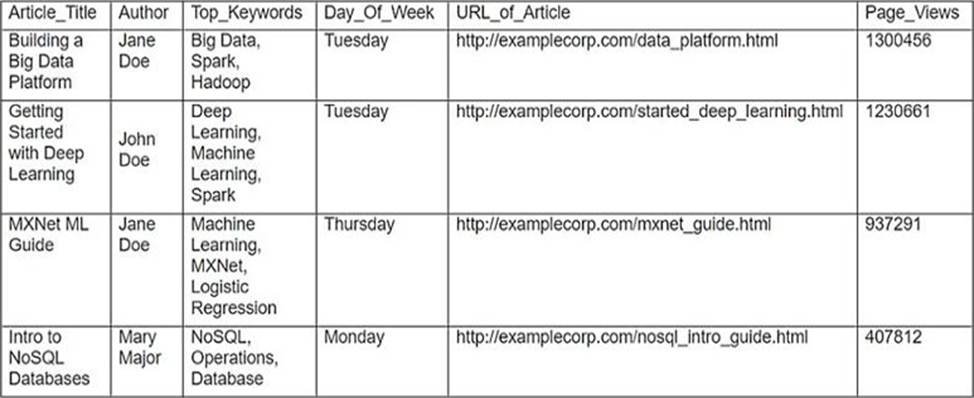
Given the dataset, the Specialist wants to convert the Day-Of_Week column to binary values.
What technique should be used to convert this column to binary values.
- A . Binarization
- B . One-hot encoding
- C . Tokenization
- D . Normalization transformation
B
Explanation:
One-hot encoding is a technique that can be used to convert a categorical variable, such as the Day-Of_Week column, to binary values. One-hot encoding creates a new binary column for each unique value in the original column, and assigns a value of 1 to the column that corresponds to the value in the original column, and 0 to the rest. For example, if the original column has values Monday, Tuesday, Wednesday, Thursday, Friday, Saturday, and Sunday, one-hot encoding will create seven new columns, each representing one day of the week. If the value in the original column is Tuesday, then the column for Tuesday will have a value of 1, and the other columns will have a value of 0.
One-hot encoding can help improve the performance of machine learning models, as it eliminates the ordinal relationship between the values and creates a more informative and sparse representation of the data.
Reference: One-Hot Encoding – Amazon SageMaker One-Hot Encoding: A Simple Guide for Beginners | by Jana Schmidt … One-Hot Encoding in Machine Learning | by Nishant Malik | Towards …
A data scientist uses Amazon SageMaker Data Wrangler to define and perform transformations and feature engineering on historical data. The data scientist saves the transformations to SageMaker Feature Store.
The historical data is periodically uploaded to an Amazon S3 bucket. The data scientist needs to transform the new historic data and add it to the online feature store. The data scientist needs to prepare the …..historic data for training and inference by using native integrations.
Which solution will meet these requirements with the LEAST development effort?
- A . Use AWS Lambda to run a predefined SageMaker pipeline to perform the transformations on each new dataset that arrives in the S3 bucket.
- B . Run an AWS Step Functions step and a predefined SageMaker pipeline to perform the transformations on each new dalaset that arrives in the S3 bucket
- C . Use Apache Airflow to orchestrate a set of predefined transformations on each new dataset that arrives in the S3 bucket.
- D . Configure Amazon EventBridge to run a predefined SageMaker pipeline to perform the transformations when a new data is detected in the S3 bucket.
D
Explanation:
The best solution is to configure Amazon EventBridge to run a predefined SageMaker pipeline to perform the transformations when a new data is detected in the S3 bucket. This solution requires the least development effort because it leverages the native integration between EventBridge and SageMaker Pipelines, which allows you to trigger a pipeline execution based on an event rule. EventBridge can monitor the S3 bucket for new data uploads and invoke the pipeline that contains the same transformations and feature engineering steps that were defined in SageMaker Data Wrangler. The pipeline can then ingest the transformed data into the online feature store for training and inference.
The other solutions are less optimal because they require more development effort and additional services. Using AWS Lambda or AWS Step Functions would require writing custom code to invoke the SageMaker pipeline and handle any errors or retries. Using Apache Airflow would require setting up and maintaining an Airflow server and DAGs, as well as integrating with the SageMaker API.
References:
Amazon EventBridge and Amazon SageMaker Pipelines integration
Create a pipeline using a JSON specification
Ingest data into a feature group
A company is building a predictive maintenance model for its warehouse equipment. The model must predict the probability of failure of all machines in the warehouse. The company has collected 10.000 event samples within 3 months. The event samples include 100 failure cases that are evenly distributed across 50 different machine types.
How should the company prepare the data for the model to improve the model’s accuracy?
- A . Adjust the class weight to account for each machine type.
- B . Oversample the failure cases by using the Synthetic Minority Oversampling Technique (SMOTE).
- C . Undersample the non-failure events. Stratify the non-failure events by machine type.
- D . Undersample the non-failure events by using the Synthetic Minority Oversampling Technique (SMOTE).
B
Explanation:
In predictive maintenance, when a dataset is imbalanced (with far fewer failure cases than non-failure cases), oversampling the minority class helps the model learn from the minority class effectively. The Synthetic Minority Oversampling Technique (SMOTE) generates synthetic samples for the minority class by creating data points between existing minority class instances. This can enhance the model’s ability to recognize failure patterns, particularly in imbalanced datasets.
SMOTE increases the effective presence of failure cases in the dataset, providing a balanced learning environment for the model. This is more effective than undersampling, which would risk losing important non-failure data.
A company is creating an application to identify, count, and classify animal images that are uploaded
to the company’s website. The company is using the Amazon SageMaker image classification algorithm with an ImageNetV2 convolutional neural network (CNN). The solution works well for most animal images but does not recognize many animal species that are less common.
The company obtains 10,000 labeled images of less common animal species and stores the images in Amazon S3. A machine learning (ML) engineer needs to incorporate the images into the model by using Pipe mode in SageMaker.
Which combination of steps should the ML engineer take to train the model? (Choose two.)
- A . Use a ResNet model. Initiate full training mode by initializing the network with random weights.
- B . Use an Inception model that is available with the SageMaker image classification algorithm.
- C . Create a .lst file that contains a list of image files and corresponding class labels. Upload the .lst file to Amazon S3.
- D . Initiate transfer learning. Train the model by using the images of less common species.
- E . Use an augmented manifest file in JSON Lines format.
C, D
Explanation:
The combination of steps that the ML engineer should take to train the model are to create a .lst file that contains a list of image files and corresponding class labels, upload the .lst file to Amazon S3, and initiate transfer learning by training the model using the images of less common species. This approach will allow the ML engineer to leverage the existing ImageNetV2 CNN model and fine-tune it with the new data using Pipe mode in SageMaker.
A company operates large cranes at a busy port. The company plans to use machine learning (ML) for predictive maintenance of the cranes to avoid unexpected breakdowns and to improve productivity. The company already uses sensor data from each crane to monitor the health of the cranes in real time. The sensor data includes rotation speed, tension, energy consumption, vibration, pressure, and …perature for each crane. The company contracts AWS ML experts to implement an ML solution.
Which potential findings would indicate that an ML-based solution is suitable for this scenario? (Select TWO.)
- A . The historical sensor data does not include a significant number of data points and attributes for certain time periods.
- B . The historical sensor data shows that simple rule-based thresholds can predict crane failures.
- C . The historical sensor data contains failure data for only one type of crane model that is in operation and lacks failure data of most other types of crane that are in operation.
- D . The historical sensor data from the cranes are available with high granularity for the last 3 years.
- E . The historical sensor data contains most common types of crane failures that the company wants to predict.
DE
Explanation:
The best indicators that an ML-based solution is suitable for this scenario are D and E, because they imply that the historical sensor data is sufficient and relevant for building a predictive maintenance model. This model can use machine learning techniques such as regression, classification, or anomaly detection to learn from the past data and forecast future failures or issues12. Having high granularity and diversity of data can improve the accuracy and generalization of the model, as well as enable the detection of complex patterns and relationships that are not captured by simple rule-based thresholds3.
The other options are not good indicators that an ML-based solution is suitable, because they suggest that the historical sensor data is incomplete, inconsistent, or inadequate for building a predictive maintenance model. These options would require additional data collection, preprocessing, or augmentation to overcome the data quality issues and ensure that the model can handle different scenarios and types of cranes4.
References:
1: Machine Learning Techniques for Predictive Maintenance
2: A Guide to Predictive Maintenance & Machine Learning
3: Machine Learning for Predictive Maintenance: Reinventing Asset Upkeep
4: Predictive Maintenance with Machine Learning: A Complete Guide
: [Machine Learning for Predictive Maintenance – AWS Online Tech Talks]
A machine learning (ML) engineer has created a feature repository in Amazon SageMaker Feature Store for the company. The company has AWS accounts for development, integration, and production. The company hosts a feature store in the development account. The company uses Amazon S3 buckets to store feature values offline. The company wants to share features and to allow the integration account and the production account to reuse the features that are in the feature repository.
Which combination of steps will meet these requirements? (Select TWO.)
- A . Create an IAM role in the development account that the integration account and production account can assume. Attach IAM policies to the role that allow access to the feature repository and the S3 buckets.
- B . Share the feature repository that is associated the S3 buckets from the development account to the integration account and the production account by using AWS Resource Access Manager (AWS RAM).
- C . Use AWS Security Token Service (AWS STS) from the integration account and the production account to retrieve credentials for the development account.
- D . Set up S3 replication between the development S3 buckets and the integration and production S3 buckets.
- E . Create an AWS PrivateLink endpoint in the development account for SageMaker.
A, B
Explanation:
The combination of steps that will meet the requirements are to create an IAM role in the development account that the integration account and production account can assume, attach IAM policies to the role that allow access to the feature repository and the S3 buckets, and share the feature repository that is associated with the S3 buckets from the development account to the integration account and the production account by using AWS Resource Access Manager (AWS RAM). This approach will enable cross-account access and sharing of the features stored in Amazon SageMaker Feature Store and Amazon S3.
Amazon SageMaker Feature Store is a fully managed, purpose-built repository to store, update, search, and share curated data used in training and prediction workflows. The service provides feature management capabilities such as enabling easy feature reuse, low latency serving, time travel, and ensuring consistency between features used in training and inference workflows. A feature group is a logical grouping of ML features whose organization and structure is defined by a feature group schem
a. A feature group schema consists of a list of feature definitions, each of which specifies the name,
type, and metadata of a feature. Amazon SageMaker Feature Store stores the features in both an online store and an offline store. The online store is a low-latency, high-throughput store that is optimized for real-time inference. The offline store is a historical store that is backed by an Amazon S3 bucket and is optimized for batch processing and model training1.
AWS Identity and Access Management (IAM) is a web service that helps you securely control access to AWS resources for your users. You use IAM to control who can use your AWS resources (authentication) and what resources they can use and in what ways (authorization). An IAM role is an IAM identity that you can create in your account that has specific permissions. You can use an IAM role to delegate access to users, applications, or services that don’t normally have access to your AWS resources.
For example, you can create an IAM role in your development account that allows the integration account and the production account to assume the role and access the resources in the development account. You can attach IAM policies to the role that specify the permissions for the feature repository and the S3 buckets. You can also use IAM conditions to restrict the access based on the source account, IP address, or other factors2.
AWS Resource Access Manager (AWS RAM) is a service that enables you to easily and securely share AWS resources with any AWS account or within your AWS Organization. You can share AWS resources that you own with other accounts using resource shares. A resource share is an entity that defines the resources that you want to share, and the principals that you want to share with. For example, you can share the feature repository that is associated with the S3 buckets from the development account to the integration account and the production account by creating a resource share in AWS RAM. You can specify the feature group ARN and the S3 bucket ARN as the resources, and the integration account ID and the production account ID as the principals. You can also use IAM policies to further control the access to the shared resources3.
The other options are either incorrect or unnecessary. Using AWS Security Token Service (AWS STS) from the integration account and the production account to retrieve credentials for the development account is not required, as the IAM role in the development account can provide temporary security credentials for the cross-account access. Setting up S3 replication between the development S3 buckets and the integration and production S3 buckets would introduce redundancy and inconsistency, as the S3 buckets are already shared through AWS RAM. Creating an AWS PrivateLink endpoint in the development account for SageMaker is not relevant, as it is used to securely connect to SageMaker services from a VPC, not from another account.
References:
1: Amazon SageMaker Feature Store C Amazon Web Services
2: What Is IAM? – AWS Identity and Access Management
3: What Is AWS Resource Access Manager? – AWS Resource Access Manager
A chemical company has developed several machine learning (ML) solutions to identify chemical process abnormalities. The time series values of independent variables and the labels are available for the past 2 years and are sufficient to accurately model the problem.
The regular operation label is marked as 0. The abnormal operation label is marked as 1. Process abnormalities have a significant negative effect on the companys profits. The company must avoid these abnormalities.
Which metrics will indicate an ML solution that will provide the GREATEST probability of detecting an abnormality?
- A . Precision = 0.91
Recall = 0.6 - B . Precision = 0.61
Recall = 0.98 - C . Precision = 0.7
Recall = 0.9 - D . Precision = 0.98
Recall = 0.8
B
Explanation:
The metrics that will indicate an ML solution that will provide the greatest probability of detecting an abnormality are precision and recall. Precision is the ratio of true positives (TP) to the total number of predicted positives (TP + FP), where FP is false positives. Recall is the ratio of true positives (TP) to the total number of actual positives (TP + FN), where FN is false negatives. A high precision means that the ML solution has a low rate of false alarms, while a high recall means that the ML solution has a high rate of true detections. For the chemical company, the goal is to avoid process abnormalities, which are marked as 1 in the labels. Therefore, the company needs an ML solution that has a high recall for the positive class, meaning that it can detect most of the abnormalities and minimize the false negatives. Among the four options, option B has the highest recall for the positive class, which is 0.98. This means that the ML solution can detect 98% of the abnormalities and miss only 2%.
Option B also has a reasonable precision for the positive class, which is 0.61. This means that the ML solution has a false alarm rate of 39%, which may be acceptable for the company, depending on the cost and benefit analysis. The other options have lower recall for the positive class, which means that they have higher false negative rates, which can be more detrimental for the company than false positive rates.
References:
1: AWS Certified Machine Learning – Specialty Exam Guide
2: AWS Training – Machine Learning on AWS
3: AWS Whitepaper – An Overview of Machine Learning on AWS
4: Precision and recall
A company is planning a marketing campaign to promote a new product to existing customers. The company has data (or past promotions that are similar. The company decides to try an experiment to send a more expensive marketing package to a smaller number of customers. The company wants to target the marketing campaign to customers who are most likely to buy the new product. The experiment requires that at least 90% of the customers who are likely to purchase the new product receive the marketing materials.
…company trains a model by using the linear learner algorithm in Amazon SageMaker. The model has a recall score of 80% and a precision of 75%.
…should the company retrain the model to meet these requirements?
- A . Set the target_recall hyperparameter to 90% Set the binaryclassrfier model_selection_critena hyperparameter to recall_at_target_precision.
- B . Set the targetprecision hyperparameter to 90%. Set the binary classifier model selection criteria hyperparameter to precision at_jarget recall.
- C . Use 90% of the historical data for training Set the number of epochs to 20.
- D . Set the normalize_jabel hyperparameter to true. Set the number of classes to 2.
A
Explanation:
The best way to retrain the model to meet the requirements is to set the target_recall hyperparameter to 90% and set the binary_classifier_model_selection_criteria hyperparameter to recall_at_target_precision. This will instruct the linear learner algorithm to optimize the model for a high recall score, while maintaining a reasonable precision score. Recall is the proportion of actual positives that were identified correctly, which is important for the company’s goal of reaching at least 90% of the customers who are likely to buy the new product1. Precision is the proportion of positive identifications that were actually correct, which is also relevant for the company’s budget and efficiency2. By setting the target_recall to 90%, the algorithm will try to achieve a recall score of at least 90%, and by setting the binary_classifier_model_selection_criteria to recall_at_target_precision, the algorithm will select the model that has the highest recall score among those that have a precision score equal to or higher than the target precision3. The target precision is automatically set to the median of the precision scores of all the models trained in parallel4.
The other options are not correct or optimal, because they have the following drawbacks:
B: Setting the target_precision hyperparameter to 90% and setting the binary_classifier_model_selection_criteria hyperparameter to precision_at_target_recall will optimize the model for a high precision score, while maintaining a reasonable recall score. However, this is not aligned with the company’s goal of reaching at least 90% of the customers who are likely to buy the new product, as precision does not reflect how well the model identifies the actual positives1. Moreover, setting the target_precision to 90% might be too high and unrealistic for the dataset, as the current precision score is only 75%4.
C: Using 90% of the historical data for training and setting the number of epochs to 20 will not necessarily improve the recall score of the model, as it does not change the optimization objective or the model selection criteria. Moreover, using more data for training might reduce the amount of data available for validation, which is needed for selecting the best model among the ones trained in parallel3. The number of epochs is also not a decisive factor for the recall score, as it depends on the learning rate, the optimizer, and the convergence of the algorithm5.
D: Setting the normalize_label hyperparameter to true and setting the number of classes to 2 will not affect the recall score of the model, as these are irrelevant hyperparameters for binary classification problems. The normalize_label hyperparameter is only applicable for regression problems, as it controls whether the label is normalized to have zero mean and unit variance3. The number of classes hyperparameter is only applicable for multiclass classification problems, as it specifies the number of output classes3.
References:
1: Classification: Precision and Recall | Machine Learning | Google for Developers
2: Precision and recall – Wikipedia
3: Linear Learner Algorithm – Amazon SageMaker
4: How linear learner works – Amazon SageMaker
5: Getting hands-on with Amazon SageMaker Linear Learner – Pluralsight