
Amazon DVA-C02 Practice Exams
Last updated on Oct 21,2026- Exam Code: DVA-C02
- Exam Name: AWS Certified Developer - Associate
- Certification Provider: Amazon
- Latest update: Oct 21,2026
A company uses AWS X-Ray to monitor a serverless application. The components of the application have different request rates. The user interactions and transactions are important to trace, but they are low in volume. The background processes such as application health checks, polling, and connection maintenance generate high volumes of read-only requests.
Currently, the default X-Ray sampling rules are universal for all requests. Only the first request per second and some additional requests are recorded. This setup is not helping the company review the requests based on service or request type.
A developer must configure rules to trace requests based on service or request properties. The developer must trace the user interactions and transactions without wasting effort recording minor background tasks.
Which solution will meet these requirements?
- A . Disable sampling for high-volume read-only requests. Sample at a lower rate for all requests that
handle user interactions or transactions. - B . Disable sampling and trace all requests for requests that handle user interactions or transactions.
Sample high-volume read-only requests at a higher rate. - C . Disable sampling and trace all requests for requests that handle user interactions or transactions.
Sample high-volume read-only requests at a lower rate. - D . Disable sampling for high-volume read-only requests. Sample at a higher rate for all requests that handle user interactions or transactions.
A company wants to automate part of its deployment process. A developer needs to automate the process of checking for and deleting unused resources that supported previously deployed stacks but that are no longer used.
The company has a central application that uses the AWS Cloud Development Kit (AWS CDK) to manage all deployment stacks. The stacks are spread out across multiple accounts. The developer’s solution must integrate as seamlessly as possible within the current deployment process.
Which solution will meet these requirements with the LEAST amount of configuration?
- A . In the central AWS CDK application, write a handler function in the code that uses AWS SDK calls to check for and delete unused resources. Create an AWS CloudPormation template from a JSON file. Use the template to attach the function code to an AWS Lambda function and lo invoke the Lambda function when the deployment slack runs.
- B . In the central AWS CDK application. write a handler function in the code that uses AWS SDK calls to check for and delete unused resources. Create an AWS CDK custom resource Use the custom resource to attach the function code to an AWS Lambda function and to invoke the Lambda function when the deployment stack runs.
- C . In the central AWS CDK, write a handler function m the code that uses AWS SDK calls to check for and delete unused resources. Create an API in AWS Amplify Use the API to attach the function code to an AWS Lambda function and to invoke the Lambda function when the deployment stack runs.
- D . In the AWS Lambda console write a handler function in the code that uses AWS SDK calls to check for and delete unused resources. Create an AWS CDK custom resource. Use the custom resource to import the Lambda function into the stack and to Invoke the Lambda function when the deployment stack runs.
B
Explanation:
This solution meets the requirements with the least amount of configuration because it uses a feature of AWS CDK that allows custom logic to be executed during stack deployment or deletion. The AWS Cloud Development Kit (AWS CDK) is a software development framework that allows you to define cloud infrastructure as code and provision it through CloudFormation. An AWS CDK custom resource is a construct that enables you to create resources that are not natively supported by CloudFormation or perform tasks that are not supported by CloudFormation during stack deployment or deletion. The developer can write a handler function in the code that uses AWS SDK calls to check for and delete unused resources, and create an AWS CDK custom resource that attaches the function code to a Lambda function and invokes it when the deployment stack runs. This way, the developer can automate the cleanup process without requiring additional configuration or integration. Creating a CloudFormation template from a JSON file will require additional configuration and integration with the central AWS CDK application. Creating an API in AWS Amplify will require additional configuration and integration with the central AWS CDK application and may not provide optimal performance or availability. Writing a handler function in the AWS Lambda console will require additional configuration and integration with the central AWS CDK application.
Reference: [AWS Cloud Development Kit (CDK)], [Custom Resources]
A developer is building a serverless application by using AWS Serverless Application Model (AWS SAM) on multiple AWS Lambda functions. When the application is deployed, the developer wants to shift 10% of the traffic to the new deployment of the application for the first 10 minutes after deployment. If there are no issues, all traffic must switch over to the new version.
Which change to the AWS SAM template will meet these requirements?
- A . Set the Deployment Preference Type to Canaryl OPercent10Minutes. Set the AutoPublishAlias property to the Lambda alias.
- B . Set the Deployment Preference Type to Linearl OPercentEveryIOMinutes. Set AutoPubIishAIias property to the Lambda alias.
- C . Set the Deployment Preference Type to Canaryl OPercentIOMinutes. Set the PreTraffic and PostTraffic properties to the Lambda alias.
- D . Set the Deployment Preference Type to Linearl OPercentEvery10Minutes. Set PreTraffic and PostTraffic properties to the Lambda alias.
A
Explanation:
The Deployment Preference Type property specifies how traffic should be shifted between versions of a Lambda function1. The Canary10Percent10Minutes option means that 10% of the traffic is immediately shifted to the new version, and after 10 minutes, the remaining 90% of the traffic is shifted1. This matches the requirement of shifting 10% of the traffic for the first 10 minutes, and then switching all traffic to the new version.
The AutoPublishAlias property enables AWS SAM to automatically create and update a Lambda alias that points to the latest version of the function1. This is required to use the Deployment Preference Type property1. The alias name can be specified by the developer, and it can be used to invoke the function with the latest code.
A company wants to migrate applications from its on-premises servers to AWS. As a first step, the company is modifying and migrating a non-critical application to a single Amazon EC2 instance. The application will store information in an Amazon S3 bucket. The company needs to follow security best practices when deploying the application on AWS.
Which approach should the company take to allow the application to interact with Amazon S3?
- A . Create an 1AM role that has administrative access to AWS. Attach the role to the EC2 instance.
- B . Create an 1AM user. Attach the AdministratorAccess policy. Copy the generated access key and secret key. Within the application code, use the access key and secret key along with the AWS SDK to communicate with Amazon S3.
- C . Create an 1AM role that has the necessary access to Amazon S3. Attach the role to the EC2 instance.
- D . Create an 1AM user. Attach a policy that provides the necessary access to Amazon S3. Copy the generated access key and secret key. Within the application code, use the access key and secret key along with the AWS SDK to communicate with Amazon S3.
A developer is building an application that processes a stream of user-supplied data. The data stream must be consumed by multiple Amazon EC2 based processing applications in parallel and in real time. Each processor must be able to resume without losing data if there is a service interruption. The application architect plans to add other processors in the near future, and wants to minimize the amount of data duplication involved.
Which solution will satisfy these requirements?
- A . Publish the data to Amazon Simple Queue Service (Amazon SQS).
- B . Publish the data to Amazon Data Firehose.
- C . Publish the data to Amazon EventBridge.
- D . Publish the data to Amazon Kinesis Data Streams.
A company runs an AWS CodeBuild project on medium-sized Amazon EC2 instances. The company wants to cost optimize the project and reduce the provisioning time.
- A . Configure the project to run on a CodeBuild reserved capacity fleet.
- B . Select AWS Lambda as the compute mode for the CodeBuild project.
- C . Configure the project to run on a CodeBuild on-demand fleet.
- D . Set up Amazon S3 caching for the CodeBuild project.
D
Explanation:
Comprehensive and Detailed Step-by-Step
Option D: Set up Amazon S3 Caching for CodeBuild:
CodeBuild supports S3 caching to store intermediate build artifacts and dependencies. This reduces the time required to download dependencies during subsequent builds, effectively lowering costs and improving build performance.
By using S3 caching, developers can optimize costs without changing the compute type or adding complexity.
Why Other Options Are Incorrect:
Option A: CodeBuild does not have a "reserved capacity fleet" option.
Option B: AWS Lambda cannot be used as the compute mode for CodeBuild projects. CodeBuild uses its own managed build environments.
Option C: CodeBuild already operates on an on-demand basis, so this does not address the need for
optimization or reduced provisioning time.
Reference: AWS CodeBuild Caching Documentation
When using the AWS Encryption SDK how does the developer keep track of the data encryption keys used to encrypt data?
- A . The developer must manually keep Hack of the data encryption keys used for each data object.
- B . The SDK encrypts the data encryption key and stores it (encrypted) as part of the resumed ophertext.
- C . The SDK stores the data encryption keys automaticity in Amazon S3.
- D . The data encryption key is stored m the user data for the EC2 instance.
B
Explanation:
This solution will meet the requirements by using AWS Encryption SDK, which is a client-side encryption library that enables developers to encrypt and decrypt data using data encryption keys that are protected by AWS Key Management Service (AWS KMS). The SDK encrypts the data encryption key with a customer master key (CMK) that is managed by AWS KMS, and stores it (encrypted) as part of the returned ciphertext. The developer does not need to keep track of the data encryption keys used to encrypt data, as they are stored with the encrypted data and can be retrieved and decrypted by using AWS KMS when needed.
Option A is not optimal because it will require manual tracking of the data encryption keys used for each data object, which is error-prone and inefficient.
Option C is not optimal because it will store the data encryption keys automatically in Amazon S3, which is unnecessary and insecure as Amazon S3 is not designed for storing encryption keys.
Option D is not optimal because it will store the data encryption key in the user data for the EC2 instance, which is also unnecessary and insecure as user data is not encrypted by default.
Reference: [AWS Encryption SDK], [AWS Key Management Service]
A developer has an application that stores data in an Amazon S3 bucket. The application uses an HTTP API to store and retrieve objects. When the PutObject API operation adds objects to the S3 bucket the developer must encrypt these objects at rest by using server-side encryption with Amazon S3 managed keys (SSE-S3).
Which solution will meet this requirement?
- A . Create an AWS Key Management Service (AWS KMS) key. Assign the KMS key to the S3 bucket.
- B . Set the x-amz-server-side-encryption header when invoking the PutObject API operation.
- C . Provide the encryption key in the HTTP header of every request.
- D . Apply TLS to encrypt the traffic to the S3 bucket.
B
Explanation:
Amazon S3 supports server-side encryption, which encrypts data at rest on the server that stores the data. One of the encryption options is SSE-S3, which uses keys managed by S3. To use SSE-S3, the x-amz-server-side-encryption header must be set to AES256 when invoking the PutObject API operation. This instructs S3 to encrypt the object data with SSE-S3 before saving it on disks in its data centers and decrypt it when it is downloaded.
Reference: Protecting data using server-side encryption with Amazon S3-managed encryption keys (SSE-S3)
What is the maximum execution duration per request for AWS Lambda functions?
- A . 5 minutes
- B . 15 minutes
- C . 30 minutes
- D . 60 minutes
A developer has written the following IAM policy to provide access to an Amazon S3 bucket:
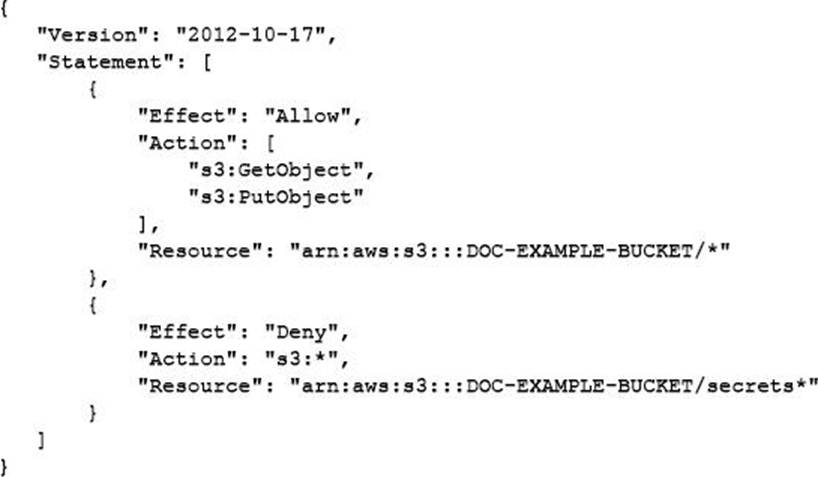
Which access does the policy allow regarding the s3:GetObject and s3:PutObject actions?
- A . Access on all buckets except the “DOC-EXAMPLE-BUCKET” bucket
- B . Access on all buckets that start with “DOC-EXAMPLE-BUCKET” except the “DOC-EXAMPLE-BUCKET/secrets” bucket
- C . Access on all objects in the “DOC-EXAMPLE-BUCKET” bucket along with access to all S3 actions for objects in the “DOC-EXAMPLE-BUCKET” bucket that start with “secrets”
- D . Access on all objects in the “DOC-EXAMPLE-BUCKET” bucket except on objects that start with “secrets”
D
Explanation:
The IAM policy shown in the image is a resource-based policy that grants or denies access to an S3 bucket based on certain conditions. The first statement allows access to any S3 action on any object in the “DOC-EXAMPLE-BUCKET” bucket when the request is made over HTTPS (the value of aws:SecureTransport is true). The second statement denies access to the s3:GetObject and s3:PutObject actions on any object in the “DOC-EXAMPLE-BUCKET/secrets” prefix when the request is made over HTTP (the value of aws:SecureTransport is false). Therefore, the policy allows access on all objects in the “DOC-EXAMPLE-BUCKET” bucket except on objects that start with “secrets”.
Reference: Using IAM policies for Amazon S3