
Amazon DVA-C02 Practice Exams
Last updated on Oct 22,2026- Exam Code: DVA-C02
- Exam Name: AWS Certified Developer - Associate
- Certification Provider: Amazon
- Latest update: Oct 22,2026
An application is processing clickstream data using Amazon Kinesis. The clickstream data feed into Kinesis experiences periodic spikes.
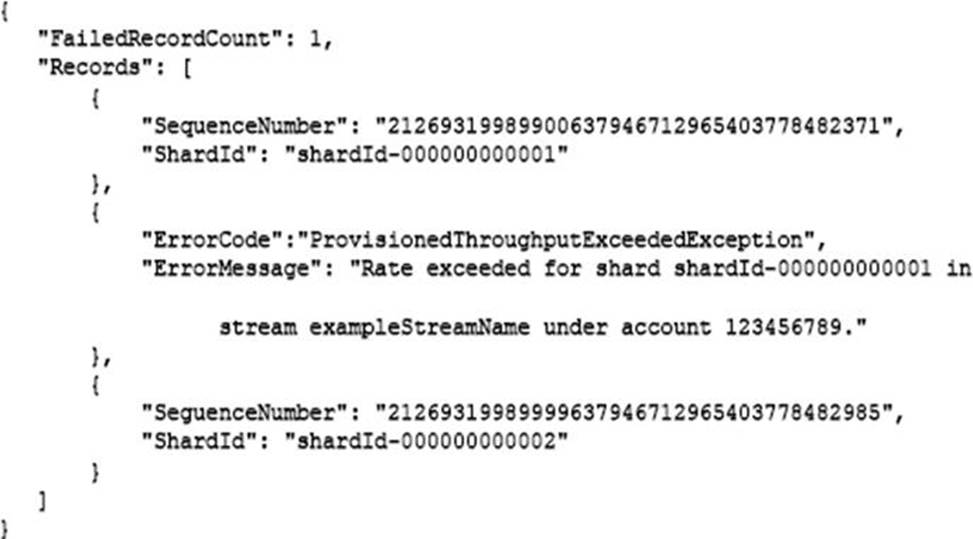
The PutRecords API call occasionally fails and the logs show that the failed call returns the response shown below:
Which techniques will help mitigate this exception? (Choose two.)
- A . Implement retries with exponential backoff.
- B . Use a PutRecord API instead of PutRecords.
- C . Reduce the frequency and/or size of the requests.
- D . Use Amazon SNS instead of Kinesis.
- E . Reduce the number of KCL consumers.
AC
Explanation:
The response from the API call indicates that the ProvisionedThroughputExceededException exception has occurred. This exception means that the rate of incoming requests exceeds the throughput limit for one or more shards in a stream.
To mitigate this exception, the developer can use one or more of the following techniques:
Implement retries with exponential backoff. This will introduce randomness in the retry intervals and avoid overwhelming the shards with retries.
Reduce the frequency and/or size of the requests. This will reduce the load on the shards and avoid throttling errors.
Increase the number of shards in the stream. This will increase the throughput capacity of the stream and accommodate higher request rates.
Use a PutRecord API instead of PutRecords. This will reduce the number of records per request and
avoid exceeding the payload limit.
Reference: [ProvisionedThroughputExceededException – Amazon Kinesis Data Streams Service API Reference] [Best Practices for Handling Kinesis Data Streams Errors]
A company has a serverless application that uses Amazon API Gateway backed by AWS Lambda proxy integration. The company is developing several backend APIs. The company needs a landing page to provide an overview of navigation to the APIs.
A developer creates a new /LandingPage resource and a new GET method that uses mock integration.
What should the developer do next to meet these requirements?
- A . Configure the integration request mapping template with Content-Type of text/html and statusCode of 200. Configure the integration response mapping template with Content-Type of application/json. In the integration response mapping template, include the LandingPage HTML code that references the APIs.
- B . Configure the Integration request mapping template with Content-Type of application/json. In the integration request mapping template, include the LandingPage HMTL code that references the APIs. Configure the integration response mapping template with Content-Type of text/html and statusCode of 200.
- C . Configure the integration request mapping template with Content-Type of application/json and statusCode of 200. Configure the integration response mapping template with Content-Type of text/html. In the integration response mapping template, include the LandingPage HTML code that references the APIs.
- D . Configure the integration request mapping template with Content-Type of text/html. In the integration request mapping template, include the LandingPage HTML code that references the APIs. Configure the integration response mapping template with Content-Type of application/json and statusCode of 200.
A developer is incorporating AWS X-Ray into an application that handles personal identifiable information (PII). The application is hosted on Amazon EC2 instances. The application trace messages include encrypted PII and go to Amazon CloudWatch. The developer needs to ensure that no PII goes outside of the EC2 instances.
Which solution will meet these requirements?
- A . Manually instrument the X-Ray SDK in the application code.
- B . Use the X-Ray auto-instrumentation agent.
- C . Use Amazon Macie to detect and hide PII. Call the X-Ray API from AWS Lambda.
- D . Use AWS Distro for Open Telemetry.
A
Explanation:
This solution will meet the requirements by allowing the developer to control what data is sent to X-Ray and CloudWatch from the application code. The developer can filter out any PII from the trace messages before sending them to X-Ray and CloudWatch, ensuring that no PII goes outside of the EC2 instances.
Option B is not optimal because it will automatically instrument all incoming and outgoing requests from the application, which may include PII in the trace messages.
Option C is not optimal because it will require additional services and costs to use Amazon Macie and AWS Lambda, which may not be able to detect and hide all PII from the trace messages.
Option D is not optimal because it will use Open Telemetry instead of X-Ray, which may not be compatible with CloudWatch and other AWS services.
Reference: [AWS X-Ray SDKs]
An AWS Lambda function requires read access to an Amazon S3 bucket and requires read/write access to an Amazon DynamoDB table The correct 1AM policy already exists
What is the MOST secure way to grant the Lambda function access to the S3 bucket and the DynamoDB table?
- A . Attach the existing 1AM policy to the Lambda function.
- B . Create an 1AM role for the Lambda function Attach the existing 1AM policy to the role Attach the role to the Lambda function
- C . Create an 1AM user with programmatic access Attach the existing 1AM policy to the user. Add the user access key ID and secret access key as environment variables in the Lambda function.
- D . Add the AWS account root user access key ID and secret access key as encrypted environment variables in the Lambda function
B
Explanation:
Principle of Least Privilege: Granting specific permissions through an IAM role is more secure than directly attaching policies to a function or using root user credentials.
IAM Roles for Lambda: Designed to provide temporary credentials to Lambda functions, enhancing security.
Reusability: The existing IAM policy ensures the correct S3 and DynamoDB access is granted.
Reference: IAM Roles for Lambda Documentation: https://docs.aws.amazon.com/lambda/latest/dg/lambda-intro-execution-role.html
IAM Best Practices: https://docs.aws.amazon.com/IAM/latest/UserGuide/best-practices.html
A company is building an application for stock trading. The application needs sub-millisecond latency for processing trade requests. The company uses Amazon DynamoDB to store all the trading data that is used to process each trading request A development team performs load testing on the application and finds that the data retrieval time is higher than expected. The development team needs a solution that reduces the data retrieval time with the least possible effort.
Which solution meets these requirements’?
- A . Add local secondary indexes (LSis) for the trading data.
- B . Store the trading data m Amazon S3 and use S3 Transfer Acceleration.
- C . Add retries with exponential back off for DynamoDB queries.
- D . Use DynamoDB Accelerator (DAX) to cache the trading data.
D
Explanation:
This solution will meet the requirements by using DynamoDB Accelerator (DAX), which is a fully managed, highly available, in-memory cache for DynamoDB that delivers up to a 10 times performance improvement – from milliseconds to microseconds – even at millions of requests per second. The developer can use DAX to cache the trading data that is used to process each trading request, which will reduce the data retrieval time with the least possible effort.
Option A is not optimal because it will add local secondary indexes (LSIs) for the trading data, which may not improve the performance or reduce the latency of data retrieval, as LSIs are stored on the same partition as the base table and share the same provisioned throughput.
Option B is not optimal because it will store the trading data in Amazon S3 and use S3 Transfer Acceleration, which is a feature that enables fast, easy, and secure transfers of files over long distances between S3 buckets and clients, not between DynamoDB and clients.
Option C is not optimal because it will add retries with exponential backoff for DynamoDB queries, which is a strategy to handle transient errors by retrying failed requests with increasing delays, not by reducing data retrieval time.
Reference: [DynamoDB Accelerator (DAX)], [Local Secondary Indexes]
A developer is modifying an AWS Lambda function that accesses an Amazon RDS for MySQL database. The developer discovers that the Lambda function has the database credentials stored as plaintext in the Lambda function code.
The developer must implement a solution to make the credentials more secure. The solution must
include automated credential rotation every 30 days.
Which solution will meet these requirements?
- A . Move the credentials to a secret in AWS Secrets Manager. Modify the Lambda function to read from Secrets Manager. Set a schedule to rotate the secret every 30 days.
- B . Move the credentials to a secure string parameter in AWS Systems Manager Parameter Store. Modify the Lambda function to read from Parameter Store. Set a schedule to rotate the parameter every 30 days.
- C . Move the credentials to an encrypted Amazon S3 bucket. Modify the Lambda function to read from the S3 bucket. Configure S3 Object Lambda to rotate the credentials every 30 days.
- D . Move the credentials to a secure string parameter in AWS Systems Manager Parameter Store.
Create an Amazon EventBridge rule to rotate the parameter every 30 days.
A
Explanation:
Requirement Summary:
Lambda function accesses RDS for MySQL
Credentials are currently hardcoded in code (insecure)
Must enable automated credential rotation every 30 days
Option A: Use AWS Secrets Manager + automatic rotation
✅ Best and secure option Secrets Manager allows: Secure storage of secrets
Integration with RDS for automatic rotation Scheduled rotation every X days (e.g., 30 days) Lambda can fetch credentials via SDK (GetSecretValue) Option B: Use SSM Parameter Store + rotation
❌ SSM does not support automatic rotation of secrets.
You’d need to build custom rotation logic = higher operational overhead.
Option C: Encrypted S3 + Object Lambda rotation
❌ Not intended for credential storage.
S3 is not a secrets management system, and Object Lambda does not perform rotation.
Option D: SSM + EventBridge rotation
❌ No native integration between Parameter Store and EventBridge for secret rotation. You’d need to build custom Lambda functions = higher maintenance.
Secrets Manager rotation for RDS:
https://docs.aws.amazon.com/secretsmanager/latest/userguide/rotating-secrets.html
Secure retrieval in Lambda:
https://docs.aws.amazon.com/secretsmanager/latest/userguide/retrieving-secrets_lambda.html
Integration with RDS MySQL:
https://docs.aws.amazon.com/secretsmanager/latest/userguide/integrating_rds_config.html
A developer is creating an application that will be deployed on IoT devices. The application will send data to a RESTful API that is deployed as an AWS Lambda function. The application will assign each API request a unique identifier. The volume of API requests from the application can randomly increase at any given time of day.
During periods of request throttling, the application might need to retry requests. The API must be able to handle duplicate requests without inconsistencies or data loss.
Which solution will meet these requirements?
- A . Create an Amazon RDS for MySQL DB instance. Store the unique identifier for each request in a database table. Modify the Lambda function to check the table for the identifier before processing the request.
- B . Create an Amazon DynamoDB table. Store the unique identifier for each request in the table.
Modify the Lambda function to check the table for the identifier before processing the request. - C . Create an Amazon DynamoDB table. Store the unique identifier for each request in the table. Modify the Lambda function to return a client error response when the function receives a duplicate request.
- D . Create an Amazon ElastiCache for Memcached instance. Store the unique identifier for each request in the cache. Modify the Lambda function to check the cache for the identifier before processing the request.
B
Explanation:
Amazon DynamoDB is a fully managed NoSQL database service that can store and retrieve any amount of data with high availability and performance. DynamoDB can handle concurrent requests from multiple IoT devices without throttling or data loss. To prevent duplicate requests from causing inconsistencies or data loss, the Lambda function can use DynamoDB conditional writes to check if the unique identifier for each request already exists in the table before processing the request. If the identifier exists, the function can skip or abort the request; otherwise, it can process the request and store the identifier in the table.
Reference: Using conditional writes
When a developer tries to run an AWS Code Build project, it raises an error because the length of all environment variables exceeds the limit for the combined maximum of characters.
What is the recommended solution?
- A . Add the export LC-_ALL" on _ US, tuft" command to the pre _ build section to ensure POSIX Localization.
- B . Use Amazon Cognate to store key-value pairs for large numbers of environment variables
- C . Update the settings for the build project to use an Amazon S3 bucket for large numbers of environment variables
- D . Use AWS Systems Manager Parameter Store to store large numbers ot environment variables
D
Explanation:
This solution allows the developer to overcome the limit for the combined maximum of characters
for environment variables in AWS CodeBuild. AWS Systems Manager Parameter Store provides secure, hierarchical storage for configuration data management and secrets management. The developer can store large numbers of environment variables as parameters in Parameter Store and reference them in the buildspec file using parameter references. Adding export LC_ALL=“en_US.utf8” command to the pre_build section will not affect the environment variables limit. Using Amazon Cognito or an Amazon S3 bucket to store key-value pairs for environment variables will require additional configuration and integration.
Reference: [Build Specification Reference for AWS CodeBuild], [What Is AWS Systems Manager Parameter Store?]
A company developed an API application on AWS by using Amazon CloudFront. Amazon API Gateway, and AWS Lambda. The API has a minimum of four requests every second A developer notices that many API users run the same query by using the POST method. The developer wants to cache the POST request to optimize the API resources.
Which solution will meet these requirements?
- A . Configure the CloudFront cache Update the application to return cached content based upon the default request headers.
- B . Override the cache method in me selected stage of API Gateway Select the POST method.
- C . Save the latest request response in Lambda /tmp directory Update the Lambda function to check the /tmp directory
- D . Save the latest request m AWS Systems Manager Parameter Store Modify the Lambda function to take the latest request response from Parameter Store
A
Explanation:
This solution will meet the requirements by using Amazon CloudFront, which is a content delivery network (CDN) service that speeds up the delivery of web content and APIs to end users. The developer can configure the CloudFront cache, which is a set of edge locations that store copies of popular or recently accessed content close to the viewers. The developer can also update the application to return cached content based upon the default request headers, which are a set of HTTP headers that CloudFront automatically forwards to the origin server and uses to determine whether an object in an edge location is still valid. By caching the POST requests, the developer can optimize the API resources and reduce the latency for repeated queries.
Option B is not optimal because it will override the cache method in the selected stage of API Gateway, which is not possible or effective as API Gateway does not support caching for POST methods by default.
Option C is not optimal because it will save the latest request response in Lambda /tmp directory, which is a local storage space that is available for each Lambda function invocation, not a cache that can be shared across multiple invocations or requests.
Option D is not optimal because it will save the latest request in AWS Systems Manager Parameter Store, which is a service that provides secure and scalable storage for configuration data and secrets, not a cache for API responses.
Reference: [Amazon CloudFront], [Caching Content Based on Request Headers]