
Amazon DVA-C02 Practice Exams
Last updated on Oct 22,2026- Exam Code: DVA-C02
- Exam Name: AWS Certified Developer - Associate
- Certification Provider: Amazon
- Latest update: Oct 22,2026
A developer is setting up a deployment pipeline. The pipeline includes an AWS CodeBuild build stage that requires access to a database to run integration tests. The developer is using a buildspec.yml file to configure the database connection. Company policy requires automatic rotation of all database
credentials.
Which solution will handle the database credentials MOST securely?
- A . Retrieve the credentials from variables that are hardcoded in the buildspec.yml file. Configure an AWS Lambda function to rotate the credentials.
- B . Retrieve the credentials from an environment variable that is linked to a SecureString parameter in AWS Systems Manager Parameter Store. Configure Parameter Store for automatic rotation.
- C . Retrieve the credentials from an environment variable that is linked to an AWS Secrets Manager secret. Configure Secrets Manager for automatic rotation.
- D . Retrieve the credentials from an environment variable that contains the connection string in plaintext. Configure an Amazon EventBridge event to rotate the credentials.
A developer is building a new application on AWS. The application uses an AWS Lambda function that retrieves information from an Amazon DynamoDB table. The developer hard coded the DynamoDB table name into the Lambda function code. The table name might change over time. The developer does not want to modify the Lambda code if the table name changes.
Which solution will meet these requirements MOST efficiently?
- A . Create a Lambda environment variable to store the table name. Use the standard method for the programming language to retrieve the variable.
- B . Store the table name in a file. Store the file in the /tmp folder. Use the SDK for the programming language to retrieve the table name.
- C . Create a file to store the table name. Zip the file and upload the file to the Lambda layer. Use the SDK for the programming language to retrieve the table name.
- D . Create a global variable that is outside the handler in the Lambda function to store the table name.
A
Explanation:
The solution that will meet the requirements most efficiently is to create a Lambda environment variable to store the table name. Use the standard method for the programming language to retrieve the variable. This way, the developer can avoid hard-coding the table name in the Lambda function code and easily change the table name by updating the environment variable. The other options either involve storing the table name in a file, which is less efficient and secure than using an environment variable, or creating a global variable, which is not recommended as it can cause concurrency issues.
Reference: Using AWS Lambda environment variables
A developer is writing an AWS Lambda function. The developer wants to log key events that occur while the Lambda function runs. The developer wants to include a unique identifier to associate the events with a specific function invocation.
The developer adds the following code to the Lambda function:

Which solution will meet this requirement?
- A . Obtain the request identifier from the AWS request ID field in the context object. Configure the application to write logs to standard output.
- B . Obtain the request identifier from the AWS request ID field in the event object. Configure the application to write logs to a file.
- C . Obtain the request identifier from the AWS request ID field in the event object. Configure the application to write logs to standard output.
- D . Obtain the request identifier from the AWS request ID field in the context object. Configure the application to write logs to a file.
A
Explanation:
https://docs.aws.amazon.com/lambda/latest/dg/nodejs-context.html
https://docs.aws.amazon.com/lambda/latest/dg/nodejs-logging.html
There is no explicit information for the runtime, the code is written in Node.js.
AWS Lambda is a service that lets developers run code without provisioning or managing servers.
The developer can use the AWS request ID field in the context object to obtain a unique identifier for each function invocation. The developer can configure the application to write logs to standard output, which will be captured by Amazon CloudWatch Logs. This solution will meet the requirement of logging key events with a unique identifier.
Reference: [What Is AWS Lambda? – AWS Lambda]
[AWS Lambda Function Handler in Node.js – AWS Lambda]
[Using Amazon CloudWatch – AWS Lambda]
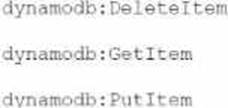
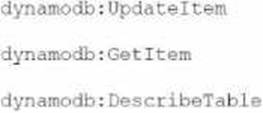
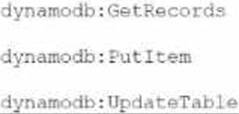
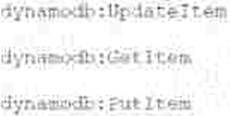
A developer is working on an AWS Lambda function that accesses Amazon DynamoDB. The Lambda function must retrieve an item and update some of its attributes, or create the item if it does not exist. The Lambda function has access to the primary key.
Which IAM permissions should the developer request for the Lambda function to achieve this functionality?
A)
B)
C)
D)
- A . Option A
- B . Option B
- C . Option C
- D . Option D
B
Explanation:
Requirement Summary:
Lambda function:
Retrieves an item from DynamoDB
Updates its attributes or creates it if it does not exist
Has primary key
Needs minimum required IAM permissions
Analysis of Required Permissions:
To get an item and update it or create it if it doesn’t exist, the Lambda function must use the **PutItem** or **UpdateItem** API, and read with **GetItem**.
✅ Valid API options:
GetItem: Read the item from the table.
UpdateItem: Update existing item attributes or insert if it doesn’t exist (with UpdateExpression and ConditionExpression).
When UpdateItem is used without a conditional check for existence, it can create a new item if it does not exist (acts like upsert).
DescribeTable: (Optional) Used if you need table metadata (not strictly required here).
Evaluate the Choices:
Option A:
DeleteItem C ❌ Not needed
GetItem C ✅
PutItem C ✅ (can create/replace but not partial update)
✅ Close, but PutItem overwrites the full item, not update-in-place. Acceptable, but UpdateItem is better suited.
Option B:
UpdateItem C ✅ Required to modify attributes or insert new item GetItem C ✅ Required to check existence or read data DescribeTable C ✅ Optional, but not harmful
✅✅ BEST FIT C Matches the update-or-create logic.
Option C:
GetRecords C ❌ This is used for DynamoDB Streams, not standard GetItem PutItem C ✅
UpdateTable C ❌ Used to change table settings, not data manipulation
❌ Incorrect usage context Option D:
UpdateItem, GetItem, PutItem C ✅ all valid
But UpdateItem alone is sufficient; including PutItem might not be necessary Also, image is faded (possibly invalid), and it’s redundant
:
UpdateItem API:
https://docs.aws.amazon.com/amazondynamodb/latest/APIReference/API_UpdateItem.html
PutItem vs UpdateItem:
https://docs.aws.amazon.com/amazondynamodb/latest/developerguide/WorkingWithItems.html
IAM actions for DynamoDB: https://docs.aws.amazon.com/service-
authorization/latest/reference/list_amazondynamodb.html
A company has deployed infrastructure on AWS. A development team wants to create an AWS Lambda function that will retrieve data from an Amazon Aurora database. The Amazon Aurora database is in a private subnet in company’s VPC. The VPC is named VPC1. The data is relational in nature. The Lambda function needs to access the data securely.
Which solution will meet these requirements?
- A . Create the Lambda function. Configure VPC1 access for the function. Attach a security group named SG1 to both the Lambda function and the database. Configure the security group inbound and outbound rules to allow TCP traffic on Port 3306.
- B . Create and launch a Lambda function in a new public subnet that is in a new VPC named VPC2.
Create a peering connection between VPC1 and VPC2. - C . Create the Lambda function. Configure VPC1 access for the function. Assign a security group named SG1 to the Lambda function. Assign a second security group named SG2 to the database. Add an inbound rule to SG1 to allow TCP traffic from Port 3306.
- D . Export the data from the Aurora database to Amazon S3. Create and launch a Lambda function in VPC1. Configure the Lambda function query the data from Amazon S3.
A
Explanation:
AWS Lambda is a service that lets you run code without provisioning or managing servers. Lambda functions can be configured to access resources in a VPC, such as an Aurora database, by specifying one or more subnets and security groups in the VPC settings of the function. A security group acts as a virtual firewall that controls inbound and outbound traffic for the resources in a VPC. To allow a Lambda function to communicate with an Aurora database, both resources need to be associated with the same security group, and the security group rules need to allow TCP traffic on Port 3306, which is the default port for MySQL databases.
Reference: [Configuring a Lambda function to access resources in a VPC]
A company needs to distribute firmware updates to its customers around the world.
Which service will allow easy and secure control of the access to the downloads at the lowest cost?
- A . Use Amazon CloudFront with signed URLs for Amazon S3.
- B . Create a dedicated Amazon CloudFront Distribution for each customer.
- C . Use Amazon CloudFront with AWS Lambda@Edge.
- D . Use Amazon API Gateway and AWS Lambda to control access to an S3 bucket.
A
Explanation:
This solution allows easy and secure control of access to the downloads at the lowest cost because it uses a content delivery network (CDN) that can cache and distribute firmware updates to customers around the world, and uses a mechanism that can restrict access to specific files or versions. Amazon CloudFront is a CDN that can improve performance, availability, and security of web applications by delivering content from edge locations closer to customers. Amazon S3 is a storage service that can store firmware updates in buckets and objects. Signed URLs are URLs that include additional information, such as an expiration date and time, that give users temporary access to specific objects in S3 buckets. The developer can use CloudFront to serve firmware updates from S3 buckets and use signed URLs to control who can download them and for how long. Creating a dedicated CloudFront distribution for each customer will incur unnecessary costs and complexity. Using Amazon CloudFront with AWS Lambda@Edge will require additional programming overhead to implement custom logic at the edge locations. Using Amazon API Gateway and AWS Lambda to control access to an S3 bucket will also require additional programming overhead and may not provide optimal performance or availability.
Reference: [Serving Private Content through CloudFront], [Using CloudFront with Amazon S3]
A company launched an online portal to announce a new product that the company will release in 6 months. The portal requests that users enter an email address to receive communications about the product. The company needs to create a REST API that will store the email addresses in Amazon DynamoDB.
A developer has created an AWS Lambda function that can store the email addresses. The developer will deploy the Lambda function by using the AWS Serverless Application Model (AWS SAM). The developer must provide access to the Lambda function over HTTP.
Which solutions will meet these requirements with the LEAST additional configuration? (Select TWO.)
- A . Expose the Lambda function by using function URLs.
- B . Expose the Lambda function by using a Gateway Load Balancer.
- C . Expose the Lambda function by using a Network Load Balancer.
- D . Expose the Lambda function by using AWS Global Accelerator
- E . Expose the Lambda function by using Amazon API Gateway.
A company has developed a new serverless application using AWS Lambda functions that will be deployed using the AWS Serverless Application Model (AWS SAM) CLI.
Which step should the developer complete prior to deploying the application?
- A . Compress the application to a zip file and upload it into AWS Lambda.
- B . Test the new AWS Lambda function by first tracing it m AWS X-Ray.
- C . Bundle the serverless application using a SAM package.
- D . Create the application environment using the eb create my-env command.
C
Explanation:
This step should be completed prior to deploying the application because it prepares the application artifacts for deployment. The AWS Serverless Application Model (AWS SAM) is a framework that simplifies building and deploying serverless applications on AWS. The AWS SAM CLI is a command-
line tool that helps you create, test, and deploy serverless applications using AWS SAM templates. The sam package command bundles the application artifacts, such as Lambda function code and API definitions, and uploads them to an Amazon S3 bucket. The command also returns a CloudFormation template that is ready to be deployed with the sam deploy command. Compressing the application to a zip file and uploading it to AWS Lambda will not work because it does not use AWS SAM templates or CloudFormation. Testing the new Lambda function by first tracing it in AWS X-Ray will not prepare the application for deployment, but only monitor its performance and errors. Creating the application environment using the eb create my-env command will not work because it is a command for AWS Elastic Beanstalk, not AWS SAM.
A developer needs to modify an application architecture to meet new functional requirements. Application data is stored in Amazon DynamoDB and processed tor analysis in a nightly batch. The system analysts do not want to wait until the next day to view the processed data and have asked to have it available in near-real time.
Which application architecture pattern would enable the data to be processed as it is received?
- A . Event driven
- B . Client-server d riven
- C . Fan-out driven
- D . Schedule driven