
Amazon DOP-C02 Practice Exams
Last updated on Oct 22,2026- Exam Code: DOP-C02
- Exam Name: AWS Certified DevOps Engineer - Professional
- Certification Provider: Amazon
- Latest update: Oct 22,2026
A company uses AWS CodeArtifact to centrally store Python packages. The CodeArtifact repository is configured with the following repository policy.
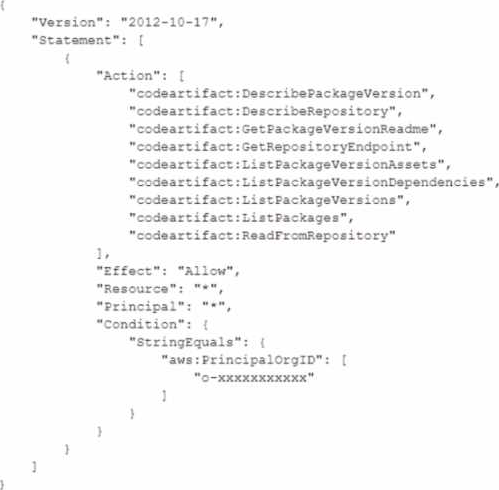
A development team is building a new project in an account that is in an organization in AWS Organizations. The development team wants to use a Python library that has already been stored in the CodeArtifact repository in the organization. The development team uses AWS CodePipeline and AWS CodeBuild to build the new application. The CodeBuild job that the development team uses to build the application is configured to run in a VPC Because of compliance requirements the VPC has no internet connectivity.
The development team creates the VPC endpoints for CodeArtifact and updates the CodeBuild buildspec yaml file. However, the development team cannot download the Python library from the repository.
Which combination of steps should a DevOps engineer take so that the development team can use Code Artifact? (Select TWO.)
- A . Create an Amazon S3 gateway endpoint Update the route tables for the subnets that are running the CodeBuild job.
- B . Update the repository policy’s Principal statement to include the ARN of the role that the CodeBuild project uses.
- C . Share the CodeArtifact repository with the organization by using AWS Resource Access Manager (AWS RAM).
- D . Update the role that the CodeBuild project uses so that the role has sufficient permissions to use the CodeArtifact repository.
- E . Specify the account that hosts the repository as the delegated administrator for CodeArtifact in the organization.
A DevOps engineer has created an AWS CloudFormation template that deploys an application on Amazon EC2 instances The EC2 instances run Amazon Linux The application is deployed to the EC2 instances by using shell scripts that contain user data. The EC2 instances have an 1AM instance profile that has an 1AM role with the AmazonSSMManagedlnstanceCore managed policy attached. The DevOps engineer has modified the user data in the CloudFormation template to install a new version of the application. The engineer has also applied the stack update. However, the application was not updated on the running EC2 instances. The engineer needs to ensure that the changes to the application are installed on the running EC2 instances.
Which combination of steps will meet these requirements? (Select TWO.)
- A . Configure the user data content to use the Multipurpose Internet Mail Extensions (MIME) multipart format. Set the scripts-user parameter to always in the text/cloud-config section.
- B . Refactor the user data commands to use the cfn-init helper script. Update the user data to install and configure the cfn-hup and cfn-mit helper scripts to monitor and apply the metadata changes
- C . Configure an EC2 launch template for the EC2 instances. Create a new EC2 Auto Scaling group. Associate the Auto Scaling group with the EC2 launch template Use the AutoScalingScheduledAction update policy for the Auto Scaling group.
- D . Refactor the user data commands to use an AWS Systems Manager document (SSM document). Add an AWS CLI command in the user data to use Systems Manager Run Command to apply the SSM document to the EC2 instances
- E . Refactor the user data command to use an AWS Systems Manager document (SSM document) Use Systems Manager State Manager to create an association between the SSM document and the EC2 instances.
A company has an application and a CI/CD pipeline. The CI/CD pipeline consists of an AWS CodePipeline pipeline and an AWS CodeBuild project. The CodeBuild project runs tests against the application as part of the build process and outputs a test report. The company must keep the test reports for 90 days.
Which solution will meet these requirements?
- A . Add a new stage in the CodePipeline pipeline after the stage that contains the CodeBuild project. Create an Amazon S3 bucket to store the reports. Configure an S3 deploy action type in the new CodePipeline stage with the appropriate path and format for the reports.
- B . Add a report group in the CodeBuild project buildspec file with the appropriate path and format for the reports. Create an Amazon S3 bucket to store the reports. Configure an Amazon EventBridge rule that invokes an AWS Lambda function to copy the reports to the S3 bucket when a build is completed. Create an S3 Lifecycle rule to expire the objects after 90 days.
- C . Add a new stage in the CodePipeline pipeline. Configure a test action type with the appropriate path and format for the reports. Configure the report expiration time to be 90 days in the CodeBuild project buildspec file.
- D . Add a report group in the CodeBuild project buildspec file with the appropriate path and format for the reports. Create an Amazon S3 bucket to store the reports. Configure the report group as an artifact in the CodeBuild project buildspec file. Configure the S3 bucket as the artifact destination. Set the object expiration to 90 days.
A company deploys updates to its Amazon API Gateway API several times a week by using an AWS CodePipeline pipeline. As part of the update process the company exports the JavaScript SDK for the API from the API. Gateway console and uploads the SDK to an Amazon S3 bucket.
The company has configured an Amazon CloudFront distribution that uses the S3 bucket as an origin Web client then download the SDK by using the CloudFront distribution’s endpoint. A DevOps engineer needs to implement a solution to make the new SDK available automatically during new API deployments.
Which solution will meet these requirements?
- A . Create a CodePipeline action immediately after the deployment stage of the API. Configure the action to invoke an AWS Lambda function. Configure the Lambda function to download the SDK from API Gateway, upload the SDK to the S3 bucket and create a CloudFront invalidation for the SDK path.
- B . Create a CodePipeline action immediately after the deployment stage of the API Configure the action to use the CodePipelme integration with API. Gateway to export the SDK to Amazon S3 Create another action that uses the CodePipeline integration with Amazon S3 to invalidate the cache for the SDK path.
- C . Create an Amazon EventBridge rule that reacts to UpdateStage events from aws apigateway Configure the rule to invoke an AWS Lambda function to download the SDK from API Gateway upload the SDK to the S3 bucket and call the CloudFront API to create an invalidation for the SDK path.
- D . Create an Amazon EventBridge rule that reacts to Create. Deployment events from aws apigateway. Configure the rule to invoke an AWS Lambda function to download the SDK from API. Gateway upload the SDK to the S3 bucket and call the S3 API to invalidate the cache for the SDK path.
A company has a guideline that every Amazon EC2 instance must be launched from an AMI that the company’s security team produces Every month the security team sends an email message with the latest approved AMIs to all the development teams.
The development teams use AWS CloudFormation to deploy their applications. When developers launch a new service they have to search their email for the latest AMIs that the security department sent. A DevOps engineer wants to automate the process that the security team uses to provide the AMI IDs to the development teams.
What is the MOST scalable solution that meets these requirements?
- A . Direct the security team to use CloudFormation to create new versions of the AMIs and to list! the AMI ARNs in an encrypted Amazon S3 object as part of the stack’s Outputs Section Instruct the developers to use a cross-stack reference to load the encrypted S3 object and obtain the most recent AMI ARNs.
- B . Direct the security team to use a CloudFormation stack to create an AWS CodePipeline pipeline that builds new AMIs and places the latest AMI ARNs in an encrypted Amazon S3 object as part of the pipeline output Instruct the developers to use a cross-stack reference within their own CloudFormation template to obtain the S3 object location and the most recent AMI ARNs.
- C . Direct the security team to use Amazon EC2 Image Builder to create new AMIs and to place the AMI ARNs as parameters in AWS Systems Manager Parameter Store Instruct the developers to specify a parameter of type SSM in their CloudFormation stack to obtain the most recent AMI ARNs from Parameter Store.
- D . Direct the security team to use Amazon EC2 Image Builder to create new AMIs and to create an Amazon Simple Notification Service (Amazon SNS) topic so that every development team can receive notifications. When the development teams receive a notification instruct them to write an AWS Lambda function that will update their CloudFormation stack with the most recent AMI ARNs.
A company recently deployed its web application on AWS. The company is preparing for a large-scale sales event and must ensure that the web application can scale to meet the demand.
The application’s frontend infrastructure includes an Amazon CloudFront distribution that has an Amazon S3 bucket as an origin. The backend infrastructure includes an Amazon API Gateway API. several AWS Lambda functions, and an Amazon Aurora DB cluster.
The company’s DevOps engineer conducts a load test and identifies that the Lambda functions can fulfill the peak number of requests However, the DevOps engineer notices request latency during the initial burst of requests Most of the requests to the Lambda functions produce queries to the database A large portion of the invocation time is used to establish database connections
Which combination of steps will provide the application with the required scalability? (Select TWO)
- A . Configure a higher reserved concurrency for the Lambda functions.
- B . Configure a higher provisioned concurrency for the Lambda functions
- C . Convert the DB cluster to an Aurora global database Add additional Aurora Replicas in AWS Regions based on the locations of the company’s customers.
- D . Refactor the Lambda Functions Move the code blocks that initialize database connections into the function handlers.
- E . Use Amazon RDS Proxy to create a proxy for the Aurora database Update the Lambda functions to use the proxy endpoints for database connections.
A company uses AWS Organizations to manage multiple accounts. Information security policies require that all unencrypted Amazon EBS volumes be marked as non-compliant. A DevOps engineer needs to automatically deploy the solution and ensure that this compliance check is always present.
Which solution will accomplish this?
- A . Create an AWS CloudFormation template that defines an AWS Inspector rule to check whether EBS encryption is enabled. Save the template to an Amazon S3 bucket that has been shared with all accounts within the company. Update the account creation script pointing to the CloudFormation template in Amazon S3.
- B . Create an AWS Config organizational rule to check whether EBS encryption is enabled and deploy the rule using the AWS CLI. Create and apply an SCP to prohibit stopping and deleting AWS Config across the organization.
- C . Create an SCP in Organizations. Set the policy to prevent the launch of Amazon EC2 instances without encryption on the EBS volumes using a conditional expression. Apply the SCP to all AWS accounts. Use Amazon Athena to analyze the AWS CloudTrail output, looking for events that deny an ec2: RunInstances action.
- D . Deploy an IAM role to all accounts from a single trusted account. Build a pipeline with AWS CodePipeline with a stage in AWS Lambda to assume the IAM role, and list all EBS volumes in the account. Publish a report to Amazon S3.
A DevOps engineer is creating an AWS CloudFormation template to deploy a web service. The web service will run on Amazon EC2 instances in a private subnet behind an Application Load Balancer (ALB). The DevOps engineer must ensure that the service can accept requests from clients that have IPv6 addresses.
What should the DevOps engineer do with the CloudFormation template so that IPv6 clients can access the web service?
- A . Add an IPv6 CIDR block to the VPC and the private subnet for the EC2 instances. Create route table entries for the IPv6 network, use EC2 instance types that support IPv6, and assign IPv6 addresses to each EC2 instance.
- B . Assign each EC2 instance an IPv6 Elastic IP address. Create a target group, and add the EC2 instances as targets. Create a listener on port 443 of the ALB, and associate the target group with the ALB.
- C . Replace the ALB with a Network Load Balancer (NLB). Add an IPv6 CIDR block to the VPC and subnets for the NLB, and assign the NLB an IPv6 Elastic IP address.
- D . Add an IPv6 CIDR block to the VPC and subnets for the ALB. Create a listener on port 443. and specify the dualstack IP address type on the ALB. Create a target group, and add the EC2 instances as targets. Associate the target group with the ALB.
A company is using AWS CodePipeline to deploy an application. According to a new guideline, a member of the company’s security team must sign off on any application changes before the changes are deployed into production. The approval must be recorded and retained.
Which combination of actions will meet these requirements? (Select TWO.)
- A . Configure CodePipeline to write actions to Amazon CloudWatch Logs.
- B . Configure CodePipeline to write actions to an Amazon S3 bucket at the end of each pipeline stage.
- C . Create an AWS CloudTrail trail to deliver logs to Amazon S3.
- D . Create a CodePipeline custom action to invoke an AWS Lambda function for approval. Create a policy that gives the security team access to manage CodePipeline custom actions.
- E . Create a CodePipeline manual approval action before the deployment step. Create a policy that grants the security team access to approve manual approval stages.
A company is hosting a web application in an AWS Region. For disaster recovery purposes, a second region is being used as a standby. Disaster recovery requirements state that session data must be replicated between regions in near-real time and 1% of requests should route to the secondary region to continuously verify system functionality. Additionally, if there is a disruption in service in the main region, traffic should be automatically routed to the secondary region, and the secondary region must be able to scale up to handle all traffic.
How should a DevOps engineer meet these requirements?
- A . In both regions, deploy the application on AWS Elastic Beanstalk and use Amazon DynamoDB global tables for session data. Use an Amazon Route 53 weighted routing policy with health checks to distribute the traffic across the regions.
- B . In both regions, launch the application in Auto Scaling groups and use DynamoDB for session data. Use a Route 53 failover routing policy with health checks to distribute the traffic across the regions.
- C . In both regions, deploy the application in AWS Lambda, exposed by Amazon API Gateway, and use Amazon RDS for PostgreSQL with cross-region replication for session data. Deploy the web application with client-side logic to call the API Gateway directly.
- D . In both regions, launch the application in Auto Scaling groups and use DynamoDB global tables for session data. Enable an Amazon CloudFront weighted distribution across regions. Point the Amazon Route 53 DNS record at the CloudFront distribution.