
Amazon DOP-C02 Practice Exams
Last updated on Oct 22,2026- Exam Code: DOP-C02
- Exam Name: AWS Certified DevOps Engineer - Professional
- Certification Provider: Amazon
- Latest update: Oct 22,2026
A company wants to deploy a workload on several hundred Amazon EC2 instances. The company will provision the EC2 instances in an Auto Scaling group by using a launch template.
The workload will pull files from an Amazon S3 bucket, process the data, and put the results into a different S3 bucket. The EC2 instances must have least-privilege permissions and must use temporary security credentials.
Which combination of steps will meet these requirements? (Select TWO.)
- A . Create an IAM role that has the appropriate permissions for S3 buckets. Add the IAM role to an instance profile.
- B . Update the launch template to include the IAM instance profile.
- C . Create an IAM user that has the appropriate permissions for Amazon S3. Generate a secret key and token.
- D . Create a trust anchor and profile. Attach the IAM role to the profile.
- E . Update the launch template. Modify the user data to use the new secret key and token.
A company runs an application on Amazon EC2 instances. The company uses a series of AWS CloudFormation stacks to define the application resources. A developer performs updates by building and testing the application on a laptop and then uploading the build output and CloudFormation stack templates to Amazon S3. The developer’s peers review the changes before the developer performs the CloudFormation stack update and installs a new version of the application onto the EC2 instances.
The deployment process is prone to errors and is time-consuming when the developer updates each EC2 instance with the new application. The company wants to automate as much of the application deployment process as possible while retaining a final manual approval step before the modification of the application or resources.
The company already has moved the source code for the application and the CloudFormation templates to AWS CodeCommit. The company also has created an AWS CodeBuild project to build and test the application.
Which combination of steps will meet the company’s requirements? (Choose two.)
- A . Create an application group and a deployment group in AWS CodeDeploy. Install the CodeDeploy agent on the EC2 instances.
- B . Create an application revision and a deployment group in AWS CodeDeploy. Create an environment in CodeDeploy. Register the EC2 instances to the CodeDeploy environment.
- C . Use AWS CodePipeline to invoke the CodeBuild job, run the CloudFormation update, and pause for a manual approval step. After approval, start the AWS CodeDeploy deployment.
- D . Use AWS CodePipeline to invoke the CodeBuild job, create CloudFormation change sets for each of the application stacks, and pause for a manual approval step. After approval, run the CloudFormation change sets and start the AWS CodeDeploy deployment.
- E . Use AWS CodePipeline to invoke the CodeBuild job, create CloudFormation change sets for each of the application stacks, and pause for a manual approval step. After approval, start the AWS CodeDeploy deployment.
A company is refactoring applications to use AWS. The company identifies an internal web application that needs to make Amazon S3 API calls in a specific AWS account.
The company wants to use its existing identity provider (IdP) auth.company.com for authentication. The IdP supports only OpenID Connect (OIDC). A DevOps engineer needs to secure the web application’s access to the AWS account.
Which combination of steps will meet these requirements? (Select THREE.)
- A . Configure AWS 1AM Identity Center. Configure an IdP. Upload the IdP metadata from the existing IdP.
- B . Create an 1AM IdP by using the provider URL, audience, and signature from the existing IdP.
- C . Create an 1AM role that has a policy that allows the necessary S3 actions. Configure the role’s trust policy to allow the OIDC IdP to assume the role if the sts.amazon.conraud context key is appid from idp.
- D . Create an 1AM role that has a policy that allows the necessary S3 actions. Configure the role’s trust policy to allow the OIDC IdP to assume the role if the auth.company.com:aud context key is appid_from_idp.
- E . Configure the web application lo use the AssumeRoleWith Web Identity API operation to retrieve temporary credentials. Use the temporary credentials to make the S3 API calls.
- F . Configure the web application to use the GetFederationToken API operation to retrieve temporary credentials Use the temporary credentials to make the S3 API calls.
A company has an application that stores data that includes personally Identifiable Information (Pll) In an Amazon S3 bucket All data Is encrypted with AWS Key Management Service (AWS KMS) customer managed keys. All AWS resources are deployed from an AWS Cloud Formation template. A DevOps engineer needs to set up a development environment for the application in a different AWS account. The data in the development environment’s S3 bucket needs to be updated once a week from the production environment’s S3 bucket.
The company must not move Pll from the production environment without anonymizmg the Pll first
The data in each environment must be encrypted with different KMS customer managed keys.
Which combination of steps should the DevOps engineer take to meet these requirements? (Select TWO)
- A . Activate Amazon Macie on the S3 bucket In the production account Create an AWS Step Functions state machine to initiate a discovery job and redact all Pll before copying files to the S3 bucket in the development account. Give the state machine tasks decrypt permissions on the KMS key in the production account. Give the state machine tasks encrypt permissions on the KMS key in the development account
- B . Set up S3 replication between the production S3 bucket and the development S3 bucket Activate Amazon Macie on the development S3 bucket Create an AWS Step Functions state machine to initiate a discovery job and redact all Pll as the files are copied to the development S3 bucket. Give the state machine tasks encrypt and decrypt permissions on the KMS key in the development account.
- C . Set up an S3 Batch Operations job to copy files from the production S3 bucket to the development S3 bucket. In the development account, configure an
AWS Lambda function to redact all Pll. Configure S3 Object Lambda to use the Lambda function for S3 GET requests Give the Lambda function’s 1AM role encrypt and decrypt permissions on the KMS key in the development account. - D . Create a development environment from the CloudFormatlon template in the development account. Schedule an Amazon EventBridge rule to start the AWS Step Functions state machine once a week
- E . Create a development environment from the CloudFormation template in the development account. Schedule a cron job on an Amazon EC2 instance to run once a week to start the S3 Batch Operations job.
A company is examining its disaster recovery capability and wants the ability to switch over its daily operations to a secondary AWS Region. The company uses AWS CodeCommit as a source control tool in the primary Region.
A DevOps engineer must provide the capability for the company to develop code in the secondary Region. If the company needs to use the secondary Region, developers can add an additional remote URL to their local Git configuration.
Which solution will meet these requirements?
- A . Create a CodeCommit repository in the secondary Region. Create an AWS CodeBuild project to perform a Git mirror operation of the primary Region’s CodeCommit repository to the secondary Region’s CodeCommit repository. Create an AWS Lambda function that invokes the CodeBuild project. Create an Amazon EventBridge rule that reacts to merge events in the primary Region’s CodeCommit repository. Configure the EventBridge rule to invoke the Lambda function.
- B . Create an Amazon S3 bucket in the secondary Region. Create an AWS Fargate task to perform a Git mirror operation of the primary Region’s CodeCommit repository and copy the result to the S3 bucket. Create an AWS Lambda function that initiates the Fargate task. Create an Amazon EventBridge rule that reacts to merge events in the CodeCommit repository. Configure the EventBridge rule to invoke the Lambda function.
- C . Create an AWS CodeArtifact repository in the secondary Region. Create an AWS CodePipeline pipeline that uses the primary Region’s CodeCommit repository for the source action. Create a Cross-Region stage in the pipeline that packages the CodeCommit repository contents and stores the contents in the CodeArtifact repository when a pull request is merged into the CodeCommit repository.
- D . Create an AWS Cloud9 environment and a CodeCommit repository in the secondary Region. Configure the primary Region’s CodeCommit repository as a remote repository in the AWS Cloud9 environment. Connect the secondary Region’s CodeCommit repository to the AWS Cloud9 environment.
A company uses an AWS CodeCommit repository to store its source code and corresponding unit tests. The company has configured an AWS CodePipeline pipeline that includes an AWS CodeBuild project that runs when code is merged to the main branch of the repository.
The company wants the CodeBuild project to run the unit tests. If the unit tests pass, the CodeBuild project must tag the most recent commit.
How should the company configure the CodeBuild project to meet these requirements?
- A . Configure the CodeBuild project to use native Git to clone the CodeCommit repository. Configure the project to run the unit tests. Configure the project to use native Git to create a tag and to push the Git tag to the repository if the code passes the unit tests.
- B . Configure the CodeBuild project to use native Git to clone the CodeCommit repository. Configure the project to run the unit tests. Configure the project to use AWS CLI commands to create a new repository tag in the repository if the code passes the unit tests.
- C . Configure the CodeBuild project to use AWS CLI commands to copy the code from the CodeCommit repository. Configure the project lo run the unit tests. Configure the project to use AWS CLI commands to create a new Git tag in the repository if the code passes the unit tests.
- D . Configure the CodeBuild project to use AWS CLI commands to copy the code from the CodeCommit repository. Configure the project to run the unit tests. Configure the project to use AWS CLI commands to create a new repository tag in the repository if the code passes the unit tests.
A company’s production environment uses an AWS CodeDeploy blue/green deployment to deploy an application. The deployment incudes Amazon EC2 Auto Scaling groups that launch instances that run Amazon Linux 2.
A working appspec. ymi file exists in the code repository and contains the following text.
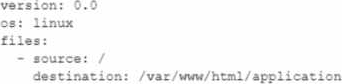
A DevOps engineer needs to ensure that a script downloads and installs a license file onto the instances before the replacement instances start to handle request traffic. The DevOps engineer adds a hooks section to the appspec. yml file.
Which hook should the DevOps engineer use to run the script that downloads and installs the license file?
- A . AfterBlockTraffic
- B . BeforeBlockTraffic
- C . Beforelnstall
- D . Down load Bundle
A company is building a new pipeline by using AWS CodePipeline and AWS CodeBuild in a build account. The pipeline consists of two stages. The first stage is a CodeBuild job to build and package an AWS Lambda function. The second stage consists of deployment actions that operate on two different AWS accounts a development environment account and a production environment account. The deployment stages use the AWS Cloud Format ion action that CodePipeline invokes to deploy the infrastructure that the Lambda function requires.
A DevOps engineer creates the CodePipeline pipeline and configures the pipeline to encrypt build artifacts by using the AWS Key Management Service (AWS KMS) AWS managed key for Amazon S3 (the aws/s3 key). The artifacts are stored in an S3 bucket When the pipeline runs, the Cloud Formation actions fail with an access denied error.
Which combination of actions must the DevOps engineer perform to resolve this error? (Select TWO.)
- A . Create an S3 bucket in each AWS account for the artifacts Allow the pipeline to write to the S3 buckets. Create a CodePipeline S3 action to copy the artifacts to the S3 bucket in each AWS account Update the CloudFormation actions to reference the artifacts S3 bucket in the production account.
- B . Create a customer managed KMS key Configure the KMS key policy to allow the IAM roles used by the CloudFormation action to perform decrypt operations Modify the pipeline to use the customer managed KMS key to encrypt artifacts.
- C . Create an AWS managed KMS key Configure the KMS key policy to allow the development account and the production account to perform decrypt operations. Modify the pipeline to use the KMS key to encrypt artifacts.
- D . In the development account and in the production account create an IAM role for CodePipeline. Configure the roles with permissions to perform CloudFormation operations and with permissions to retrieve and decrypt objects from the artifacts S3 bucket. In the CodePipeline account configure the CodePipeline CloudFormation action to use the roles.
- E . In the development account and in the production account create an IAM role for CodePipeline Configure the roles with permissions to perform CloudFormation operations and with permissions to retrieve and decrypt objects from the artifacts S3 bucket. In the CodePipelme account modify the artifacts S3 bucket policy to allow the roles access Configure the CodePipeline CloudFormation action to use the roles.
A company uses AWS Key Management Service (AWS KMS) keys and manual key rotation to meet regulatory compliance requirements. The security team wants to be notified when any keys have not been rotated after 90 days.
Which solution will accomplish this?
- A . Configure AWS KMS to publish to an Amazon Simple Notification Service (Amazon SNS) topic when keys are more than 90 days old.
- B . Configure an Amazon EventBridge event to launch an AWS Lambda function to call the AWS Trusted Advisor API and publish to an Amazon Simple Notification Service (Amazon SNS) topic.
- C . Develop an AWS Config custom rule that publishes to an Amazon Simple Notification Service (Amazon SNS) topic when keys are more than 90 days old.
- D . Configure AWS Security Hub to publish to an Amazon Simple Notification Service (Amazon SNS) topic when keys are more than 90 days old.
A DevOps engineer notices that all Amazon EC2 instances running behind an Application Load Balancer in an Auto Scaling group are failing to respond to user requests. The EC2 instances are also failing target group HTTP health checks
Upon inspection, the engineer notices the application process was not running in any EC2 instances. There are a significant number of out of memory messages in the system logs. The engineer needs to improve the resilience of the application to cope with a potential application memory leak.
Monitoring and notifications should be enabled to alert when there is an issue Which combination of actions will meet these requirements? (Select TWO.)
- A . Change the Auto Scaling configuration to replace the instances when they fail the load balancer’s health checks.
- B . Change the target group health check HealthChecklntervalSeconds parameter to reduce the interval between health checks.
- C . Change the target group health checks from HTTP to TCP to check if the port where the application is listening is reachable.
- D . Enable the available memory consumption metric within the Amazon CloudWatch dashboard for the entire Auto Scaling group Create an alarm when the memory utilization is high Associate an Amazon SNS topic to the alarm to receive notifications when the alarm goes off
- E . Use the Amazon CloudWatch agent to collect the memory utilization of the EC2 instances in the Auto Scaling group Create an alarm when the memory utilization is high and associate an Amazon SNS topic to receive a notification.