
Amazon DOP-C02 Practice Exams
Last updated on Oct 22,2026- Exam Code: DOP-C02
- Exam Name: AWS Certified DevOps Engineer - Professional
- Certification Provider: Amazon
- Latest update: Oct 22,2026
Which AWS service provides continuous compliance by evaluating configurations in AWS resources?
- A . AWS IAM
- B . AWS Config
- C . Amazon Inspector
- D . AWS Systems Manager
A company’s developers use Amazon EC2 instances as remote workstations. The company is concerned that users can create or modify EC2 security groups to allow unrestricted inbound access.
A DevOps engineer needs to develop a solution to detect when users create unrestricted security group rules. The solution must detect changes to security group rules in near real time, remove unrestricted rules, and send email notifications to the security team. The DevOps engineer has created an AWS Lambda function that checks for security group ID from input, removes rules that grant unrestricted access, and sends notifications through Amazon Simple Notification Service (Amazon SNS).
What should the DevOps engineer do next to meet the requirements?
- A . Configure the Lambda function to be invoked by the SNS topic. Create an AWS CloudTrail subscription for the SNS topic. Configure a subscription filter for security group modification events.
- B . Create an Amazon EventBridge scheduled rule to invoke the Lambda function. Define a schedule pattern that runs the Lambda function every hour.
- C . Create an Amazon EventBridge event rule that has the default event bus as the source. Define the rule’s event pattern to match EC2 security group creation and modification events. Configure the rule to invoke the Lambda function.
- D . Create an Amazon EventBridge custom event bus that subscribes to events from all AWS services. Configure the Lambda function to be invoked by the custom event bus.
A company has multiple AWS accounts. The company uses AWS IAM Identity Center (AWS Single Sign-On) that is integrated with AWS Toolkit for Microsoft Azure DevOps. The attributes for access control feature is enabled in IAM Identity Center.
The attribute mapping list contains two entries. The department key is mapped to ${path:enterprise.department}. The costCenter key is mapped to ${path:enterprise.costCenter}.
All existing Amazon EC2 instances have a department tag that corresponds to three company departments (d1, d2, d3). A DevOps engineer must create policies based on the matching attributes. The policies must minimize administrative effort and must grant each Azure AD user access to only the EC2 instances that are tagged with the user’s respective department name.
Which condition key should the DevOps engineer include in the custom permissions policies to meet these requirements?
A)
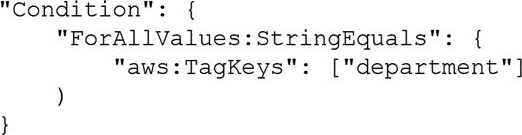
B)

C)

D)

- A . Option A
- B . Option B
- C . Option C
- D . Option D
A company runs applications on Windows and Linux Amazon EC2 instances. The instances run across multiple Availability Zones In an AWS Region. The company uses Auto Scaling groups for each application.
The company needs a durable storage solution for the instances. The solution must use SMB for Windows and must use NFS for Linux. The solution must also have sub-millisecond latencies. All instances will read and write the data.
Which combination of steps will meet these requirements? (Select THREE.)
- A . Create an Amazon Elastic File System (Amazon EFS) file system that has targets in multiple Availability Zones
- B . Create an Amazon FSx for NetApp ONTAP Multi-AZ file system.
- C . Create a General Purpose SSD (gp3) Amazon Elastic Block Store (Amazon EBS) volume to use for shared storage.
- D . Update the user data for each application’s launch template to mount the file system
- E . Perform an instance refresh on each Auto Scaling group.
- F . Update the EC2 instances for each application to mount the file system when new instances are launched
A company has many AWS accounts. During AWS account creation the company uses automation to create an Amazon CloudWatch Logs log group in every AWS Region that the company operates in. The automaton configures new resources in the accounts to publish logs to the provisioned log groups in their Region.
The company has created a logging account to centralize the logging from all the other accounts. A DevOps engineer needs to aggregate the log groups from all the accounts to an existing Amazon S3 bucket in the logging account.
Which solution will meet these requirements in the MOST operationally efficient manner?
- A . In the logging account create a CloudWatch Logs destination with a destination policy. For each new account subscribe the CloudWatch Logs log groups to the. Destination Configure a single Amazon Kinesis data stream and a single Amazon Kinesis Data Firehose delivery stream to deliver the logs from the CloudWatch Logs destination to the S3 bucket.
- B . In the logging account create a CloudWatch Logs destination with a destination policy for each Region. For each new account subscribe the CloudWatch Logs log groups to the destination. Configure a single Amazon Kinesis data stream and a single Amazon Kinesis Data Firehose delivery stream to deliver the logs from all the CloudWatch Logs destinations to the S3 bucket.
- C . In the logging account create a CloudWatch Logs destination with a destination policy for each Region. For each new account subscribe the CloudWatch Logs log groups to the destination Configure an Amazon Kinesis data stream and an Amazon Kinesis Data Firehose delivery stream for each Region to deliver the logs from the CloudWatch Logs destinations to the S3 bucket.
- D . In the logging account create a CloudWatch Logs destination with a destination policy. For each new account subscribe the CloudWatch Logs log groups to the destination. Configure a single Amazon Kinesis data stream to deliver the logs from the CloudWatch Logs destination to the S3
bucket.
A company uses AWS and has a VPC that contains critical compute infrastructure with predictable traffic patterns. The company has configured VPC flow logs that are published to a log group in Amazon CloudWatch Logs.
The company’s DevOps team needs to configure a monitoring solution for the VPC flow logs to identify anomalies in network traffic to the VPC over time. If the monitoring solution detects an anomaly, the company needs the ability to initiate a response to the anomaly.
How should the DevOps team configure the monitoring solution to meet these requirements?
- A . Create an Amazon Kinesis data stream. Subscribe the log group to the data stream. Configure Amazon Kinesis Data Analytics to detect log anomalies in the data stream. Create an AWS Lambda function to use as the output of the data stream. Configure the Lambda function to write to the default Amazon EventBridge event bus in the event of an anomaly finding.
- B . Create an Amazon Kinesis Data Firehose delivery stream that delivers events to an Amazon S3 bucket. Subscribe the log group to the delivery stream. Configure Amazon Lookout for Metrics to monitor the data in the S3 bucket for anomalies. Create an AWS Lambda function to run in response to Lookout for Metrics anomaly findings. Configure the Lambda function to publish to the default Amazon EventBridge event bus.
- C . Create an AWS Lambda function to detect anomalies. Configure the Lambda function to publish an event to the default Amazon EventBridge event bus if the Lambda function detects an anomaly. Subscribe the Lambda function to the log group.
- D . Create an Amazon Kinesis data stream. Subscribe the log group to the data stream. Create an AWS Lambda function to detect log anomalies. Configure the Lambda function to write to the default Amazon EventBridge event bus if the Lambda function detects an anomaly. Set the Lambda function as the processor for the data stream.
A company has containerized all of its in-house quality control applications. The company is running Jenkins on Amazon EC2 instances, which require patching and upgrading. The compliance officer has requested a DevOps engineer begin encrypting build artifacts since they contain company intellectual property.
What should the DevOps engineer do to accomplish this in the MOST maintainable manner?
- A . Automate patching and upgrading using AWS Systems Manager on EC2 instances and encrypt Amazon EBS volumes by default.
- B . Deploy Jenkins to an Amazon ECS cluster and copy build artifacts to an Amazon S3 bucket with default encryption enabled.
- C . Leverage AWS CodePipeline with a build action and encrypt the artifacts using AWS Secrets Manager.
- D . Use AWS CodeBuild with artifact encryption to replace the Jenkins instance running on EC2 instances.
A company uses an Amazon Aurora PostgreSQL global database that has two secondary AWS Regions. A DevOps engineer has configured the database parameter group to guarantee an RPO of 60 seconds. Write operations on the primary cluster are occasionally blocked because of the RPO setting.
The DevOps engineer needs to reduce the frequency of blocked write operations.
Which solution will meet these requirements?
- A . Add an additional secondary cluster to the global database.
- B . Enable write forwarding for the global database.
- C . Remove one of the secondary clusters from the global database.
- D . Configure synchronous replication for the global database.
A development team wants to use AWS CloudFormation stacks to deploy an application. However, the developer IAM role does not have the required permissions to provision the resources that are specified in the AWS CloudFormation template. A DevOps engineer needs to implement a solution that allows the developers to deploy the stacks. The solution must follow the principle of least privilege.
Which solution will meet these requirements?
- A . Create an IAM policy that allows the developers to provision the required resources. Attach the policy to the developer IAM role.
- B . Create an IAM policy that allows full access to AWS CloudFormation. Attach the policy to the developer IAM role.
- C . Create an AWS CloudFormation service role that has the required permissions. Grant the developer IAM role a cloudformation:* action. Use the new service role during stack deployments.
- D . Create an AWS CloudFormation service role that has the required permissions. Grant the developer IAM role the iam:PassRole permission. Use the new service role during stack deployments.
A company builds an application that uses an Application Load Balancer in front of Amazon EC2 instances that are in an Auto Scaling group. The application is stateless. The Auto Scaling group uses a custom AMI that is fully prebuilt. The EC2 instances do not have a custom bootstrapping process.
The AMI that the Auto Scaling group uses was recently deleted. The Auto Scaling group’s scaling activities show failures because the AMI ID does not exist.
Which combination of steps should a DevOps engineer take to meet these requirements? (Select THREE.)
- A . Create a new launch template that uses the new AMI.
- B . Update the Auto Scaling group to use the new launch template.
- C . Reduce the Auto Scaling group’s desired capacity to O.
- D . Increase the Auto Scaling group’s desired capacity by I.
- E . Create a new AMI from a running EC2 instance in the Auto Scaling group.
- F . Create a new AMI by copying the most recent public AMI of the operating system that the EC2 instances use.