
Amazon DOP-C02 Practice Exams
Last updated on Oct 22,2026- Exam Code: DOP-C02
- Exam Name: AWS Certified DevOps Engineer - Professional
- Certification Provider: Amazon
- Latest update: Oct 22,2026
A DevOps engineer is building a continuous deployment pipeline for a serverless application that uses AWS Lambda functions. The company wants to reduce the customer impact of an unsuccessful deployment. The company also wants to monitor for issues.
Which deploy stage configuration will meet these requirements?
- A . Use an AWS Serverless Application Model (AWS SAM) template to define the serverless application. Use AWS CodeDeploy to deploy the Lambda functions with the Canary10Percent15Minutes Deployment Preference Type. Use Amazon CloudWatch alarms to monitor the health of the functions.
- B . Use AWS CloudFormation to publish a new stack update, and include Amazon CloudWatch alarms on all resources. Set up an AWS CodePipeline approval action for a developer to verify and approve the AWS CloudFormation change set.
- C . Use AWS CloudFormation to publish a new version on every stack update, and include Amazon CloudWatch alarms on all resources. Use the RoutingConfig property of the AWS::Lambda::Alias resource to update the traffic routing during the stack update.
- D . Use AWS CodeBuild to add sample event payloads for testing to the Lambda functions. Publish a new version of the functions, and include Amazon CloudWatch alarms. Update the production alias to point to the new version. Configure rollbacks to occur when an alarm is in the ALARM state.
A company must encrypt all AMIs that the company shares across accounts. A DevOps engineer has access to a source account where an unencrypted custom AMI has been built. The DevOps engineer also has access to a target account where an Amazon EC2 Auto Scaling group will launch EC2 instances from the AMI. The DevOps engineer must share the AMI with the target account.
The company has created an AWS Key Management Service (AWS KMS) key in the source account.
Which additional steps should the DevOps engineer perform to meet the requirements? (Choose three.)
- A . In the source account, copy the unencrypted AMI to an encrypted AMI. Specify the KMS key in the copy action.
- B . In the source account, copy the unencrypted AMI to an encrypted AMI. Specify the default Amazon Elastic Block Store (Amazon EBS) encryption key in the copy action.
- C . In the source account, create a KMS grant that delegates permissions to the Auto Scaling group service-linked role in the target account.
- D . In the source account, modify the key policy to give the target account permissions to create a grant. In the target account, create a KMS grant that delegates permissions to the Auto Scaling group service-linked role.
- E . In the source account, share the unencrypted AMI with the target account.
- F . In the source account, share the encrypted AMI with the target account.
A company has an application that includes AWS Lambda functions. The Lambda functions run Python code that is stored in an AWS CodeCommit repository. The company has recently experienced failures in the production environment because of an error in the Python code. An engineer has written unit tests for the Lambda functions to help avoid releasing any future defects into the production environment.
The company’s DevOps team needs to implement a solution to integrate the unit tests into an existing AWS CodePipeline pipeline. The solution must produce reports about the unit tests for the company to view.
Which solution will meet these requirements?
- A . Associate the CodeCommit repository with Amazon CodeGuru Reviewer. Create a new AWS CodeBuild project. In the CodePipeline pipeline, configure a test stage that uses the new CodeBuild project. Create a buildspec.yml file in the CodeCommit repository. In the buildspec.yml file, define the actions to run a CodeGuru review.
- B . Create a new AWS CodeBuild project. In the CodePipeline pipeline, configure a test stage that uses the new CodeBuild project. Create a CodeBuild report group. Create a buildspec.yml file in the CodeCommit repository. In the buildspec.yml file, define the actions to run the unit tests with an output of JUNITXML in the build phase section. Configure the test reports to be uploaded to the new CodeBuild report group.
- C . Create a new AWS CodeArtifact repository. Create a new AWS CodeBuild project. In the CodePipeline pipeline, configure a test stage that uses the new CodeBuild project. Create an appspec.yml file in the original CodeCommit repository. In the appspec.yml file, define the actions to run the unit tests with an output of CUCUMBERJSON in the build phase section. Configure the tests reports to be sent to the new CodeArtifact repository.
- D . Create a new AWS CodeBuild project. In the CodePipeline pipeline, configure a test stage that uses the new CodeBuild project. Create a new Amazon S3 bucket. Create a buildspec.yml file in the CodeCommit repository. In the buildspec.yml file, define the actions to run the unit tests with an output of HTML in the phases section. In the reports section, upload the test reports to the S3 bucket.
A space exploration company receives telemetry data from multiple satellites. Small packets of data are received through Amazon API Gateway and are placed directly into an Amazon Simple Queue Service (Amazon SQS) standard queue. A custom application is subscribed to the queue and transforms the data into a standard format.
Because of inconsistencies in the data that the satellites produce, the application is occasionally unable to transform the data. In these cases, the messages remain in theSQS queue. A DevOps engineer must develop a solution that retains the failed messages and makes them available to scientists for review and future processing.
Which solution will meet these requirements?
- A . Configure AWS Lambda to poll the SQS queue and invoke a Lambda function to check whether the queue messages are valid. If validation fails, send a copy of the data that is not valid to an Amazon S3 bucket so that the scientists can review and correct the data. When the data is corrected, amend the message in the SQS queue by using a replay Lambda function with the corrected data.
- B . Convert the SQS standard queue to an SQS FIFO queue. Configure AWS Lambda to poll the SQS queue every 10 minutes by using an Amazon EventBridge schedule. Invoke the Lambda function to identify any messages with a SentTimestamp value that is older than 5 minutes, push the data to the same location as the application’s output location, and remove the messages from the queue.
- C . Create an SQS dead-letter queue. Modify the existing queue by including a redrive policy that sets the Maximum Receives setting to 1 and sets the dead-letter queue ARN to the ARN of the newly created queue. Instruct the scientists to use the dead-letter queue to review the data that is not valid. Reprocess this data at a later time.
- D . Configure API Gateway to send messages to different SQS virtual queues that are named for each of the satellites. Update the application to use a new virtual queue for any data that it cannot transform, and send the message to the new virtual queue. Instruct the scientists to use the virtual queue to review the data that is not valid. Reprocess this data at a later time.
A security review has identified that an AWS CodeBuild project is downloading a database population script from an Amazon S3 bucket using an unauthenticated request. The security team does not allow unauthenticated requests to S3 buckets for this project.
How can this issue be corrected in the MOST secure manner?
- A . Add the bucket name to the AllowedBuckets section of the CodeBuild project settings. Update the build spec to use the AWS CLI to download the database population script.
- B . Modify the S3 bucket settings to enable HTTPS basic authentication and specify a token. Update the build spec to use cURL to pass the token and download the database population script.
- C . Remove unauthenticated access from the S3 bucket with a bucket policy. Modify the service role for the CodeBuild project to include Amazon S3 access. Use the AWS CLI to download the database population script.
- D . Remove unauthenticated access from the S3 bucket with a bucket policy. Use the AWS CLI to download the database population script using an IAM access key and a secret access key.
A company has an organization in AWS Organizations. A DevOps engineer needs to maintain multiple AWS accounts that belong to different OUs in the organization. All resources, including 1AM policies and Amazon S3 policies within an account, are deployed through AWS CloudFormation. All templates and code are maintained in an AWS CodeCommit repository Recently, some developers have not been able to access an S3 bucket from some accounts in the organization.
The following policy is attached to the S3 bucket.
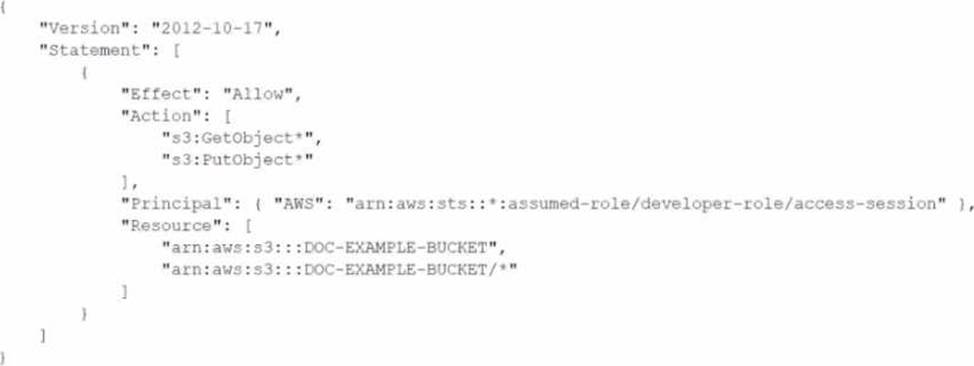
What should the DevOps engineer do to resolve this access issue?
- A . Modify the S3 bucket policy Turn off the S3 Block Public Access setting on the S3 bucket In the S3 policy, add the awsSourceAccount condition. Add the AWS account IDs of all developers who are experiencing the issue.
- B . Verify that no 1AM permissions boundaries are denying developers access to the S3 bucket Make the necessary changes to IAM permissions boundaries. Use an AWS Config recorder in the individual developer accounts that are experiencing the issue to revert any changes that are blocking access.
Commit the fix back into the CodeCommit repository. Invoke deployment through Cloud Formation to apply the changes. - C . Configure an SCP that stops anyone from modifying 1AM resources in developer OUs. In the S3 policy, add the awsSourceAccount condition. Add the AWS account IDs of all developers who are experiencing the issue Commit the fix back into the CodeCommit repository Invoke deployment through CloudFormation to apply the changes
- D . Ensure that no SCP is blocking access for developers to the S3 bucket Ensure that no 1AM policy permissions boundaries are denying access to developer 1AM users Make the necessary changes to the SCP and 1AM policy permissions boundaries in the CodeCommit repository Invoke deployment through CloudFormation to apply the changes
A highly regulated company has a policy that DevOps engineers should not log in to their Amazon EC2 instances except in emergencies. It a DevOps engineer does log in the security team must be notified within 15 minutes of the occurrence.
Which solution will meet these requirements?
- A . Install the Amazon Inspector agent on each EC2 instance Subscribe to Amazon EventBridge notifications Invoke an AWS Lambda function to check if a message is about user logins If it is send a notification to the security team using Amazon SNS.
- B . Install the Amazon CloudWatch agent on each EC2 instance Configure the agent to push all logs to Amazon CloudWatch Logs and set up a CloudWatch metric filter that searches for user logins. If a login is found send a notification to the security team using Amazon SNS.
- C . Set up AWS CloudTrail with Amazon CloudWatch Logs. Subscribe CloudWatch Logs to Amazon Kinesis Attach AWS Lambda to Kinesis to parse and determine if a log contains a user login If it does, send a notification to the security team using Amazon SNS.
- D . Set up a script on each Amazon EC2 instance to push all logs to Amazon S3 Set up an S3 event to invoke an AWS Lambda function which invokes an Amazon Athena query to run. The Athena query checks tor logins and sends the output to the security team using Amazon SNS.
A company hosts applications in its AWS account Each application logs to an individual Amazon CloudWatch log group. The company’s CloudWatch costs for ingestion are increasing
A DevOps engineer needs to Identify which applications are the source of the increased logging costs.
Which solution Will meet these requirements?
- A . Use CloudWatch metrics to create a custom expression that Identifies the CloudWatch log groups that have the most data being written to them.
- B . Use CloudWatch Logs Insights to create a set of queries for the application log groups to Identify the number of logs written for a period of time
- C . Use AWS Cost Explorer to generate a cost report that details the cost for CloudWatch usage
- D . Use AWS CloudTrail to filter for CreateLogStream events for each application
A company has configured Amazon RDS storage autoscaling for its RDS DB instances. A DevOps team needs to visualize the autoscaling events on an Amazon CloudWatch dashboard.
Which solution will meet this requirement?
- A . Create an Amazon EventBridge rule that reacts to RDS storage autoscaling events from RDS events. Create an AWS Lambda function that publishes a CloudWatch custom metric. Configure the EventBridge rule to invoke the Lambda function. Visualize the custom metric by using the CloudWatch dashboard.
- B . Create a trail by using AWS CloudTrail with management events configured. Configure the trail to send the management events to Amazon CloudWatch Logs. Create a metric filter in CloudWatch Logs to match the RDS storage autoscaling events. Visualize the metric filter by using the CloudWatch dashboard.
- C . Create an Amazon EventBridge rule that reacts to RDS storage autoscaling events (rom the RDS events. Create a CloudWatch alarm. Configure the EventBridge rule to change the status of the CloudWatch alarm. Visualize the alarm status by using the CloudWatch dashboard.
- D . Create a trail by using AWS CloudTrail with data events configured. Configure the trail to send the data events to Amazon CloudWatch Logs. Create a metric filter in CloudWatch Logs to match the RDS storage autoscaling events. Visualize the metric filter by using the CloudWatch dashboard.
A DevOps engineer manages a web application that runs on Amazon EC2 instances behind an Application Load Balancer (ALB). The instances run in an EC2 Auto Scaling group across multiple Availability Zones.
The engineer needs to implement a deployment strategy that:
Launches a second fleet of instances with the same capacity as the original fleet.
Maintains the original fleet unchanged while the second fleet is launched.
Transitions traffic to the second fleet when the second fleet is fully deployed.
Terminates the original fleet automatically 1 hour after transition.
Which solution will satisfy these requirements?
- A . Use an AWS CloudFormation template with a retention policy for the ALB set to 1 hour. Update the Amazon Route 53 record to reflect the new ALB.
- B . Use two AWS Elastic Beanstalk environments to perform a blue/green deployment from the original environment to the new one. Create an application version lifecycle policy to terminate the original environment in 1 hour.
- C . Use AWS CodeDeploy with a deployment group configured with a blue/green deployment configuration Select the option Terminate the original instances in the deployment group with a waiting period of 1 hour.
- D . Use AWS Elastic Beanstalk with the configuration set to Immutable. Create an .ebextension using the Resources key that sets the deletion policy of the ALB to 1 hour, and deploy the application.