
CIPS L6M1 Practice Exams
Last updated on Oct 21,2026- Exam Code: L6M1
- Exam Name: Strategic Ethical Leadership
- Certification Provider: CIPS
- Latest update: Oct 21,2026
SIMULATION
What is strategic sourcing (10 marks) and what factors can influence this? (15 marks)
Strategic sourcing is a systematic and proactive approach to procurement that focuses on aligning purchasing decisions with an organization’s long-term goals to maximize value, reduce costs, and mitigate risks. In the context of the CIPS L5M4 Advanced Contract and Financial Management study guide, strategic sourcing goes beyond transactional buying to build supplier relationships and optimize the supply chain for financial and operational efficiency. Below is a step-by-step explanation:
Definition:
Strategic sourcing involves analyzing an organization’s spending, identifying sourcing opportunities, selecting suppliers, and managing relationships to achieve strategic objectives. It emphasizes value creation over simply minimizing costs.
Purpose:
Aims to ensure supply chain reliability, improve quality, and deliver financial benefits like cost savings or ROI.
Example: A company uses strategic sourcing to consolidate suppliers, reducing procurement costs by 15%.
Part 2: What Factors Can Influence Strategic Sourcing? (15 marks)
Several internal and external factors can impact the strategic sourcing process, affecting how an organization approaches supplier selection and contract management. Below are five key factors: Market Conditions:
Economic trends, such as inflation or supply shortages, influence supplier pricing and availability.
Example: A rise in raw material costs may force a shift to alternative suppliers.
Organizational Goals and Strategy:
The company’s priorities (e.g., sustainability, cost leadership) shape sourcing decisions.
Example: A focus on green initiatives may prioritize suppliers with eco-friendly practices.
Supplier Capabilities and Performance:
The supplier’s ability to meet quality, delivery, and innovation requirements affects selection.
Example: A supplier with a poor track record for on-time delivery may be excluded. Regulatory and Compliance Requirements:
Legal or industry standards (e.g., safety, environmental regulations) dictate sourcing choices.
Example: Sourcing must comply with EU REACH regulations for chemical suppliers.
Technology and Innovation:
Advances in technology (e.g., automation, data analytics) can change sourcing strategies by enabling better supplier evaluation or collaboration.
Example: Using AI to analyze supplier performance data for better decision-making.
Exact Extract Explanation
Part 1: What is Strategic Sourcing?
The CIPS L5M4 Advanced Contract and Financial Management study guide defines strategic sourcing
as "a structured process to optimize an organization’s supply base and improve the overall value
proposition." It is positioned as a key procurement strategy that integrates financial management
principles, such as cost optimization and risk mitigation, with long-term business objectives. The
guide emphasizes that strategic sourcing is not just about cost reduction but about "delivering
sustainable value" through supplier partnerships.
Detailed Explanation
The guide outlines that strategic sourcing involves steps like spend analysis, market research, supplier evaluation, and contract negotiation. For example, a company might analyze its spending on raw materials, identify over-reliance on a single supplier, and strategically diversify to reduce risk.
It aligns with L5M4’s focus on value for money by ensuring procurement decisions support broader goals, such as quality improvement or innovation. Strategic sourcing also fosters collaboration, as seen in practices like Early Supplier Involvement (Question 8).
Part 2: Factors Influencing Strategic Sourcing
The study guide discusses various influences on sourcing strategies, particularly in the context of supplier selection and contract management, emphasizing the need to adapt to internal and external dynamics.
Factors Explained:
Market Conditions:
The guide highlights that "external market forces" like commodity price volatility or supply chain disruptions (e.g., post-COVID shortages) impact sourcing. A buyer might need to source locally if global supply chains are unstable, affecting cost and lead times. Organizational Goals and Strategy:
Chapter 2 notes that sourcing must "align with corporate objectives." For instance, if a company prioritizes sustainability (a strategic goal), it may source from suppliers with low carbon footprints, even if they’re costlier.
Supplier Capabilities and Performance:
The guide stresses evaluating "supplier suitability" based on quality, reliability, and innovation capacity (as in Question 2). A supplier unable to scale production might be unsuitable for a growing business.
Regulatory and Compliance Requirements:
L5M4’s risk management section underscores the need to comply with "legal and regulatory frameworks." For example, sourcing electronics components must meet RoHS standards, limiting supplier options.
Technology and Innovation:
The guide recognizes that "technological advancements" enable better sourcing decisions. Tools like
e-procurement platforms or data analytics (e.g., for spend analysis) help identify cost-saving
opportunities or high-performing suppliers.
Practical Application:
For XYZ Ltd (Question 7), strategic sourcing might involve selecting a raw material supplier based on cost, quality, and sustainability. Market conditions (e.g., steel price hikes) might push them to local suppliers, while a strategic goal of reducing emissions influences them to choose a supplier with green certifications. Supplier performance (e.g., 98% on-time delivery), compliance with safety regulations, and the use of tech for supplier evaluation would further shape their approach. Broader Implications:
The guide advises that these factors are interconnected―e.g., market conditions might force a reassessment of organizational goals. A balanced sourcing strategy considers all factors to mitigate risks and maximize value, aligning with L5M4’s financial and operational focus.
Regular reviews of these factors ensure sourcing remains adaptive, such as shifting suppliers if new regulations emerge or technology improves.
Reference: CIPS L5M4 Study Guide, Chapter 2: Performance Management in Contracts, Section on Strategic Procurement and Sourcing.
Additional
Reference: Chapter 4: Financial Management in Contracts, Section on Risk Management and Value Optimization.
SIMULATION
Discuss the difference between mentoring and coaching. As well as mentoring and coaching, what other activities are completed by a manager? What skills does this require? (25 points)
Both mentoring and coaching are essential for employee development, but they serve different purposes. Below is a structured comparison:
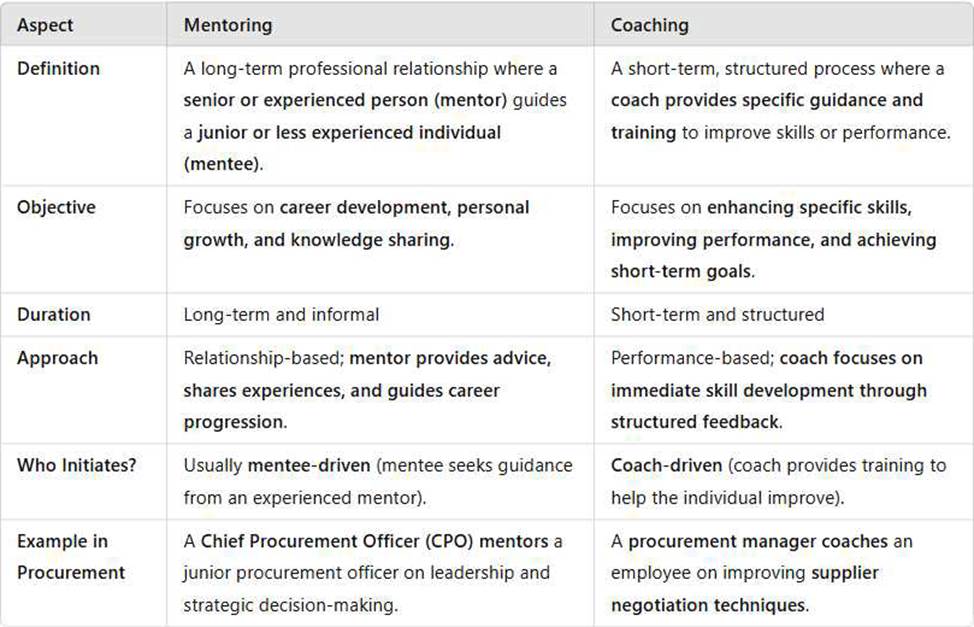
Key Takeaways:
Mentoring is long-term, relationship-driven, and focused on personal/career development.
Coaching is short-term, performance-driven, and focused on specific skill enhancement.
(B) Other Activities Completed by a Manager (10 Points)
Apart from mentoring and coaching, managers in procurement and supply chain roles perform several key functions, including:
Strategic Planning and Decision-Making (2 Points)
Managers align procurement strategies with business goals, ensuring cost savings, risk management, and supplier selection.
Example: Deciding whether to source locally or internationally based on cost, lead time, and risk factors.
Performance Management & Employee Development (2 Points)
Managers conduct performance reviews, set KPIs, and ensure employees meet procurement objectives.
Example: Monitoring contract compliance and assessing supplier delivery performance.
Supplier and Stakeholder Relationship Management (2 Points)
Managers negotiate contracts, build relationships with suppliers, and collaborate with internal stakeholders.
Example: Engaging in supplier development programs to improve quality and efficiency.
Problem-Solving and Conflict Resolution (2 Points)
Managers handle supplier disputes, contract issues, and logistical challenges in procurement operations.
Example: Managing disputes with suppliers over late deliveries or non-compliance.
Compliance and Ethical Procurement Practices (2 Points)
Managers ensure adherence to procurement regulations, ethical sourcing policies, and sustainability goals.
Example: Implementing an anti-bribery and corruption policy in procurement operations.
(C) Skills Required for These Activities (5 Points)
To successfully carry out these responsibilities, a manager needs the following key skills:
Leadership & People Management (1 Point)
Ability to motivate, mentor, and coach employees while fostering a productive work environment. Negotiation & Communication (1 Point)
Strong skills to negotiate contracts, resolve supplier disputes, and manage stakeholder expectations. Strategic Thinking & Decision-Making (1 Point)
Capability to analyze procurement data and make informed strategic decisions to reduce costs and risks.
Problem-Solving & Conflict Resolution (1 Point)
Skill in addressing supply chain disruptions, supplier conflicts, and operational inefficiencies.
Ethical and Compliance Knowledge (1 Point)
Understanding of procurement laws, ethical sourcing, and corporate governance.
SIMULATION
Discuss the difference between mentoring and coaching. As well as mentoring and coaching, what other activities are completed by a manager? What skills does this require? (25 points)
Both mentoring and coaching are essential for employee development, but they serve different purposes. Below is a structured comparison:
Key Takeaways:
Mentoring is long-term, relationship-driven, and focused on personal/career development.
Coaching is short-term, performance-driven, and focused on specific skill enhancement.
(B) Other Activities Completed by a Manager (10 Points)
Apart from mentoring and coaching, managers in procurement and supply chain roles perform several key functions, including:
Strategic Planning and Decision-Making (2 Points)
Managers align procurement strategies with business goals, ensuring cost savings, risk management, and supplier selection.
Example: Deciding whether to source locally or internationally based on cost, lead time, and risk factors.
Performance Management & Employee Development (2 Points)
Managers conduct performance reviews, set KPIs, and ensure employees meet procurement objectives.
Example: Monitoring contract compliance and assessing supplier delivery performance.
Supplier and Stakeholder Relationship Management (2 Points)
Managers negotiate contracts, build relationships with suppliers, and collaborate with internal stakeholders.
Example: Engaging in supplier development programs to improve quality and efficiency.
Problem-Solving and Conflict Resolution (2 Points)
Managers handle supplier disputes, contract issues, and logistical challenges in procurement operations.
Example: Managing disputes with suppliers over late deliveries or non-compliance.
Compliance and Ethical Procurement Practices (2 Points)
Managers ensure adherence to procurement regulations, ethical sourcing policies, and sustainability goals.
Example: Implementing an anti-bribery and corruption policy in procurement operations.
(C) Skills Required for These Activities (5 Points)
To successfully carry out these responsibilities, a manager needs the following key skills:
Leadership & People Management (1 Point)
Ability to motivate, mentor, and coach employees while fostering a productive work environment. Negotiation & Communication (1 Point)
Strong skills to negotiate contracts, resolve supplier disputes, and manage stakeholder expectations. Strategic Thinking & Decision-Making (1 Point)
Capability to analyze procurement data and make informed strategic decisions to reduce costs and risks.
Problem-Solving & Conflict Resolution (1 Point)
Skill in addressing supply chain disruptions, supplier conflicts, and operational inefficiencies.
Ethical and Compliance Knowledge (1 Point)
Understanding of procurement laws, ethical sourcing, and corporate governance.
SIMULATION
Zoe has recently formed a cross-functional team to work on a new secret project called Project X. There are 8 members of Project X and these members have different ages, cultural backgrounds, lengths of service at the company and personalities.
Discuss 5 reasons why teams can fail, relating these to potential issues Zoe may face with her team, and discuss ways Zoe can overcome them. (25 points)
Cross-functional teams, such as Zoe’s Project X team, bring together diverse skills, perspectives, and experiences. While this diversity can foster innovation, it also presents challenges that can lead to team failure if not managed properly. Below are five key reasons why teams fail, how these issues may arise in Project X, and how Zoe can overcome them.